Important Details
IJCRT - International Peer Reviewed, Open Access Journal, Multidisciplinary, Monthly, Nominal(Low) Fees for Professional Research Services International Journal of Creative Research Thoughts - IJCRT Peer Review Journal, Refereed Journal, Peer Reviewed Journal , Referred Journal and Indexed Journal, Open access, Online and Print Journal,international Journal Open Access, Accepted by Indian and foreign university ,IJCRT Followed Norms, guidelines, requirement, listing criteria and methodology of score/point also applied from: Scopus , Web of Science , UGC Approved , UGC CARE, UGC-CARE .
UGC Approved Journal No: 49023 (18)
UGC approval Link
https://ijcrt.org/ugc%20approval.jpg
All Policy and Approval
Please Like Our Facebook Page | CrossRef DOI and Hard copy of Certificate Provide if required. | www.IJCRT.org | editor@IJCRT.org | IJCRT WhatsApp +91 7990172303
Publication Details:
- Paper Submission : 30-Jun-2026. Call For Paper (Volume 14 | Issue 6 | Month- June 2026)
- Acceptance/Rejection Notification: Within 02-04 Days.
- Paper Publish: Within 02-04 Days after submitting all documents.
-
Submit Your Paper Any time There No deadline.
-
Publication fees : 1570 INR for Indian author & 59$ for foreign International author.
Please Like Our Facebook Page | CrossRef DOI and Hard copy of Certificate Provide if required.
Licence and Indexing
Indexing In Google Scholar, SSRN, ResearcherID-Publons, Semantic Scholar | AI-Powered Research Tool, Microsoft Academic, Academia.edu, arXiv.org, Research Gate, CiteSeerX, ResearcherID Thomson Reuters, Mendeley : reference manager, DocStoc, ISSUU, Scribd, and many more | High Impact Factor: 7.97 | Digital object identifier (DOI) and Hard Copy of certificate Provided.




























Licence
DOI
ISSN Approved impact factor: 7.97 
Creative Common 
Valid as per new UGC Gazette regulations 

INTERNATIONAL JOURNAL OF CREATIVE RESEARCH THOUGHTS - IJCRT (IJCRT.ORG)
International Peer Reviewed & Refereed Journals, Open Access Journal
IJCRT Peer-Reviewed (Refereed) Journal as Per New UGC Rules.
ISSN Approved Journal No: 2320-2882 | Impact factor: 7.97 | ESTD Year: 2013
Call For Paper - Volume 14 | Issue 6 | Month- June 2026
Scholarly open access journals, Peer-reviewed, and Refereed Journals, Impact factor 7.97 (Calculate by google scholar and Semantic Scholar | AI-Powered Research Tool) , Multidisciplinary, Monthly, Indexing in all major database & Metadata, Citation Generator, Digital Object Identifier(CrossRef DOI)
IJCRT WhatsApp Contact
IJCRT Search Xplore - Search all paper by Paper Name , Author Name, and Title
Volume 13 | Issue 8 |
Volume 13 | Issue 8 | Month
Downlaod After Publication 1) Table of content index in PDF
2) Table of content index in HTML 2)Table of content index in HTML
3) Front Page 3) Front Page
4) Back Page 4) Back Page
5) Editor Board Member 5)Editor Board Member
6) OLD Style Issue 6)OLD Style Issue
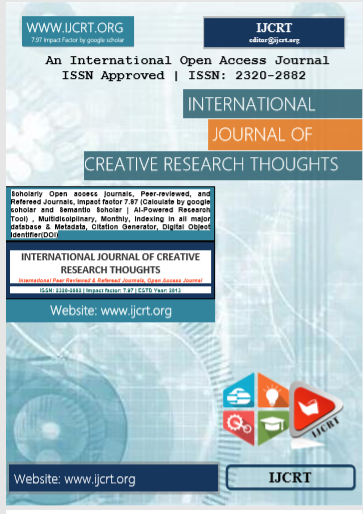 |
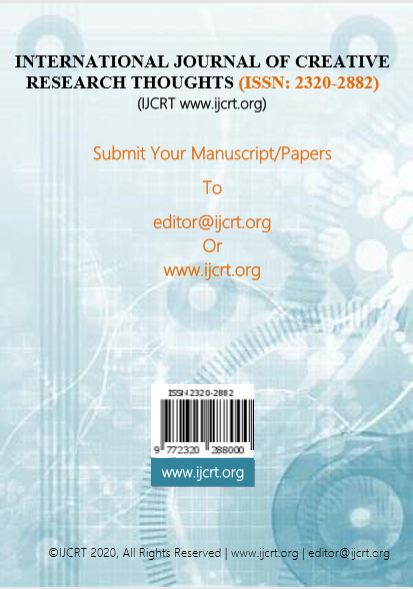 |
|---|---|
| IJCRT Journal front page | IJCRT Journal Back Page |
Paper Title: Tali to 'Pechan' Me Hijra Me Laxmi: 'Everyday Resistance' and Negotiating Gender(ed) Identity
Author Name(s): Ms Devarshi Modi, Prof. Jagdish S. Joshi
Published Paper ID: - IJCRT2508051
Register Paper ID - 292020
Publisher Journal Name: IJPUBLICATION, IJCRT
DOI Member ID: 10.6084/m9.doi.one.IJCRT2508051 and DOI : https://doi.org/10.56975/ijcrt.v13i8.292020
Author Country : Indian Author, India, 382026 , Gandhinagar, Gujarat , 382026 , | Research Area: Arts All Published Paper URL: http://ijcrt.org/viewfull.php?&p_id=IJCRT2508051 Published Paper PDF: download.php?file=IJCRT2508051 Published Paper PDF: http://www.ijcrt.org/papers/IJCRT2508051.pdf
Your Paper Publication Details:
Title: TALI TO 'PECHAN' ME HIJRA ME LAXMI: 'EVERYDAY RESISTANCE' AND NEGOTIATING GENDER(ED) IDENTITY
DOI (Digital Object Identifier) : https://doi.org/10.56975/ijcrt.v13i8.292020
Pubished in Volume: 13 | Issue: 8 | Year: August 2025
Publisher Name : IJCRT | www.ijcrt.org | ISSN : 2320-2882
Subject Area: Arts All
Author type: Indian Author
Pubished in Volume: 13
Issue: 8
Pages: a427-a434
Year: August 2025
Downloads: 243
E-ISSN Number: 2320-2882
Abstract
The present paper examines Everyday Resistance and Gender(ed) struggle of renowned transgender person of India Laxami Tripathi as accounted in her autobiography Me Laxami Me Hijra, originally written in Marathi and translated into English by R Raj Rao. The paper underscores the critical significance of Everyday livelihood and struggles of Transgenders combining insights from Transgender theoretical framework. Standing upon the recent research that re-evaluate transgender discourses through an encounter with Gender theory, this paper argues that Everyday challenges and elision of sexual and gender non-normative character. This paper extends the projection of transgender across the trans-national / trans-disciplinary academic framework, addressing the everyday negotiation with the heteronormative society. The paper has used Gende Performativity and Intersectionality as a theoretical framework and delineates the everyday struggle of Transgender individuals represented through autobiographical accounts. The paper will ruminate on the social space and habitus theory propounded by Bourdieu in the light of the selected primary source.
Licence: creative commons attribution 4.0
License
Creative Commons Attribution 4.0 and The Open Definition

Keywords
Gender Performance, Queer, Transgender, Autobiography, Everyday Culture
License
Creative Commons Attribution 4.0 and The Open Definition
Paper Title: CHITOSAN-BASED HYDROGELS FOR CHRONIC WOUND HEALING
Author Name(s): Nava Dharsha R, Dr Karpagam P, Thogai Shri M
Published Paper ID: - IJCRT2508050
Register Paper ID - 291444
Publisher Journal Name: IJPUBLICATION, IJCRT
DOI Member ID: 10.6084/m9.doi.one.IJCRT2508050 and DOI : https://doi.org/10.56975/ijcrt.v13i8.291444
Author Country : Indian Author, India, 641014 , Coimbatore, 641014 , | Research Area: Biological Science Published Paper URL: http://ijcrt.org/viewfull.php?&p_id=IJCRT2508050 Published Paper PDF: download.php?file=IJCRT2508050 Published Paper PDF: http://www.ijcrt.org/papers/IJCRT2508050.pdf
Your Paper Publication Details:
Title: CHITOSAN-BASED HYDROGELS FOR CHRONIC WOUND HEALING
DOI (Digital Object Identifier) : https://doi.org/10.56975/ijcrt.v13i8.291444
Pubished in Volume: 13 | Issue: 8 | Year: August 2025
Publisher Name : IJCRT | www.ijcrt.org | ISSN : 2320-2882
Subject Area: Biological Science
Author type: Indian Author
Pubished in Volume: 13
Issue: 8
Pages: a420-a426
Year: August 2025
Downloads: 314
E-ISSN Number: 2320-2882
Abstract
Abstract: The process of wound healing is intricate and requires a synchronized reaction from numerous cell types and growth factors to quickly restore the structure and functionality of the skin. Even though there are now several hydrogel-based dressings available, the aging population urgently needs innovative wound care treatment options to handle the increasing incidence of severe acute, and chronic wounds. Chitosan based hydrogels are considered to be the most effective substances for improving wound healing because of their haemostatic, biologically adhesive, biodegradable, biocompatible, non-toxic, and antibacterial properties. In addition, these hydrogels have a variety of biochemical properties that aid in wound healing, such as conductivity, temperature-dependent drug releasability, anti-infection, antioxidation, and good self-healing qualities. The preparation of chitosan-based hydrogels and their properties are summarized.
Licence: creative commons attribution 4.0
License
Creative Commons Attribution 4.0 and The Open Definition
Keywords
Chitosan, Hydrogel based Dressings, Chronic wounds
License
Creative Commons Attribution 4.0 and The Open Definition
Paper Title: Formulation And Evaluation Of Anti-rodent Gel By Using Gliricidia sepium
Author Name(s): Ms Dipika Sampat Unde, Ms Rutuja Vijay Chaudhari, Ms Minaj Jakirhusen Shaikh, Mrs Archana S Kadam
Published Paper ID: - IJCRT2508049
Register Paper ID - 292019
Publisher Journal Name: IJPUBLICATION, IJCRT
DOI Member ID: 10.6084/m9.doi.one.IJCRT2508049 and DOI :
Author Country : Indian Author, India, 413737 , Babhleshwar, 413737 , | Research Area: Pharmacy All Published Paper URL: http://ijcrt.org/viewfull.php?&p_id=IJCRT2508049 Published Paper PDF: download.php?file=IJCRT2508049 Published Paper PDF: http://www.ijcrt.org/papers/IJCRT2508049.pdf
Your Paper Publication Details:
Title: FORMULATION AND EVALUATION OF ANTI-RODENT GEL BY USING GLIRICIDIA SEPIUM
DOI (Digital Object Identifier) :
Pubished in Volume: 13 | Issue: 8 | Year: August 2025
Publisher Name : IJCRT | www.ijcrt.org | ISSN : 2320-2882
Subject Area: Pharmacy All
Author type: Indian Author
Pubished in Volume: 13
Issue: 8
Pages: a407-a419
Year: August 2025
Downloads: 217
E-ISSN Number: 2320-2882
Abstract
Rodent infestations pose a significant threat to food security, public health, and infrastructure across various sectors. Traditional rodenticides, while effective, have raised concerns due to their environmental impact and the development of resistance in rodent populations. This study explores the formulation and evaluation of an eco-friendly, plant-based anti-rodent compound utilizing readily available natural ingredients. The primary objective was to develop a biodegradable, non-toxic repellent that effectively deters rodent activity in storage and residential areas. Rodent infestations pose a major challenge to agriculture, public health, and urban environments. Traditional rodenticides, while effective, often contain harsh chemicals that harm ecosystems and non-target species. This study introduces a more sustainable approach--an anti-rodent gel formulated using Gliricidia sepium, a plant known for its natural toxicity. By combining Gliricidia sepium extract with phosphorus and coumarin, the gel delivers targeted action against rodents while minimizing environmental risks. Developed with a sodium alginate base and enhanced for stability, the gel exhibited excellent physical properties, including ideal balance, spreadability, and homogeneity. Early tests confirmed its potent anti-rodent effects. With its promising results, this herbal gel offers a safer, eco-friendly alternative to conventional rodenticides, paving the way for sustainable and responsible pest Physicochemical analysis of the formulation confirmed its non-toxic nature and compatibility with standard packaging and storage materials. The results suggest that this plant-based compound offers a sustainable alternative to conventional rodenticides, with potential applications in agricultural storage, food processing units, and residential spaces.
Licence: creative commons attribution 4.0
License
Creative Commons Attribution 4.0 and The Open Definition
Keywords
Gliricidia sepium, Anti-rodent gel, Coumarin, Sustainable rodent control, Herbal formulation
License
Creative Commons Attribution 4.0 and The Open Definition
Paper Title: PRESERVATION AND CONSERVATION PRACTICES OF PRINT MATERIALS: A CASE STUDY OF COLLEGE LIBRARIES IN JALPAIGURI DISTRICT, WEST BENGAL
Author Name(s): Asha Lama
Published Paper ID: - IJCRT2508048
Register Paper ID - 291912
Publisher Journal Name: IJPUBLICATION, IJCRT
DOI Member ID: 10.6084/m9.doi.one.IJCRT2508048 and DOI : https://doi.org/10.56975/ijcrt.v13i8.291912
Author Country : Indian Author, India, 735204 , Birpara, Alipurduar, 735204 , | Research Area: Others area Published Paper URL: http://ijcrt.org/viewfull.php?&p_id=IJCRT2508048 Published Paper PDF: download.php?file=IJCRT2508048 Published Paper PDF: http://www.ijcrt.org/papers/IJCRT2508048.pdf
Your Paper Publication Details:
Title: PRESERVATION AND CONSERVATION PRACTICES OF PRINT MATERIALS: A CASE STUDY OF COLLEGE LIBRARIES IN JALPAIGURI DISTRICT, WEST BENGAL
DOI (Digital Object Identifier) : https://doi.org/10.56975/ijcrt.v13i8.291912
Pubished in Volume: 13 | Issue: 8 | Year: August 2025
Publisher Name : IJCRT | www.ijcrt.org | ISSN : 2320-2882
Subject Area: Others area
Author type: Indian Author
Pubished in Volume: 13
Issue: 8
Pages: a400-a406
Year: August 2025
Downloads: 268
E-ISSN Number: 2320-2882
Abstract
This study examined the different methods employed to preserve and conserve library materials in several college libraries located in the Jalpaiguri district of West Bengal. Specifically, it explores the causes and forms of deterioration, the strategies and techniques applied to manage them, the presence of preservation and conservation policies, and the challenges hindering effective implementation The study adopted a survey method. A total of fifteen (15) college libraries were specifically selected. Data was collected using a mixed-structured questionnaire. Despite having preservation policies, the college libraries' established conservation and preservation techniques were not being applied effectively, according to the findings. The findings also revealed that the cleaning and dusting are the major techniques adopted for library materials. According to the study, there are books that tear, crack, and scratch are the greatest causes of deterioration of Library materials. Additional research revealed that the biggest problem to compelling conservation and preservation efforts at college libraries was a lack of financing. Recommendations were given to improve the libraries' conservation and preservation techniques in light of the findings.
Licence: creative commons attribution 4.0
License
Creative Commons Attribution 4.0 and The Open Definition
Keywords
Keywords: Conservation, Library resources, Conservation practices, Preservation strategy, College Libraries.
License
Creative Commons Attribution 4.0 and The Open Definition
Paper Title: A Case study : Verruca Plana treated with Homoeopathic approach by Natrum Muriaticum considering ailments from.
Author Name(s): Dr.Dilip Tiwari
Published Paper ID: - IJCRT2508047
Register Paper ID - 291983
Publisher Journal Name: IJPUBLICATION, IJCRT
DOI Member ID: 10.6084/m9.doi.one.IJCRT2508047 and DOI :
Author Country : Indian Author, India, 421203 , Dombivli, 421203 , | Research Area: Humanities All Published Paper URL: http://ijcrt.org/viewfull.php?&p_id=IJCRT2508047 Published Paper PDF: download.php?file=IJCRT2508047 Published Paper PDF: http://www.ijcrt.org/papers/IJCRT2508047.pdf
Your Paper Publication Details:
Title: A CASE STUDY : VERRUCA PLANA TREATED WITH HOMOEOPATHIC APPROACH BY NATRUM MURIATICUM CONSIDERING AILMENTS FROM.
DOI (Digital Object Identifier) :
Pubished in Volume: 13 | Issue: 8 | Year: August 2025
Publisher Name : IJCRT | www.ijcrt.org | ISSN : 2320-2882
Subject Area: Humanities All
Author type: Indian Author
Pubished in Volume: 13
Issue: 8
Pages: a394-a399
Year: August 2025
Downloads: 201
E-ISSN Number: 2320-2882
Abstract
Licence: creative commons attribution 4.0
License
Creative Commons Attribution 4.0 and The Open Definition
Keywords
Warts ,HPV,Ailments, Natrum Muriaticum, Homoeopathy.
License
Creative Commons Attribution 4.0 and The Open Definition
Paper Title: A critical review on Physicochemical Parameters in Water quality management: Key Indicators for sustainability and pollution mitigation
Author Name(s): Snehal Balasaheb Punde, Prof. Manisha N. Kulkarni
Published Paper ID: - IJCRT2508046
Register Paper ID - 292011
Publisher Journal Name: IJPUBLICATION, IJCRT
DOI Member ID: 10.6084/m9.doi.one.IJCRT2508046 and DOI :
Author Country : Indian Author, India, 410502 , PUNE, 410502 , | Research Area: Science All Published Paper URL: http://ijcrt.org/viewfull.php?&p_id=IJCRT2508046 Published Paper PDF: download.php?file=IJCRT2508046 Published Paper PDF: http://www.ijcrt.org/papers/IJCRT2508046.pdf
Your Paper Publication Details:
Title: A CRITICAL REVIEW ON PHYSICOCHEMICAL PARAMETERS IN WATER QUALITY MANAGEMENT: KEY INDICATORS FOR SUSTAINABILITY AND POLLUTION MITIGATION
DOI (Digital Object Identifier) :
Pubished in Volume: 13 | Issue: 8 | Year: August 2025
Publisher Name : IJCRT | www.ijcrt.org | ISSN : 2320-2882
Subject Area: Science All
Author type: Indian Author
Pubished in Volume: 13
Issue: 8
Pages: a380-a393
Year: August 2025
Downloads: 231
E-ISSN Number: 2320-2882
Abstract
Physicochemical parameters are critical indicators for assessing water quality and play a key role in determining the suitability of water for various uses, such as drinking, agriculture, industry, and recreation. These parameters encompass both physical properties (e.g., temperature, turbidity) and chemical characteristics (e.g., pH, dissolved oxygen, nutrients, and heavy metals). Regular monitoring of these parameters is essential to detect pollution, ensure safe water for human consumption, and protect aquatic ecosystems. Parameters like pH and temperature influence the solubility of gases and the metabolic rates of aquatic organisms, while dissolved oxygen (DO) levels are vital for respiration in aquatic life. The presence of excess nutrients such as nitrates and phosphates can lead to eutrophication, causing harmful algal blooms that deplete oxygen and degrade water quality. Additionally, the concentration of heavy metals, such as mercury and lead, poses significant risks to both aquatic organisms and human health. Other parameters like electrical conductivity (EC), hardness, and Biological Oxygen Demand (BOD) provide valuable information on the ionic strength, organic content, and overall health of the water. By continuously monitoring these physicochemical parameters, we can effectively manage water resources, identify pollution sources, and implement strategies to safeguard water quality and ecosystem health. This review emphasizes the importance of physicochemical analysis in water quality management, highlighting its role in mitigating environmental pollution and ensuring sustainable water usage.
Licence: creative commons attribution 4.0
License
Creative Commons Attribution 4.0 and The Open Definition
Keywords
Physicochemical Parameters, Water quality, dissolved oxygen, eutrophication, heavy metals, water management, environmental pollution, ecosystem health
License
Creative Commons Attribution 4.0 and The Open Definition
Paper Title: Advantages of Hespiridin on Skin Health
Author Name(s): Nabishek kanwar, Ms Pryanka, Manpreet Kaur Walia
Published Paper ID: - IJCRT2508045
Register Paper ID - 291151
Publisher Journal Name: IJPUBLICATION, IJCRT
DOI Member ID: 10.6084/m9.doi.one.IJCRT2508045 and DOI :
Author Country : Indian Author, India, 140301 , mohali, 140301 , | Research Area: Pharmacy All Published Paper URL: http://ijcrt.org/viewfull.php?&p_id=IJCRT2508045 Published Paper PDF: download.php?file=IJCRT2508045 Published Paper PDF: http://www.ijcrt.org/papers/IJCRT2508045.pdf
Your Paper Publication Details:
Title: ADVANTAGES OF HESPIRIDIN ON SKIN HEALTH
DOI (Digital Object Identifier) :
Pubished in Volume: 13 | Issue: 8 | Year: August 2025
Publisher Name : IJCRT | www.ijcrt.org | ISSN : 2320-2882
Subject Area: Pharmacy All
Author type: Indian Author
Pubished in Volume: 13
Issue: 8
Pages: a353-a379
Year: August 2025
Downloads: 310
E-ISSN Number: 2320-2882
Abstract
Hesperidin is a type of bioflavonoid that is found in large amounts in citrus fruits. Besides its famous advantages for heart health, type II diabetes management, and reducing inflammation, recent research has shown that hesperidin offers various benefits for skin health. These include helping with wound healing, protecting against UV damage, fighting inflammation, acting against harmful microbes, reducing the risk of skin cancer, and lightening the skin. Additionally, hesperidin improves the balance of the skin's protective barrier in both young and older skin. Hesperidin helps skin functions in several ways. It acts as an antioxidant, blocks certain signaling pathways, and promotes the growth, development, and production of lipids in the outer skin layer. Due to its affordability, easy accessibility, and excellent safety profile, hesperidin may be beneficial for treating various skin conditions.
Licence: creative commons attribution 4.0
License
Creative Commons Attribution 4.0 and The Open Definition
Keywords
hespiridin melasma hyperpigmentation
License
Creative Commons Attribution 4.0 and The Open Definition
Paper Title: A Study of The Barber's Trade Union as a Modern Short Story
Author Name(s): Narendra Sonu Tayade
Published Paper ID: - IJCRT2508044
Register Paper ID - 292009
Publisher Journal Name: IJPUBLICATION, IJCRT
DOI Member ID: 10.6084/m9.doi.one.IJCRT2508044 and DOI : https://doi.org/10.56975/ijcrt.v13i8.292009
Author Country : Indian Author, India, 425109 , Erandol Dist. Jalgaon, 425109 , | Research Area: Medical Science All Published Paper URL: http://ijcrt.org/viewfull.php?&p_id=IJCRT2508044 Published Paper PDF: download.php?file=IJCRT2508044 Published Paper PDF: http://www.ijcrt.org/papers/IJCRT2508044.pdf
Your Paper Publication Details:
Title: A STUDY OF THE BARBER'S TRADE UNION AS A MODERN SHORT STORY
DOI (Digital Object Identifier) : https://doi.org/10.56975/ijcrt.v13i8.292009
Pubished in Volume: 13 | Issue: 8 | Year: August 2025
Publisher Name : IJCRT | www.ijcrt.org | ISSN : 2320-2882
Subject Area: Medical Science All
Author type: Indian Author
Pubished in Volume: 13
Issue: 8
Pages: a348-a352
Year: August 2025
Downloads: 345
E-ISSN Number: 2320-2882
Abstract
Beginning of the Modernity in India can be traced back to the date when the Indians, irrespective of sex, age and caste, gathered together alongside the railway route to watch the first railway running between Bombay to Thane. This is the time, approach or curiosity which compelled the Indians to forget their caste, age and gender for a while consciously to watch the train. Many writers have attacked the social evils prevalent as customs in Indian society in their writing but they were the social reformers. Mulk Raj Anand was basically a writer who from his childhood, was witnessing the practices and the conflict between the powerful and powerless. The short story, The Barber's Trade Union focuses on the revolt of a barber boy against the socially affluent people of his village who decline their shaving and hair cutting by his hands. The chief aim of the paper is to study the short story in the light of modernity. The revolt of the protagonist; writer's support to him in all his plans, lead to establishment of the barbers' union. In the end of the story, the protagonist forms a trade union so that the villagers come to the barbers for shaving and cutting their hair. Earlier the landlord, Panditji, and the jagirdar would ask Chandu to dance to their tune, now Chandu changed the situation in such a way that the prominent people in the village started to visit him or the other barbers for shaving or for cutting their hair.
Licence: creative commons attribution 4.0
License
Creative Commons Attribution 4.0 and The Open Definition
Keywords
Mulk Raj Anand, Chandu, Modern India
License
Creative Commons Attribution 4.0 and The Open Definition
Paper Title: Nyaya Darshaner Aaloke Moksher Dharana
Author Name(s): Dr. Anjan Kumar Mandal
Published Paper ID: - IJCRT2508043
Register Paper ID - 292014
Publisher Journal Name: IJPUBLICATION, IJCRT
DOI Member ID: 10.6084/m9.doi.one.IJCRT2508043 and DOI :
Author Country : Indian Author, India, 721101 , Midnapore Town, 721101 , | Research Area: Arts1 All Published Paper URL: http://ijcrt.org/viewfull.php?&p_id=IJCRT2508043 Published Paper PDF: download.php?file=IJCRT2508043 Published Paper PDF: http://www.ijcrt.org/papers/IJCRT2508043.pdf
Your Paper Publication Details:
Title: NYAYA DARSHANER AALOKE MOKSHER DHARANA
DOI (Digital Object Identifier) :
Pubished in Volume: 13 | Issue: 8 | Year: August 2025
Publisher Name : IJCRT | www.ijcrt.org | ISSN : 2320-2882
Subject Area: Arts1 All
Author type: Indian Author
Pubished in Volume: 13
Issue: 8
Pages: a341-a347
Year: August 2025
Downloads: 215
E-ISSN Number: 2320-2882
Abstract
In Indian philosophy, Ny?ya philosophy is known as Mok?ha-oriented philosophy. In Ny?ya philosophy, the word Mok?ha is used in the sense of apavarga or nih?reyasa. According to Ny?ya, Mok?ha or liberation is the ultimate goal. The main purpose of Ny?ya philosophy is to guide the right path to attain this ultimate goal of Mok?ha through epistemological and theoretical discussions. A total of sixteen padarthas are mentioned in Ny?ya philosophy. According to Maharshi Gautama, only if one has the tattvajnana of these sixteen pad?rthas can attain the nih?reyasa or the supreme puru??rtha apavarga. The main obstacle to attaining apavarga is suffering. And this suffering comes from false knowledge. Therefore, when false knowledge is destroyed, suffering ends, and only when suffering ends is liberation possible. That is, to attain liberation, we first need to destroy false knowledge. Only through knowledge of truth can the destruction of false knowledge be possible. When the knowledge of the truth is attained, the previously accumulated karma of the living being is destroyed and new karma is no longer produced. That is, the enjoyment of destiny of the living being is inevitably destroyed. When the enjoyment of destiny of the living being is destroyed and the karma is not produced, the rebirth of the living being is naturally prevented. If there is no rebirth, the ultimate cessation of suffering occurs. And only when suffering is completely eliminated does one attain Mok?ha or apavarga.
Licence: creative commons attribution 4.0
License
Creative Commons Attribution 4.0 and The Open Definition
Keywords
Mok?ha, Apabarga, Nih?reyasa Duhkha, Puru??rtha.
License
Creative Commons Attribution 4.0 and The Open Definition
Paper Title: Ramlala Adhikari Ka Chori Chori Bhayko Ghar Kosh Kavya Ko Naarivadi Adhyan
Author Name(s): MAHESH CHETTRI
Published Paper ID: - IJCRT2508042
Register Paper ID - 292018
Publisher Journal Name: IJPUBLICATION, IJCRT
DOI Member ID: 10.6084/m9.doi.one.IJCRT2508042 and DOI : https://doi.org/10.56975/ijcrt.v13i8.292018
Author Country : Indian Author, India, 734013 , DARJEELING, 734013 , | Research Area: Arts1 All Published Paper URL: http://ijcrt.org/viewfull.php?&p_id=IJCRT2508042 Published Paper PDF: download.php?file=IJCRT2508042 Published Paper PDF: http://www.ijcrt.org/papers/IJCRT2508042.pdf
Your Paper Publication Details:
Title: RAMLALA ADHIKARI KA CHORI CHORI BHAYKO GHAR KOSH KAVYA KO NAARIVADI ADHYAN
DOI (Digital Object Identifier) : https://doi.org/10.56975/ijcrt.v13i8.292018
Pubished in Volume: 13 | Issue: 8 | Year: August 2025
Publisher Name : IJCRT | www.ijcrt.org | ISSN : 2320-2882
Subject Area: Arts1 All
Author type: Indian Author
Pubished in Volume: 13
Issue: 8
Pages: a331-a340
Year: August 2025
Downloads: 256
E-ISSN Number: 2320-2882
Abstract
Ramlala Adhikari Ka Chori Chori Bhayko Ghar Kosh Kavya Ko Naarivadi Adhyan
Licence: creative commons attribution 4.0
License
Creative Commons Attribution 4.0 and The Open Definition
Keywords
Ramlala Adhikari Ka Chori Chori Bhayko Ghar Kosh Kavya Ko Naarivadi Adhyan
License
Creative Commons Attribution 4.0 and The Open Definition
Call For Paper June 2026
Call For Papers
June 2026
Volume 14 | Issue 6
Last Date :
30-Jun-2026
Submit Manuscript Online Impact Factor: 7.97 Review Results : Within 02-03 Days Paper Publication : Within 02-03 Days
June 2026
Volume 14 | Issue 6
Last Date :
30-Jun-2026
Submit Manuscript Online Impact Factor: 7.97 Review Results : Within 02-03 Days Paper Publication : Within 02-03 Days
Published Issue Details
For Authors
Forms / Downloads
Other IMP Links
Indexing Partner
Research Area
LICENSE





ISSN and 7.97 Impact Factor Details

ISSN: 2320-2882 Impact Factor: 7.97 and ISSN APPROVED Journal Starting Year (ESTD) : 2013


ISSN and 7.97 Impact Factor Details
ISSN: 2320-2882 Impact Factor: 7.97 and ISSN APPROVED Journal Starting Year (ESTD) : 2013
DOI Details
CONFERENCE
CONFERENCE MANAGMENT & PUBLICATION CONFERENCE PROPOSAL
RECENT CONFERENCE

CONFERENCE PROPOSAL CONFERENCE PROCEEDINGS
CONFERENCE PROPOSAL CONFERENCE PROCEEDINGS
For Reviewer /Referral (RMS) Earn 500 per paper
Important Links
NEWS & Conference
Digital Library
IJCRT RMS | Earn 500 Per Paper.

Open Access


LICENSE
Indexing Partner
Scholarly open access journals, Peer-reviewed, and Refereed Journals, Impact factor 7.97 (Calculate by google scholar and Semantic Scholar | AI-Powered Research Tool) , Multidisciplinary, Monthly, Indexing in all major database & Metadata, Citation Generator, Digital Object Identifier(DOI)