Important Details
IJCRT - International Peer Reviewed, Open Access Journal, Multidisciplinary, Monthly, Nominal(Low) Fees for Professional Research Services International Journal of Creative Research Thoughts - IJCRT Peer Review Journal, Refereed Journal, Peer Reviewed Journal , Referred Journal and Indexed Journal, Open access, Online and Print Journal,international Journal Open Access, Accepted by Indian and foreign university ,IJCRT Followed Norms, guidelines, requirement, listing criteria and methodology of score/point also applied from: Scopus , Web of Science , UGC Approved , UGC CARE, UGC-CARE .
UGC Approved Journal No: 49023 (18)
UGC approval Link
https://ijcrt.org/ugc%20approval.jpg
All Policy and Approval
Please Like Our Facebook Page | CrossRef DOI and Hard copy of Certificate Provide if required. | www.IJCRT.org | editor@IJCRT.org | IJCRT WhatsApp +91 7990172303
Publication Details:
- Paper Submission : 30-Jun-2026. Call For Paper (Volume 14 | Issue 6 | Month- June 2026)
- Acceptance/Rejection Notification: Within 02-04 Days.
- Paper Publish: Within 02-04 Days after submitting all documents.
-
Submit Your Paper Any time There No deadline.
-
Publication fees : 1570 INR for Indian author & 59$ for foreign International author.
Please Like Our Facebook Page | CrossRef DOI and Hard copy of Certificate Provide if required.
Licence and Indexing
Indexing In Google Scholar, SSRN, ResearcherID-Publons, Semantic Scholar | AI-Powered Research Tool, Microsoft Academic, Academia.edu, arXiv.org, Research Gate, CiteSeerX, ResearcherID Thomson Reuters, Mendeley : reference manager, DocStoc, ISSUU, Scribd, and many more | High Impact Factor: 7.97 | Digital object identifier (DOI) and Hard Copy of certificate Provided.




























Licence
DOI
ISSN Approved impact factor: 7.97 
Creative Common 
Valid as per new UGC Gazette regulations 

INTERNATIONAL JOURNAL OF CREATIVE RESEARCH THOUGHTS - IJCRT (IJCRT.ORG)
International Peer Reviewed & Refereed Journals, Open Access Journal
IJCRT Peer-Reviewed (Refereed) Journal as Per New UGC Rules.
ISSN Approved Journal No: 2320-2882 | Impact factor: 7.97 | ESTD Year: 2013
Call For Paper - Volume 14 | Issue 6 | Month- June 2026
Scholarly open access journals, Peer-reviewed, and Refereed Journals, Impact factor 7.97 (Calculate by google scholar and Semantic Scholar | AI-Powered Research Tool) , Multidisciplinary, Monthly, Indexing in all major database & Metadata, Citation Generator, Digital Object Identifier(CrossRef DOI)
IJCRT WhatsApp Contact
IJCRT Search Xplore - Search all paper by Paper Name , Author Name, and Title
Volume 13 | Issue 8 |
Volume 13 | Issue 8 | Month
Downlaod After Publication 1) Table of content index in PDF
2) Table of content index in HTML 2)Table of content index in HTML
3) Front Page 3) Front Page
4) Back Page 4) Back Page
5) Editor Board Member 5)Editor Board Member
6) OLD Style Issue 6)OLD Style Issue
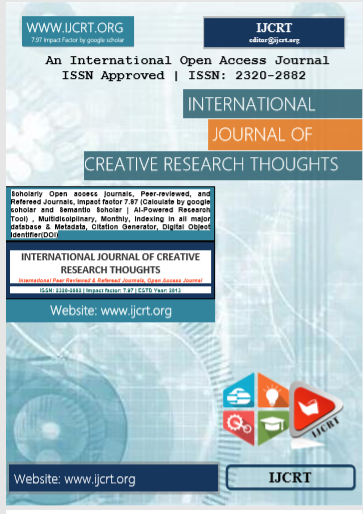 |
 |
|---|---|
| IJCRT Journal front page | IJCRT Journal Back Page |
Paper Title: A Study on Factors Affecting the Attitude of Stakeholders of Higher Education Institutions
Author Name(s): Ms. Priyanka, Dr. Shweta Singh
Published Paper ID: - IJCRT2508563
Register Paper ID - 292754
Publisher Journal Name: IJPUBLICATION, IJCRT
DOI Member ID: 10.6084/m9.doi.one.IJCRT2508563 and DOI :
Author Country : Indian Author, India, - , -, - , | Research Area: Science and Technology Published Paper URL: http://ijcrt.org/viewfull.php?&p_id=IJCRT2508563 Published Paper PDF: download.php?file=IJCRT2508563 Published Paper PDF: http://www.ijcrt.org/papers/IJCRT2508563.pdf
Your Paper Publication Details:
Title: A STUDY ON FACTORS AFFECTING THE ATTITUDE OF STAKEHOLDERS OF HIGHER EDUCATION INSTITUTIONS
DOI (Digital Object Identifier) :
Pubished in Volume: 13 | Issue: 8 | Year: August 2025
Publisher Name : IJCRT | www.ijcrt.org | ISSN : 2320-2882
Subject Area: Science and Technology
Author type: Indian Author
Pubished in Volume: 13
Issue: 8
Pages: e953-e964
Year: August 2025
Downloads: 172
E-ISSN Number: 2320-2882
Abstract
The positivist paradigm and the quantitative research technique formed the basis of this study's research design. A total of 421 respondents from Haryana's educational institutions provided the data. Using structural equation modelling (SEM), the study's model was evaluated. The study's findings suggested that the individual's attitude is influenced by performance expectancy, perceived service quality, facilitating conditions, and effort expectancy. The intention to recommend is influenced by the behaviour intention to use, which is in turn influenced by the attitude.
Licence: creative commons attribution 4.0
License
Creative Commons Attribution 4.0 and The Open Definition

Keywords
E-government, e-gov, UTAUT model, TAM model, UMEGA model
License
Creative Commons Attribution 4.0 and The Open Definition
Paper Title: Personalized Product Recommendation Using Artificial Intelligence
Author Name(s): Anubhav Sharma, Deepak Kumar Gupta, Aditya Kumar Yadav
Published Paper ID: - IJCRT2508562
Register Paper ID - 292794
Publisher Journal Name: IJPUBLICATION, IJCRT
DOI Member ID: 10.6084/m9.doi.one.IJCRT2508562 and DOI : https://doi.org/10.56975/ijcrt.v13i8.292794
Author Country : Indian Author, India, 250404 , Meerut , 250404 , | Research Area: Science and Technology Published Paper URL: http://ijcrt.org/viewfull.php?&p_id=IJCRT2508562 Published Paper PDF: download.php?file=IJCRT2508562 Published Paper PDF: http://www.ijcrt.org/papers/IJCRT2508562.pdf
Your Paper Publication Details:
Title: PERSONALIZED PRODUCT RECOMMENDATION USING ARTIFICIAL INTELLIGENCE
DOI (Digital Object Identifier) : https://doi.org/10.56975/ijcrt.v13i8.292794
Pubished in Volume: 13 | Issue: 8 | Year: August 2025
Publisher Name : IJCRT | www.ijcrt.org | ISSN : 2320-2882
Subject Area: Science and Technology
Author type: Indian Author
Pubished in Volume: 13
Issue: 8
Pages: e946-e952
Year: August 2025
Downloads: 217
E-ISSN Number: 2320-2882
Abstract
Recommender systems have become pivotal in the digital era, enhancing customer experiences by providing personalized suggestions across different domains such as e commerce, entertainment, and social media. This paper presents a comprebensive literature survey and proposes a novel hybrid framework that integrates image based data with advanced mathemnatical models improve recommendation accuracy and user engagement. We develop an image enhanced matrix factorization method and a visually aware neural collaborative fltering model, and we evaluate both on standard benchmarks, achieving a 15 % improvement in F1 score over leading baselines. Detailed mathematical formulations of each algorithm are provided, along with a thorough comparison of efficiency and scal ealability, The results demonstrate that ncopor visual features significantly enbances the relevance and recommendations, ultimately boosting customer satisfaction.
Licence: creative commons attribution 4.0
License
Creative Commons Attribution 4.0 and The Open Definition
Keywords
Recommender Systems, Customer Experience, Image Processing, Machine Learning, Customer Behavior, Hybrid Approach I.
License
Creative Commons Attribution 4.0 and The Open Definition
Paper Title: The Influence of Sanskrit on English Language
Author Name(s): Shatabdi Roy
Published Paper ID: - IJCRT2508561
Register Paper ID - 292746
Publisher Journal Name: IJPUBLICATION, IJCRT
DOI Member ID: 10.6084/m9.doi.one.IJCRT2508561 and DOI :
Author Country : Indian Author, India, 700160 , Kolkata, 700160 , | Research Area: Arts1 All Published Paper URL: http://ijcrt.org/viewfull.php?&p_id=IJCRT2508561 Published Paper PDF: download.php?file=IJCRT2508561 Published Paper PDF: http://www.ijcrt.org/papers/IJCRT2508561.pdf
Your Paper Publication Details:
Title: THE INFLUENCE OF SANSKRIT ON ENGLISH LANGUAGE
DOI (Digital Object Identifier) :
Pubished in Volume: 13 | Issue: 8 | Year: August 2025
Publisher Name : IJCRT | www.ijcrt.org | ISSN : 2320-2882
Subject Area: Arts1 All
Author type: Indian Author
Pubished in Volume: 13
Issue: 8
Pages: e942-e945
Year: August 2025
Downloads: 209
E-ISSN Number: 2320-2882
Abstract
When the English conquered the world, the English language slowly spread around the globe. It did not remain just the language of the small island of England. In course of time, the language being widely spoken came to be known as a global language in today's world. The English language has several loanwords. The language not just borrowed from other European languages, but also from different Indian languages. Old English or the language of the Celts is very different from modern English. When the nomadic tribes dwelled in the island, they went through various invasions and influences, thus slowly affecting the language. The French, Scandinavian and Latin influences made it what it is today. The language Sanskrit, being a very important part of Indian art and culture, has also greatly influenced English. Many words of common use including several names have been taken from the language Sanskrit. English, being the official language of many countries, has a large number of speakers. It is not just spoken in the United States of America and England, but also in Afro-Asian countries. Even non-English speaking countries encourage children to take up English in School as a second language. Being widely used today, English has now become a language of science and technology.
Licence: creative commons attribution 4.0
License
Creative Commons Attribution 4.0 and The Open Definition
Keywords
English Language, Communication, Sanskrit
License
Creative Commons Attribution 4.0 and The Open Definition
Paper Title: Postcolonial Travel Writing and the Diasporic Gaze: Naipaul's India Trilogy
Author Name(s): HARISH H U, Dr. RAVIKUMAR S. KUMBAR
Published Paper ID: - IJCRT2508560
Register Paper ID - 292787
Publisher Journal Name: IJPUBLICATION, IJCRT
DOI Member ID: 10.6084/m9.doi.one.IJCRT2508560 and DOI :
Author Country : Indian Author, India, 577002 , DAVANGERE, 577002 , | Research Area: Medical Science All Published Paper URL: http://ijcrt.org/viewfull.php?&p_id=IJCRT2508560 Published Paper PDF: download.php?file=IJCRT2508560 Published Paper PDF: http://www.ijcrt.org/papers/IJCRT2508560.pdf
Your Paper Publication Details:
Title: POSTCOLONIAL TRAVEL WRITING AND THE DIASPORIC GAZE: NAIPAUL'S INDIA TRILOGY
DOI (Digital Object Identifier) :
Pubished in Volume: 13 | Issue: 8 | Year: August 2025
Publisher Name : IJCRT | www.ijcrt.org | ISSN : 2320-2882
Subject Area: Medical Science All
Author type: Indian Author
Pubished in Volume: 13
Issue: 8
Pages: e937-e941
Year: August 2025
Downloads: 176
E-ISSN Number: 2320-2882
Abstract
Abstract This article critically examines V.S. Naipaul's India trilogy An Area of Darkness, India: A Wounded Civilization, and India: A Million Mutinies Now as exemplary postcolonial travel writing that navigates diasporic consciousness and identity formation. It argues that Naipaul's positionality as a Trinidadian of Indian descent educated in Britain situates him as both insider and outsider, allowing him to produce a complex critique of India's colonial legacies, cultural hybridity, and social transformation. Through close reading and intertextual analysis, this article demonstrates how Naipaul's ambivalence functions methodologically, revealing the tensions between longing, critique, and recognition of pluralism in postcolonial India.
Licence: creative commons attribution 4.0
License
Creative Commons Attribution 4.0 and The Open Definition
Keywords
Keywords: V.S. Naipaul, Postcolonial Travel Writing, Diaspora, India Trilogy, Cultural Hybridity, National Identity, Colonial Legacy
License
Creative Commons Attribution 4.0 and The Open Definition
Paper Title: FPGA-Based Object Detection Using YOLOv8 with Verilog Implementation
Author Name(s): K.B.L. Phani Kumar, K. Jhansi Rani
Published Paper ID: - IJCRT2508559
Register Paper ID - 292756
Publisher Journal Name: IJPUBLICATION, IJCRT
DOI Member ID: 10.6084/m9.doi.one.IJCRT2508559 and DOI : https://doi.org/10.56975/ijcrt.v13i8.292756
Author Country : Indian Author, India, 521329 , CHINATUMMIDI, 521329 , | Research Area: Science and Technology Published Paper URL: http://ijcrt.org/viewfull.php?&p_id=IJCRT2508559 Published Paper PDF: download.php?file=IJCRT2508559 Published Paper PDF: http://www.ijcrt.org/papers/IJCRT2508559.pdf
Your Paper Publication Details:
Title: FPGA-BASED OBJECT DETECTION USING YOLOV8 WITH VERILOG IMPLEMENTATION
DOI (Digital Object Identifier) : https://doi.org/10.56975/ijcrt.v13i8.292756
Pubished in Volume: 13 | Issue: 8 | Year: August 2025
Publisher Name : IJCRT | www.ijcrt.org | ISSN : 2320-2882
Subject Area: Science and Technology
Author type: Indian Author
Pubished in Volume: 13
Issue: 8
Pages: e924-e936
Year: August 2025
Downloads: 288
E-ISSN Number: 2320-2882
Abstract
An object detection processor based on a binarized neural network (BNN) architecture is developed to enable efficient deployment on resource-constrained FPGA platforms. Traditional convolutional neural networks (CNNs), while highly effective for visual recognition tasks, impose significant demands on computational resources and memory bandwidth, present challenges for embedded applications. To address these limitations, the proposed system leverages binary operations, on-chip memory usage, and an optimized neural architecture to minimize complexity and power consumption. The design achieves accurate object detection performance within the limitations of FPGA hardware, highlighting its potential for efficient inference in real-time environments. Its modularity and scalability allow for adaptation across a wide range of embedded vision scenarios, particularly in domains requiring low latency and high energy efficiency. The proposed approach demonstrates the feasibility of integrating deep learning models into compact, resource-effective hardware systems, offering a promising direction for future applications in areas such as IoT monitoring, smart sensors, and mobile robotics.
Licence: creative commons attribution 4.0
License
Creative Commons Attribution 4.0 and The Open Definition
Keywords
Object Detection, FPGA, Binarized Neural Network, Embedded Vision, Resource Optimization, Low-Power Design, IoT, Robotics, Hardware Acceleration.
License
Creative Commons Attribution 4.0 and The Open Definition
Paper Title: Automated Lung Cancer Detection Using Image Processing
Author Name(s): Shridevi Soma, Kaniyar Fatima, Misba anjum, Vijaylaxmi Chichkote
Published Paper ID: - IJCRT2508558
Register Paper ID - 292279
Publisher Journal Name: IJPUBLICATION, IJCRT
DOI Member ID: 10.6084/m9.doi.one.IJCRT2508558 and DOI :
Author Country : Indian Author, India, 585102 , kalaburagi, 585102 , | Research Area: Health Science All Published Paper URL: http://ijcrt.org/viewfull.php?&p_id=IJCRT2508558 Published Paper PDF: download.php?file=IJCRT2508558 Published Paper PDF: http://www.ijcrt.org/papers/IJCRT2508558.pdf
Your Paper Publication Details:
Title: AUTOMATED LUNG CANCER DETECTION USING IMAGE PROCESSING
DOI (Digital Object Identifier) :
Pubished in Volume: 13 | Issue: 8 | Year: August 2025
Publisher Name : IJCRT | www.ijcrt.org | ISSN : 2320-2882
Subject Area: Health Science All
Author type: Indian Author
Pubished in Volume: 13
Issue: 8
Pages: e915-e923
Year: August 2025
Downloads: 179
E-ISSN Number: 2320-2882
Abstract
The domain of medical image processing focuses on the early detection of lung cancer using advanced image processing techniques. Currently, lung cancer diagnosis primarily depends on manual analysis of chest X-rays or CT scans by radiologists. While experienced professionals can identify abnormalities, the process is time-consuming, prone to human error, and often limited by subtle signs that are difficult to interpret in early stages. Existing computer-aided detection systems are available, but many suffer from low accuracy, high false-positive rates, and limited generalization to diverse datasets. The system is designed to process standard datasets of lung images, performing key steps such as image preprocessing to enhance quality, feature extraction to identify relevant patterns, and classification to accurately distinguish between cancerous and non-cancerous images. The dual-phase approach consists of a training phase, where the CNN model learns from labeled data, and a testing phase, where the model is validated with unseen images to measure its performance. The application of CNNs allows the model to learn complex features that are difficult to capture through traditional handcrafted techniques, leading to improved accuracy and reduced false positives. Overall, integrating advanced image processing techniques with machine learning models such as CNN offers promising improvements in lung cancer diagnosis. This approach not only accelerates the diagnostic workflow but also supports healthcare professionals by providing consistent and reliable analysis of medical images. The proposed system has the potential to improve patient outcomes by facilitating timely detection and treatment, ultimately contributing to more effective management of lung cancer on a broader scale.
Licence: creative commons attribution 4.0
License
Creative Commons Attribution 4.0 and The Open Definition
Keywords
Lung Cancer Detection, CT Imaging, Image Processing, CNN, Medical Diagnosis
License
Creative Commons Attribution 4.0 and The Open Definition
Paper Title: Complete Edentulism and Its Association with Sociodemographic Variables: A Review
Author Name(s): Dr. Nazish Baig, Dr. Namrata Baste, Dr. Babita Yeshwante, Dr. Shivani Kapoor, Dr. Rutuja Rajmane
Published Paper ID: - IJCRT2508557
Register Paper ID - 291861
Publisher Journal Name: IJPUBLICATION, IJCRT
DOI Member ID: 10.6084/m9.doi.one.IJCRT2508557 and DOI :
Author Country : Indian Author, India, 422003 , Nashik, 422003 , | Research Area: Health Science All Published Paper URL: http://ijcrt.org/viewfull.php?&p_id=IJCRT2508557 Published Paper PDF: download.php?file=IJCRT2508557 Published Paper PDF: http://www.ijcrt.org/papers/IJCRT2508557.pdf
Your Paper Publication Details:
Title: COMPLETE EDENTULISM AND ITS ASSOCIATION WITH SOCIODEMOGRAPHIC VARIABLES: A REVIEW
DOI (Digital Object Identifier) :
Pubished in Volume: 13 | Issue: 8 | Year: August 2025
Publisher Name : IJCRT | www.ijcrt.org | ISSN : 2320-2882
Subject Area: Health Science All
Author type: Indian Author
Pubished in Volume: 13
Issue: 8
Pages: e911-e914
Year: August 2025
Downloads: 204
E-ISSN Number: 2320-2882
Abstract
Complete edentulism remains a significant public health concern worldwide, posing adverse functional, aesthetic, and psychosocial consequences. Its prevalence, however, exhibits striking variability across different populations, influenced by a multitude of sociodemographic determinants such as age, gender, socioeconomic status, educational attainment, geographical location, and systemic health conditions. This review looks into how being fully edentulous is connected with different social and demographic factors. It brings together global data to show how these relationships can shape real-world dental care and influence public health efforts. An understanding of these associations is essential for the formulation of targeted preventive strategies and equitable prosthodontic care delivery.
Licence: creative commons attribution 4.0
License
Creative Commons Attribution 4.0 and The Open Definition
Keywords
Complete edentulism, Sociodemographic variables, Epidemiology, Prevalence
License
Creative Commons Attribution 4.0 and The Open Definition
Paper Title: The Role of Nanotechnology in Understanding Potentization in Homoeopathy
Author Name(s): Dr. PRAKASH, Dr. Ritu Sharma
Published Paper ID: - IJCRT2508556
Register Paper ID - 292770
Publisher Journal Name: IJPUBLICATION, IJCRT
DOI Member ID: 10.6084/m9.doi.one.IJCRT2508556 and DOI : https://doi.org/10.56975/ijcrt.v13i8.292770
Author Country : Indian Author, India, 342001 , JODHPUR, 342001 , | Research Area: Health Science All Published Paper URL: http://ijcrt.org/viewfull.php?&p_id=IJCRT2508556 Published Paper PDF: download.php?file=IJCRT2508556 Published Paper PDF: http://www.ijcrt.org/papers/IJCRT2508556.pdf
Your Paper Publication Details:
Title: THE ROLE OF NANOTECHNOLOGY IN UNDERSTANDING POTENTIZATION IN HOMOEOPATHY
DOI (Digital Object Identifier) : https://doi.org/10.56975/ijcrt.v13i8.292770
Pubished in Volume: 13 | Issue: 8 | Year: August 2025
Publisher Name : IJCRT | www.ijcrt.org | ISSN : 2320-2882
Subject Area: Health Science All
Author type: Indian Author
Pubished in Volume: 13
Issue: 8
Pages: e908-e910
Year: August 2025
Downloads: 233
E-ISSN Number: 2320-2882
Abstract
Potentization is a hallmark process in homoeopathy involving serial dilution and succussion, believed to enhance the dynamic properties of medicinal substances. Scientific validation of this principle has long been debated. Recent advancements in nanotechnology provide promising evidence for the presence of nanoparticles in ultra-diluted homoeopathic preparations. This review explores how nanoscience offers a mechanistic explanation for potentization, bridging traditional homoeopathic philosophy and modern experimental research. The findings suggest potential avenues for quality control, pharmaceutical innovation, and educational reform in homoeopathic pharmacy.
Licence: creative commons attribution 4.0
License
Creative Commons Attribution 4.0 and The Open Definition
Keywords
Homoeopathy; Potentization; Nanoparticles; Ultra-dilution; Nanotechnology; Drug dynamization
License
Creative Commons Attribution 4.0 and The Open Definition
Paper Title: SOCIAL MEDIA'S IMPACT ON ENGLISH LANGUAGE STUDENTS STUDY IN DHARWAD DISTRICT
Author Name(s): SMT. VIJAYLAXMI PATIL
Published Paper ID: - IJCRT2508555
Register Paper ID - 292645
Publisher Journal Name: IJPUBLICATION, IJCRT
DOI Member ID: 10.6084/m9.doi.one.IJCRT2508555 and DOI :
Author Country : Indian Author, India, 581314 , ankola, 581314 , | Research Area: Languages Published Paper URL: http://ijcrt.org/viewfull.php?&p_id=IJCRT2508555 Published Paper PDF: download.php?file=IJCRT2508555 Published Paper PDF: http://www.ijcrt.org/papers/IJCRT2508555.pdf
Your Paper Publication Details:
Title: SOCIAL MEDIA'S IMPACT ON ENGLISH LANGUAGE STUDENTS STUDY IN DHARWAD DISTRICT
DOI (Digital Object Identifier) :
Pubished in Volume: 13 | Issue: 8 | Year: August 2025
Publisher Name : IJCRT | www.ijcrt.org | ISSN : 2320-2882
Subject Area: Languages
Author type: Indian Author
Pubished in Volume: 13
Issue: 8
Pages: e895-e907
Year: August 2025
Downloads: 165
E-ISSN Number: 2320-2882
Abstract
Abstract: Introduction: Social media has a big effect on how students in Dharwad district learn and use the English language. It gives them chances to practice their language skills and see different ways people communicate. However, it also brings some problems, like grammar mistakes, difficulty with new words, and the risk of developing poor communication habits. Both teachers and students need to understand how social media influences language learning in many ways. They should use the good parts of social media while being careful to avoid the bad effects. This discussion will look at both the positive and negative influences of social media on language learning, communication styles, and overall English language ability among students in Dharwad district. Review of literature: Wang et al., (2011) found that using social media too much can lead to feelings of being alone and less face-to-face time, which might lower learners' motivation and how well they learn overall. Objective of a study: The aim of this study is to examine how social media affects the English language skills and fluency of language learners in the Dharwad district. This research paper looks at both the good and bad ways social media can influence different language abilities and the general interest people have in learning English. Research methodology: Using a mix of different research methods, including both asking questions and gathering numerical data, is best for understanding how social media affects English as a second language learner. This approach helps fully understand the complex ways social media influences language learning, by looking at both measurable improvements in language skills and personal stories and opinions from students. Data analysis and interpretation: This article paper discusses the relationship between social media and the English language. It covers the impacts of multimedia resources, how they affect collaborative learning, their influence on motivational engagement, the effects of distraction and time consumption, and the limitations of face-to-face interaction in Dharwad District. Conclusion: In conclusion, social media is a vital resource for English language learning, but its effects are nuanced. Keyword: Social Media's, Impact on English Language, Students, Dharwad District
Licence: creative commons attribution 4.0
License
Creative Commons Attribution 4.0 and The Open Definition
Keywords
Keyword: Social Media's, Impact on English Language, Students, Dharwad District
License
Creative Commons Attribution 4.0 and The Open Definition
Paper Title: DIGITAL DECEPTION:AN EXPLORATION OF ONLINE FRAUD SCHEMES AND PREVENTION STRATEGIES
Author Name(s): Dr. Kudshiya Raza, Dr. Surbhi Jain, Dr. Ekta Mukar
Published Paper ID: - IJCRT2508554
Register Paper ID - 292679
Publisher Journal Name: IJPUBLICATION, IJCRT
DOI Member ID: 10.6084/m9.doi.one.IJCRT2508554 and DOI :
Author Country : Indian Author, India, 482001 , Jabalpur, 482001 , | Research Area: Commerce All Published Paper URL: http://ijcrt.org/viewfull.php?&p_id=IJCRT2508554 Published Paper PDF: download.php?file=IJCRT2508554 Published Paper PDF: http://www.ijcrt.org/papers/IJCRT2508554.pdf
Your Paper Publication Details:
Title: DIGITAL DECEPTION:AN EXPLORATION OF ONLINE FRAUD SCHEMES AND PREVENTION STRATEGIES
DOI (Digital Object Identifier) :
Pubished in Volume: 13 | Issue: 8 | Year: August 2025
Publisher Name : IJCRT | www.ijcrt.org | ISSN : 2320-2882
Subject Area: Commerce All
Author type: Indian Author
Pubished in Volume: 13
Issue: 8
Pages: e885-e894
Year: August 2025
Downloads: 170
E-ISSN Number: 2320-2882
Abstract
Abstract The quick rise in digital interactions and online transactions has made it easier for online fraud schemes to flourish, leading to large financial losses and compromised personal information. The purpose of this study is to investigate how internet fraud methods, such as phishing, identity theft, and social engineering attempts, are changing. To investigate the strategies, techniques, and procedures (TTPs) utilised by online fraudsters, a mixed-methods approach comprising surveys and a Questionnaire will be utilised. Data was collected from a sample of 295 respondents, selected through random sampling to ensure diversity in age, education, and digital exposure. Furthermore, this study will examine the efficacy of current preventative measures such as digital literacy initiatives, anti-phishing software, and two-factor authentication. This paper aims to show internet awareness and literacy rate among users. It's also covered effective preventive strategies related to online fraud. The results of the study also help to create a thorough framework for stopping online fraud, offering guidance to legislators, law enforcement, and anybody else looking to safeguard themselves against online fraud.
Licence: creative commons attribution 4.0
License
Creative Commons Attribution 4.0 and The Open Definition
Keywords
Key Words: Cyber Fraud, Internet Literacy, Digital Security and Prevention Strategies.
License
Creative Commons Attribution 4.0 and The Open Definition
Call For Paper June 2026
Call For Papers
June 2026
Volume 14 | Issue 6
Last Date :
30-Jun-2026
Submit Manuscript Online Impact Factor: 7.97 Review Results : Within 02-03 Days Paper Publication : Within 02-03 Days
June 2026
Volume 14 | Issue 6
Last Date :
30-Jun-2026
Submit Manuscript Online Impact Factor: 7.97 Review Results : Within 02-03 Days Paper Publication : Within 02-03 Days
Published Issue Details
For Authors
Forms / Downloads
Other IMP Links
Indexing Partner
Research Area
LICENSE





ISSN and 7.97 Impact Factor Details

ISSN: 2320-2882 Impact Factor: 7.97 and ISSN APPROVED Journal Starting Year (ESTD) : 2013


ISSN and 7.97 Impact Factor Details
ISSN: 2320-2882 Impact Factor: 7.97 and ISSN APPROVED Journal Starting Year (ESTD) : 2013
DOI Details
CONFERENCE
CONFERENCE MANAGMENT & PUBLICATION CONFERENCE PROPOSAL
RECENT CONFERENCE

CONFERENCE PROPOSAL CONFERENCE PROCEEDINGS
CONFERENCE PROPOSAL CONFERENCE PROCEEDINGS
For Reviewer /Referral (RMS) Earn 500 per paper
Important Links
NEWS & Conference
Digital Library
IJCRT RMS | Earn 500 Per Paper.

Open Access


LICENSE
Indexing Partner
Scholarly open access journals, Peer-reviewed, and Refereed Journals, Impact factor 7.97 (Calculate by google scholar and Semantic Scholar | AI-Powered Research Tool) , Multidisciplinary, Monthly, Indexing in all major database & Metadata, Citation Generator, Digital Object Identifier(DOI)