Important Details
IJCRT - International Peer Reviewed, Open Access Journal, Multidisciplinary, Monthly, Nominal(Low) Fees for Professional Research Services International Journal of Creative Research Thoughts - IJCRT Peer Review Journal, Refereed Journal, Peer Reviewed Journal , Referred Journal and Indexed Journal, Open access, Online and Print Journal,international Journal Open Access, Accepted by Indian and foreign university ,IJCRT Followed Norms, guidelines, requirement, listing criteria and methodology of score/point also applied from: Scopus , Web of Science , UGC Approved , UGC CARE, UGC-CARE .
UGC Approved Journal No: 49023 (18)
UGC approval Link
https://ijcrt.org/ugc%20approval.jpg
All Policy and Approval
Please Like Our Facebook Page | CrossRef DOI and Hard copy of Certificate Provide if required. | www.IJCRT.org | editor@IJCRT.org | IJCRT WhatsApp +91 94294 58311
Publication Details:
- Paper Submission : 31-Aug-2026. Call For Paper (Volume 14 | Issue 8 | Month- August 2026)
- Acceptance/Rejection Notification: Within 02-04 Days.
- Paper Publish: Within 02-04 Days after submitting all documents.
-
Submit Your Paper Any time There No deadline.
-
Publication fees : 1570 INR for Indian author & 59$ for foreign International author.
Please Like Our Facebook Page | CrossRef DOI and Hard copy of Certificate Provide if required.
Licence and Indexing
Indexing In Google Scholar, SSRN, ResearcherID-Publons, Semantic Scholar | AI-Powered Research Tool, Microsoft Academic, Academia.edu, arXiv.org, Research Gate, CiteSeerX, ResearcherID Thomson Reuters, Mendeley : reference manager, DocStoc, ISSUU, Scribd, and many more | High Impact Factor: 7.97 | Digital object identifier (DOI) and Hard Copy of certificate Provided.




























Licence
DOI
ISSN Approved impact factor: 7.97 
Creative Common 
Valid as per new UGC Gazette regulations 

INTERNATIONAL JOURNAL OF CREATIVE RESEARCH THOUGHTS - IJCRT (IJCRT.ORG)
International Peer Reviewed & Refereed Journals, Open Access Journal
IJCRT Peer-Reviewed (Refereed) Journal as Per New UGC Rules.
ISSN Approved Journal No: 2320-2882 | Impact factor: 7.97 | ESTD Year: 2013
Call For Paper - Volume 14 | Issue 8 | Month- August 2026
Scholarly open access journals, Peer-reviewed, and Refereed Journals, Impact factor 7.97 (Calculate by google scholar and Semantic Scholar | AI-Powered Research Tool) , Multidisciplinary, Monthly, Indexing in all major database & Metadata, Citation Generator, Digital Object Identifier(CrossRef DOI)
IJCRT WhatsApp Contact
IJCRT Search Xplore - Search all paper by Paper Name , Author Name, and Title
Volume 14 | Issue 7 |
Volume 14 | Issue 7 | Month
Downlaod After Publication 1) Table of content index in PDF
2) Table of content index in HTML 2)Table of content index in HTML
3) Front Page 3) Front Page
4) Back Page 4) Back Page
5) Editor Board Member 5)Editor Board Member
6) OLD Style Issue 6)OLD Style Issue
 |
 |
|---|---|
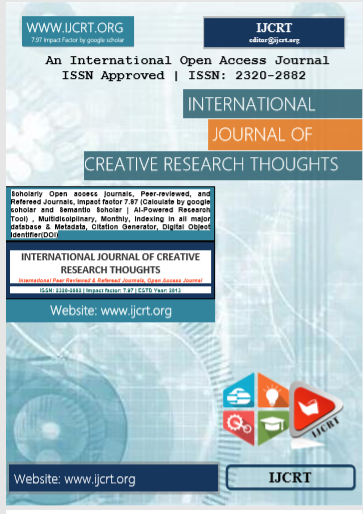
| IJCRT Journal front page | IJCRT Journal Back Page |
Paper Title: Virtual Reality Integration In STEAM Instruction In Higher Education: Advancing Virtual Laboratory Learning In M.Sc. Physics
Author Name(s): Prerana Prada Padhan, Chandan Kumar Satpathy
Published Paper ID: - IJCRT2607165
Register Paper ID - 311461
Publisher Journal Name: IJPUBLICATION, IJCRT
DOI Member ID: 10.6084/m9.doi.one.IJCRT2607165 and DOI : https://doi.org/10.56975/ijcrt.v14i7.311461
Author Country : Indian Author, India, 768028 , Bargarh, 768028 , | Research Area: Social Science All Published Paper URL: http://ijcrt.org/viewfull.php?&p_id=IJCRT2607165 Published Paper PDF: download.php?file=IJCRT2607165 Published Paper PDF: http://www.ijcrt.org/papers/IJCRT2607165.pdf
Your Paper Publication Details:
Title: VIRTUAL REALITY INTEGRATION IN STEAM INSTRUCTION IN HIGHER EDUCATION: ADVANCING VIRTUAL LABORATORY LEARNING IN M.SC. PHYSICS
DOI (Digital Object Identifier) : https://doi.org/10.56975/ijcrt.v14i7.311461
Pubished in Volume: 14 | Issue: 7 | Year: July 2026
Publisher Name : IJCRT | www.ijcrt.org | ISSN : 2320-2882
Subject Area: Social Science All
Author type: Indian Author
Pubished in Volume: 14
Issue: 7
Pages: b627-b637
Year: July 2026
Downloads: 53
E-ISSN Number: 2320-2882
Abstract
Virtual reality (VR) is increasingly positioned as a transformative educational technology for Science, Technology, Engineering, Arts and Mathematics (STEAM) instruction in higher education. Its immersive, interactive and spatially oriented environments can support the visualisation of abstract phenomena, experimental rehearsal, collaborative inquiry and interdisciplinary problem-solving. This paper critically examines the integration of VR in higher education STEAM instruction, with particular emphasis on virtual laboratory learning in Master of Science (M.Sc.) Physics programmes. Drawing upon constructivism, experiential learning, embodied cognition and the Technology, Pedagogy and Content Knowledge framework, the paper argues that VR laboratories can enrich physics learning by enabling students to explore microscopic, computational and experimentally hazardous phenomena that are difficult to access through conventional laboratories alone. The paper discusses pedagogical affordances, instructional design principles, applications in advanced physics practicals, assessment strategies, equity concerns and implementation challenges. It proposes a blended techno-laboratory model in which VR serves as a preparatory, complementary and reflective environment before and after actual laboratory experimentation. The paper concludes that VR should not be treated as a replacement for physical laboratories; rather, it should be integrated as a pedagogically designed bridge between theoretical visualisation, procedural understanding and experimental authenticity.
Licence: creative commons attribution 4.0
License
Creative Commons Attribution 4.0 and The Open Definition

Keywords
Virtual Reality, STEAM Education, Higher Education, Virtual Laboratory, M.Sc. Physics, Immersive Learning, Techno-Laboratory
License
Creative Commons Attribution 4.0 and The Open Definition
Paper Title: ASSESSMENT OF SMOKING AND ALCOHOL USE AMONG CHRONIC DISEASE PATIENT
Author Name(s): Ganesh Harinadh Baba Janapareddi, Kesavarapu Hyma Nandini, Depuri Haswika, Gandham Jayathrinadh, Racha Jaya Sankar
Published Paper ID: - IJCRT2607164
Register Paper ID - 311435
Publisher Journal Name: IJPUBLICATION, IJCRT
DOI Member ID: 10.6084/m9.doi.one.IJCRT2607164 and DOI :
Author Country : Indian Author, India, 533285 , G.Kothapalli, 533285 , | Research Area: Pharmacy All Published Paper URL: http://ijcrt.org/viewfull.php?&p_id=IJCRT2607164 Published Paper PDF: download.php?file=IJCRT2607164 Published Paper PDF: http://www.ijcrt.org/papers/IJCRT2607164.pdf
Your Paper Publication Details:
Title: ASSESSMENT OF SMOKING AND ALCOHOL USE AMONG CHRONIC DISEASE PATIENT
DOI (Digital Object Identifier) :
Pubished in Volume: 14 | Issue: 7 | Year: July 2026
Publisher Name : IJCRT | www.ijcrt.org | ISSN : 2320-2882
Subject Area: Pharmacy All
Author type: Indian Author
Pubished in Volume: 14
Issue: 7
Pages: b608-b626
Year: July 2026
Downloads: 45
E-ISSN Number: 2320-2882
Abstract
India is experiencing a growing public health problem due to the widespread use of smoking, tobacco, and alcohol, which are major contributors to the development and progression of chronic diseases. Non-communicable diseases, such as cardiovascular diseases, diabetes, chronic respiratory diseases, cancer, and hypertension, account for nearly two-thirds of all deaths in the country, and substance use has been identified as one of the most important modifiable risk factors. The purpose of this study is to assess the patterns of smoking, tobacco, and alcohol use among chronic disease patients in India, including state-wise, gender-wise, and age-wise variations. Based on data obtained from nationally representative surveys, such as the National Family Health Survey (NFHS-5) and the Global Adult Tobacco Survey (GATS), an analysis has been conducted, and the results are presented in detailed tables and graphical illustrations. The results show that there are significant regional variations, with the highest prevalence of tobacco and alcohol use found in the North-Eastern states, specifically in Mizoram, Tripura, Meghalaya, and Arunachal Pradesh. The prevalence of male use is significantly higher than that of females in most states; however, some states have shown appreciable prevalence of female use, specifically for smokeless tobacco and alcohol. Age-wise distribution shows higher use of substances among those aged 30-59 years, which coincides with the peak period of chronic disease burden. In patients with chronic illnesses, the use of tobacco and alcohol is linked to the progression of the disease, complications, decreased efficacy of pharmacotherapy, and mortality. The use of tobacco is responsible for more than one million deaths per year in India, while alcohol is a major contributor to liver disease, cardiovascular disease, injuries, and early deaths. The joint use of tobacco and alcohol has a synergistic effect, especially in cancers and cardiovascular diseases. The paper highlights the importance of screening, intervention, and the incorporation of tobacco and alcohol cessation programs into chronic disease care. Improving public health policies, regional enforcement, and the use of gender- and age-sensitive approaches are important in minimizing the long-term impact of chronic diseases related to substance use in India.
Licence: creative commons attribution 4.0
License
Creative Commons Attribution 4.0 and The Open Definition
Keywords
Smoking; Tobacco Use; Alcohol Consumption; Chronic Diseases; India; State-Wise Analysis; Gender Differences; Mortality; Public Health; Non-Communicable Diseases.
License
Creative Commons Attribution 4.0 and The Open Definition
Paper Title: The Socio-Cultural Life of the Irulas in Krishnagiri District - A Study
Author Name(s): T. Myvizhi, Dr P. Venkateswaran
Published Paper ID: - IJCRT2607163
Register Paper ID - 311428
Publisher Journal Name: IJPUBLICATION, IJCRT
DOI Member ID: 10.6084/m9.doi.one.IJCRT2607163 and DOI :
Author Country : Indian Author, India, 635001 , krishnagiri, 635001 , | Research Area: Arts All Published Paper URL: http://ijcrt.org/viewfull.php?&p_id=IJCRT2607163 Published Paper PDF: download.php?file=IJCRT2607163 Published Paper PDF: http://www.ijcrt.org/papers/IJCRT2607163.pdf
Your Paper Publication Details:
Title: THE SOCIO-CULTURAL LIFE OF THE IRULAS IN KRISHNAGIRI DISTRICT - A STUDY
DOI (Digital Object Identifier) :
Pubished in Volume: 14 | Issue: 7 | Year: July 2026
Publisher Name : IJCRT | www.ijcrt.org | ISSN : 2320-2882
Subject Area: Arts All
Author type: Indian Author
Pubished in Volume: 14
Issue: 7
Pages: b601-b607
Year: July 2026
Downloads: 37
E-ISSN Number: 2320-2882
Abstract
The Irulas are recognized as the sole indigenous tribal community residing in the Krishnagiri district. Although the Irulas currently inhabit the states of Tamil Nadu, Karnataka, Andhra Pradesh, and Kerala, their presence is more widespread and concentrated in Tamil Nadu compared to other regions. The Irulas of Tamil Nadu are broadly categorized into two major groups: the 'Nilgiri Hill Irulas' and the 'Plain Irulas.' The 'Plains Irulas' refer to those members of the community who reside in the northern districts of Tamil Nadu; the Irulas of Krishnagiri district are classified under this 'Plains Irular' category. Within this district, they are found scattered across the Denkanikottai taluk, as well as the Krishnagiri, Barur, and Sulagiri taluks. Generally, they establish their settlements in areas adjacent to forests; they rarely reside in urban areas. They continue to show a lack of interest in availing themselves of formal educational opportunities. Furthermore, they tend to possess a disposition that prefers living in isolation, rather than engaging socially with members of other communities. However, this scenario is slowly changing, as they have established settlements and found employment near urban centres. The Irulas of this region are linguistically distinct, comprising groups that speak Tamil and others that speak a hybrid language blending elements of Kannada and Telugu. Their native language currently lacks a written script. While their traditional occupations generally involved gathering forest produce and collecting honey, contemporary restrictions imposed by the Forest Department have led them to opt for agricultural wage labour instead. Additionally, some families have undertaken the occupation of rearing goats and cattle, utilizing livestock provided to them through subsidies by the Forest Department. Currently, many are migrating to areas surrounding cities in the neighbouring state--specifically Bangalore, Mysore, and Hassan - in search of employment, particularly in construction work and as night watchmen duties. Comparatively, the socio-cultural life of this community is characterized by greater hardship and stunted development when contrasted with the living conditions of other communities residing in the plain regions. It can be assessed that their way of life is even more impoverished than that of the Irulas people of the Nilgiri Hills. This article is undertaken as a study to shed light on their contemporary social life.
Licence: creative commons attribution 4.0
License
Creative Commons Attribution 4.0 and The Open Definition
Keywords
Irulas, Krishnagiri, Socio-cultural life
License
Creative Commons Attribution 4.0 and The Open Definition
Paper Title: Anusuchit Janjatiyon mein Dalhan, Sabziyon evam Phalon ke Upbhog ki Sthaniya Vividhata: Sarguja Jile ke Vishesh Sandarbh mein
Author Name(s): Dr. Aruna Kujur
Published Paper ID: - IJCRT2607162
Register Paper ID - 311427
Publisher Journal Name: IJPUBLICATION, IJCRT
DOI Member ID: 10.6084/m9.doi.one.IJCRT2607162 and DOI :
Author Country : Indian Author, India, - , -, - , | Research Area: Arts All Published Paper URL: http://ijcrt.org/viewfull.php?&p_id=IJCRT2607162 Published Paper PDF: download.php?file=IJCRT2607162 Published Paper PDF: http://www.ijcrt.org/papers/IJCRT2607162.pdf
Your Paper Publication Details:
Title: ANUSUCHIT JANJATIYON MEIN DALHAN, SABZIYON EVAM PHALON KE UPBHOG KI STHANIYA VIVIDHATA: SARGUJA JILE KE VISHESH SANDARBH MEIN
DOI (Digital Object Identifier) :
Pubished in Volume: 14 | Issue: 7 | Year: July 2026
Publisher Name : IJCRT | www.ijcrt.org | ISSN : 2320-2882
Subject Area: Arts All
Author type: Indian Author
Pubished in Volume: 14
Issue: 7
Pages: b584-b600
Year: July 2026
Downloads: 42
E-ISSN Number: 2320-2882
Abstract
Anusuchit Janjatiyon mein Dalhan, Sabziyon evam Phalon ke Upbhog ki Sthaniya Vividhata: Sarguja Jile ke Vishesh Sandarbh mein
Licence: creative commons attribution 4.0
License
Creative Commons Attribution 4.0 and The Open Definition
Keywords
Anusuchit Janjatiyon mein Dalhan, Sabziyon evam Phalon ke Upbhog ki Sthaniya Vividhata: Sarguja Jile ke Vishesh Sandarbh mein
License
Creative Commons Attribution 4.0 and The Open Definition
Paper Title: GUIDANCE ON SELECTING THE APPROPRIATE HOMEOPATHIC POTENCY
Author Name(s): Dr Khushboo Prajapati, Dr Palak Rajawat, Dr Nisha Manani, Dr Megha Parmar
Published Paper ID: - IJCRT2607161
Register Paper ID - 311421
Publisher Journal Name: IJPUBLICATION, IJCRT
DOI Member ID: 10.6084/m9.doi.one.IJCRT2607161 and DOI :
Author Country : Indian Author, India, 380050 , AHMADABAD, 380050 , | Research Area: Health Science All Published Paper URL: http://ijcrt.org/viewfull.php?&p_id=IJCRT2607161 Published Paper PDF: download.php?file=IJCRT2607161 Published Paper PDF: http://www.ijcrt.org/papers/IJCRT2607161.pdf
Your Paper Publication Details:
Title: GUIDANCE ON SELECTING THE APPROPRIATE HOMEOPATHIC POTENCY
DOI (Digital Object Identifier) :
Pubished in Volume: 14 | Issue: 7 | Year: July 2026
Publisher Name : IJCRT | www.ijcrt.org | ISSN : 2320-2882
Subject Area: Health Science All
Author type: Indian Author
Pubished in Volume: 14
Issue: 7
Pages: b580-b583
Year: July 2026
Downloads: 44
E-ISSN Number: 2320-2882
Abstract
Abstract Potency selection is a fundamental component of homeopathic prescribing and is traditionally regarded as an important factor in individualized treatment. Selecting an appropriate potency requires consideration of multiple patient- and disease-related factors, including the nature and duration of the condition, patient sensitivity, age, general health, and the degree of similarity between the remedy and the patient's symptom profile. This article presents an overview of commonly described principles of potency selection in classical homeopathic literature. It discusses the characteristics of low, medium, and high potencies, practical approaches to initiating treatment, monitoring patient response, and adjusting potency when appropriate. The article also emphasizes the importance of individualized prescribing and professional clinical judgment in homeopathic practice. By providing a structured overview of traditional potency selection concepts, this review aims to serve as a useful educational resource for homeopathy students and practitioners while recognizing that recommendations may vary among different schools of homeopathy.
Licence: creative commons attribution 4.0
License
Creative Commons Attribution 4.0 and The Open Definition
Keywords
Keywords Homeopathy Homeopathic Potency Potency Selection Individualized Treatment Homeopathic Remedies Acute Conditions Chronic Conditions Patient Sensitivity Homeopathic Prescribing Classical Homeopathy Potentization Clinical Practice
License
Creative Commons Attribution 4.0 and The Open Definition
Paper Title: Deep Learning-Based Flood Risk Assessment Using a Hybrid CNN-LSTM Model Integrated with Remote Sensing and GIS
Author Name(s): G.Vijayakumar
Published Paper ID: - IJCRT2607160
Register Paper ID - 311407
Publisher Journal Name: IJPUBLICATION, IJCRT
DOI Member ID: 10.6084/m9.doi.one.IJCRT2607160 and DOI : https://doi.org/10.56975/ijcrt.v14i7.311407
Author Country : Indian Author, India, 523187 , Chirala, 523187 , | Research Area: Science and Technology Published Paper URL: http://ijcrt.org/viewfull.php?&p_id=IJCRT2607160 Published Paper PDF: download.php?file=IJCRT2607160 Published Paper PDF: http://www.ijcrt.org/papers/IJCRT2607160.pdf
Your Paper Publication Details:
Title: DEEP LEARNING-BASED FLOOD RISK ASSESSMENT USING A HYBRID CNN-LSTM MODEL INTEGRATED WITH REMOTE SENSING AND GIS
DOI (Digital Object Identifier) : https://doi.org/10.56975/ijcrt.v14i7.311407
Pubished in Volume: 14 | Issue: 7 | Year: July 2026
Publisher Name : IJCRT | www.ijcrt.org | ISSN : 2320-2882
Subject Area: Science and Technology
Author type: Indian Author
Pubished in Volume: 14
Issue: 7
Pages: b567-b579
Year: July 2026
Downloads: 52
E-ISSN Number: 2320-2882
Abstract
Floods are among the most devastating natural hazards, causing severe loss of life, infrastructure damage and environmental degradation. Accurate flood risk assessment crucial for effective disaster management and sustainable planning. This study develops a deep learning framework using a hybrid Convolutional Neural Network-Long Short-Term Memory (CNN-LSTM) model integrated with remote sensing and GIS to assess flood risk in the Lower Godavari basin, India. Spatial datasets including DEM, land use/land cover, slope, drainage density, distance to river, soil and NDVI derived from Sentinel-2, along with temporal data such as daily rainfall and river discharge (2015-2024), were used. The CNN component extracts spatial features, while the LSTM component learns temporal dependencies. The model achieved high performance with an AUC of 0.92, accuracy of 0.89 and F1-score of 0.87. The final flood risk map categorizes the basin into low, moderate, high and very high risk zones. The study demonstrates that the integration of deep learning with geospatial data significantly improves flood risk assessment and can support decision makers in planning and mitigation.
Licence: creative commons attribution 4.0
License
Creative Commons Attribution 4.0 and The Open Definition
Keywords
Flood risk, CNN-LSTM, Remote sensing, GIS, Deep learning, Flood susceptibility, Lower Godavari basin
License
Creative Commons Attribution 4.0 and The Open Definition
Paper Title: The Rise of SUVs and Its Impact on the Indian Car Market
Author Name(s): Amit Raut
Published Paper ID: - IJCRT2607159
Register Paper ID - 311398
Publisher Journal Name: IJPUBLICATION, IJCRT
DOI Member ID: 10.6084/m9.doi.one.IJCRT2607159 and DOI :
Author Country : Indian Author, India, 444606 , Amravati, 444606 , | Research Area: Commerce All Published Paper URL: http://ijcrt.org/viewfull.php?&p_id=IJCRT2607159 Published Paper PDF: download.php?file=IJCRT2607159 Published Paper PDF: http://www.ijcrt.org/papers/IJCRT2607159.pdf
Your Paper Publication Details:
Title: THE RISE OF SUVS AND ITS IMPACT ON THE INDIAN CAR MARKET
DOI (Digital Object Identifier) :
Pubished in Volume: 14 | Issue: 7 | Year: July 2026
Publisher Name : IJCRT | www.ijcrt.org | ISSN : 2320-2882
Subject Area: Commerce All
Author type: Indian Author
Pubished in Volume: 14
Issue: 7
Pages: b556-b566
Year: July 2026
Downloads: 37
E-ISSN Number: 2320-2882
Abstract
The Indian automobile industry has undergone a significant transformation over the last decade, with Sport Utility Vehicles (SUVs) emerging as the fastest-growing and most preferred passenger vehicle segment. Earlier, the Indian market was dominated by small hatchbacks due to affordability, fuel efficiency, and ease of driving. However, changing consumer preferences, rising disposable incomes, rapid urbanization, improved road infrastructure, and technological advancements have led to a remarkable shift toward SUVs. Automobile manufacturers have responded by introducing compact, mid-size, and premium SUVs across various price ranges, making them accessible to a wider section of consumers. The rapid rise of SUVs has not only influenced buying behaviour but has also reshaped production strategies, competition, employment opportunities, and investment patterns within the Indian automobile industry. Companies such as Maruti Suzuki, Hyundai, Tata Motors, Mahindra, Kia, Toyota, and MG Motor have significantly expanded their SUV portfolios to capture growing demand. At the same time, the increasing popularity of SUVs has raised concerns regarding fuel consumption, carbon emissions, urban traffic congestion, and environmental sustainability. This research paper examines the factors responsible for the rapid growth of SUVs in India and analyses their impact on the Indian automobile market from economic, social, and environmental perspectives. The paper also discusses the challenges facing the SUV segment and highlights future opportunities, particularly the emergence of electric and hybrid SUVs. The study is based on secondary data collected from industry reports, government publications, company reports, and academic journals.
Licence: creative commons attribution 4.0
License
Creative Commons Attribution 4.0 and The Open Definition
Keywords
SUV, Indian Automobile Industry, Consumer Behaviour, Passenger Vehicles, Market Growth, Electric SUVs.
License
Creative Commons Attribution 4.0 and The Open Definition
Paper Title: "GARBHOPANISHAD"- AN ANCIENT BLUEPRINT OF HUMAN EMBRYOLOGY & DEVELOPMENT : A REVIEW
Author Name(s): Dr. Yashawanth Y.K, Dr. Swapna Kumary, Dr. Soumya .S
Published Paper ID: - IJCRT2607158
Register Paper ID - 310741
Publisher Journal Name: IJPUBLICATION, IJCRT
DOI Member ID: 10.6084/m9.doi.one.IJCRT2607158 and DOI :
Author Country : Indian Author, India, - , -, - , | Research Area: Humanities All Published Paper URL: http://ijcrt.org/viewfull.php?&p_id=IJCRT2607158 Published Paper PDF: download.php?file=IJCRT2607158 Published Paper PDF: http://www.ijcrt.org/papers/IJCRT2607158.pdf
Your Paper Publication Details:
Title: "GARBHOPANISHAD"- AN ANCIENT BLUEPRINT OF HUMAN EMBRYOLOGY & DEVELOPMENT : A REVIEW
DOI (Digital Object Identifier) :
Pubished in Volume: 14 | Issue: 7 | Year: July 2026
Publisher Name : IJCRT | www.ijcrt.org | ISSN : 2320-2882
Subject Area: Humanities All
Author type: Indian Author
Pubished in Volume: 14
Issue: 7
Pages: b548-b555
Year: July 2026
Downloads: 54
E-ISSN Number: 2320-2882
Abstract
Garbhopanishad is a Upanishad that presents a comprehensive account of human embryological development by integrating anatomical, physiological, psychological, and spiritual dimensions. This review critically analyses the embryological concepts described in Garbhopanishad and evaluates their relevance in relation to classical Ayurvedic literature and modern embryology through a qualitative literary review of the text along with comparative references from the Sushruta Samhita, Harita Samhita, and contemporary embryology literature. The text explains embryogenesis through the principles of Panchamaha bhuta, Sapta Dhatu, Beeja, and Jeevatma, describing the sequential stages of foetal development from Kalila (gelatinous stage) to Budbuda, Pinda, and complete foetal formation over nine months. It further discusses linga niryana, yamala garbha, congenital anomalies, foetal consciousness, and Sankhya Sharira (anatomical enumeration). Several developmental milestones and concepts described in Garbhopanishad demonstrate notable conceptual similarities with Ayurvedic embryological doctrines and certain observations of modern embryology. Thus, Garbhopanishad offers a holistic and multidimensional understanding of embryogenesis that remains relevant to Ayurveda, developmental biology, prenatal psychology, and integrative medicine, highlighting the enduring significance of ancient Indian embryological knowledge in contemporary scientific discourse.
Licence: creative commons attribution 4.0
License
Creative Commons Attribution 4.0 and The Open Definition
Keywords
Garbhopanishad, Garbha Vigyana, Embryology, Ayurveda, Foetal Development, Foetal Consciousness.
License
Creative Commons Attribution 4.0 and The Open Definition
Paper Title: INFLUENCE OF PSYCHOLOGICAL BIASES OVERCONFIDENCE, HERD BEHAVIOUR AND LOSS AVERSION ON STOCK TRADING DECISIONS: A STUDY OF TRADERS IN RANCHI DISTRICT.
Author Name(s): Arvind kumar paswan, Dr. Julius Aind, Dr. Ajay kumar
Published Paper ID: - IJCRT2607157
Register Paper ID - 311356
Publisher Journal Name: IJPUBLICATION, IJCRT
DOI Member ID: 10.6084/m9.doi.one.IJCRT2607157 and DOI :
Author Country : Indian Author, India, 834008 , Ranchi, 834008 , | Research Area: Other area not in list Published Paper URL: http://ijcrt.org/viewfull.php?&p_id=IJCRT2607157 Published Paper PDF: download.php?file=IJCRT2607157 Published Paper PDF: http://www.ijcrt.org/papers/IJCRT2607157.pdf
Your Paper Publication Details:
Title: INFLUENCE OF PSYCHOLOGICAL BIASES OVERCONFIDENCE, HERD BEHAVIOUR AND LOSS AVERSION ON STOCK TRADING DECISIONS: A STUDY OF TRADERS IN RANCHI DISTRICT.
DOI (Digital Object Identifier) :
Pubished in Volume: 14 | Issue: 7 | Year: July 2026
Publisher Name : IJCRT | www.ijcrt.org | ISSN : 2320-2882
Subject Area: Other area not in list
Author type: Indian Author
Pubished in Volume: 14
Issue: 7
Pages: b532-b547
Year: July 2026
Downloads: 49
E-ISSN Number: 2320-2882
Abstract
This research analyses how psychological influences-a trader's behaviour regarding stock trades-derive from cognitive distortions that lead to faulty methods of reasoning, which ultimately disrupt their normal decision-making processes, therefore revealing damaging results. Previous research as well as theoretical constructs regarding investment decision-making and other behavioural influences on trader behaviour are illustrated using traditional financial theory, which assumes that all investment decisions are based solely upon rationality; however, in practice, emotional factors, belief systems, peer pressures, and mental shortcuts known as heuristics comprise significant parts of making investment decisions. Therefore, how investment decisions are made may differ from what is theoretically postulated by these traditional financial theories. This paper presents three primary cognitive biases that can affect a trader's buying and selling decisions: overconfidence bias, herd behaviour, and loss aversion. Overconfidence, due to an investor believing they are more knowledgeable and capable than they actually are, may cause an investor to trade excessively or take risks disproportionately; therefore, overconfidence also influences their degree of willingness to pursue investment decisions even during increased risk periods. Herd behaviour is defined as an investor following the direction of another investor rather than using independent analysis during periods of economic uncertainty. Loss aversion bias refers to the fact that investors are much more afraid of losing money than they value making money, and so they frequently hold onto losing stock longer than is necessary or avoid taking investments that could lead to loss, regardless of whether they can profit by taking such an investment. This research will provide a detailed description and analytical analysis of retail investors and traders. The Quantitative method will be applied to obtain primary data from respondents using structured questionnaires. Secondary data will include journals, books, and prior research that have studied behavioural finance. Statistical tools will be utilized to analyse the data and identify any relationship between psychological biases and the production of investment decisions. Statistical techniques will consist of descriptive analysis, correlational analysis, regression analysis, SPSS, and Excel. The purpose of this research is to raise awareness among investors of the existence of hidden psychological influences impacting their trading behaviours. Additionally, this research will add to the behavioural finance literature about investors in a developing market, which in this case is Ranchi. The result of this research will assist investors, financial advisors, and policymakers in formulating effective financial strategies through the provision of financial literacy and to provide investors with better informed and derived decision making in their investments.
Licence: creative commons attribution 4.0
License
Creative Commons Attribution 4.0 and The Open Definition
Keywords
Key words: - Psychological Biases, Overconfidence Bias, Herd Behaviour, Loss Aversion, Behavioural Finance, Stock Market, Investment Decision-Making.
License
Creative Commons Attribution 4.0 and The Open Definition
Paper Title: Innovative security for active and passive attacks
Author Name(s): Harshitha S, Dr. H. Srinivas Murthy
Published Paper ID: - IJCRT2607156
Register Paper ID - 311457
Publisher Journal Name: IJPUBLICATION, IJCRT
DOI Member ID: 10.6084/m9.doi.one.IJCRT2607156 and DOI :
Author Country : Indian Author, India, 562110 , bangalore rural, 562110 , | Research Area: Science and Technology Published Paper URL: http://ijcrt.org/viewfull.php?&p_id=IJCRT2607156 Published Paper PDF: download.php?file=IJCRT2607156 Published Paper PDF: http://www.ijcrt.org/papers/IJCRT2607156.pdf
Your Paper Publication Details:
Title: INNOVATIVE SECURITY FOR ACTIVE AND PASSIVE ATTACKS
DOI (Digital Object Identifier) :
Pubished in Volume: 14 | Issue: 7 | Year: July 2026
Publisher Name : IJCRT | www.ijcrt.org | ISSN : 2320-2882
Subject Area: Science and Technology
Author type: Indian Author
Pubished in Volume: 14
Issue: 7
Pages: b523-b531
Year: July 2026
Downloads: 49
E-ISSN Number: 2320-2882
Abstract
The continued build-out of online infrastructure and digital services has greatly increased the threat of both passive and aggressive cyber attacks and thus threatens the accessibility, privacy and integrity of Sensitive data. A hybrid encryption and analysis based security framework to mitigate both passive and active attacks The system combines RSA and AES cryptographic algorithms for providing strong data security during transmission. A genetic algorithm based optimization technique is used to improve the detection of suspicious patterns in web usage. In addition, the model gives importance to early threat detection and prevention through web usage mining and access log analysis. The approach supports secure data flow, user behavior profiling, and real-time response to unauthorized activities with results to demonstrate improved accuracy, encryption strength.It contributes to more resilient, privacy-aware digital communication environments in dynamic threat landscapes.
Licence: creative commons attribution 4.0
License
Creative Commons Attribution 4.0 and The Open Definition
Keywords
Cybersecurity, Passive Attacks, Active Attacks, RSA, AES, Genetic Algorithm, Web Usage Mining, Data Encryption, Attack Detection, Secure Communication, Real-Time Monitoring, Intrusion Prevention System
License
Creative Commons Attribution 4.0 and The Open Definition
Call For Paper August 2026
Call For Papers
August 2026
Volume 14 | Issue 8
Last Date :
31-Aug-2026
Submit Manuscript Online Impact Factor: 7.97 Review Results : Within 02-03 Days Paper Publication : Within 02-03 Days
August 2026
Volume 14 | Issue 8
Last Date :
31-Aug-2026
Submit Manuscript Online Impact Factor: 7.97 Review Results : Within 02-03 Days Paper Publication : Within 02-03 Days
Published Issue Details
For Authors
Forms / Downloads
Other IMP Links
Indexing Partner
Research Area
LICENSE





ISSN and 7.97 Impact Factor Details

ISSN: 2320-2882 Impact Factor: 7.97 and ISSN APPROVED Journal Starting Year (ESTD) : 2013


ISSN and 7.97 Impact Factor Details
ISSN: 2320-2882 Impact Factor: 7.97 and ISSN APPROVED Journal Starting Year (ESTD) : 2013
DOI Details
CONFERENCE
CONFERENCE MANAGMENT & PUBLICATION CONFERENCE PROPOSAL
RECENT CONFERENCE

CONFERENCE PROPOSAL CONFERENCE PROCEEDINGS
CONFERENCE PROPOSAL CONFERENCE PROCEEDINGS
For Reviewer /Referral (RMS) Earn 500 per paper
Important Links
NEWS & Conference
Digital Library
IJCRT RMS | Earn 500 Per Paper.

Open Access


LICENSE
Indexing Partner
Scholarly open access journals, Peer-reviewed, and Refereed Journals, Impact factor 7.97 (Calculate by google scholar and Semantic Scholar | AI-Powered Research Tool) , Multidisciplinary, Monthly, Indexing in all major database & Metadata, Citation Generator, Digital Object Identifier(DOI)