Important Details
IJCRT - International Peer Reviewed, Open Access Journal, Multidisciplinary, Monthly, Nominal(Low) Fees for Professional Research Services International Journal of Creative Research Thoughts - IJCRT Peer Review Journal, Refereed Journal, Peer Reviewed Journal , Referred Journal and Indexed Journal, Open access, Online and Print Journal,international Journal Open Access, Accepted by Indian and foreign university ,IJCRT Followed Norms, guidelines, requirement, listing criteria and methodology of score/point also applied from: Scopus , Web of Science , UGC Approved , UGC CARE, UGC-CARE .
UGC Approved Journal No: 49023 (18)
UGC approval Link
https://ijcrt.org/ugc%20approval.jpg
All Policy and Approval
Please Like Our Facebook Page | CrossRef DOI and Hard copy of Certificate Provide if required. | www.IJCRT.org | editor@IJCRT.org | IJCRT WhatsApp +91 94294 58311
Publication Details:
- Paper Submission : 31-Aug-2026. Call For Paper (Volume 14 | Issue 8 | Month- August 2026)
- Acceptance/Rejection Notification: Within 02-04 Days.
- Paper Publish: Within 02-04 Days after submitting all documents.
-
Submit Your Paper Any time There No deadline.
-
Publication fees : 1570 INR for Indian author & 59$ for foreign International author.
Please Like Our Facebook Page | CrossRef DOI and Hard copy of Certificate Provide if required.
Licence and Indexing
Indexing In Google Scholar, SSRN, ResearcherID-Publons, Semantic Scholar | AI-Powered Research Tool, Microsoft Academic, Academia.edu, arXiv.org, Research Gate, CiteSeerX, ResearcherID Thomson Reuters, Mendeley : reference manager, DocStoc, ISSUU, Scribd, and many more | High Impact Factor: 7.97 | Digital object identifier (DOI) and Hard Copy of certificate Provided.




























Licence
DOI
ISSN Approved impact factor: 7.97 
Creative Common 
Valid as per new UGC Gazette regulations 

INTERNATIONAL JOURNAL OF CREATIVE RESEARCH THOUGHTS - IJCRT (IJCRT.ORG)
International Peer Reviewed & Refereed Journals, Open Access Journal
IJCRT Peer-Reviewed (Refereed) Journal as Per New UGC Rules.
ISSN Approved Journal No: 2320-2882 | Impact factor: 7.97 | ESTD Year: 2013
Call For Paper - Volume 14 | Issue 8 | Month- August 2026
Scholarly open access journals, Peer-reviewed, and Refereed Journals, Impact factor 7.97 (Calculate by google scholar and Semantic Scholar | AI-Powered Research Tool) , Multidisciplinary, Monthly, Indexing in all major database & Metadata, Citation Generator, Digital Object Identifier(CrossRef DOI)
IJCRT WhatsApp Contact
IJCRT Search Xplore - Search all paper by Paper Name , Author Name, and Title
Volume 14 | Issue 6 |
Volume 14 | Issue 6 | Month
Downlaod After Publication 1) Table of content index in PDF
2) Table of content index in HTML 2)Table of content index in HTML
3) Front Page 3) Front Page
4) Back Page 4) Back Page
5) Editor Board Member 5)Editor Board Member
6) OLD Style Issue 6)OLD Style Issue
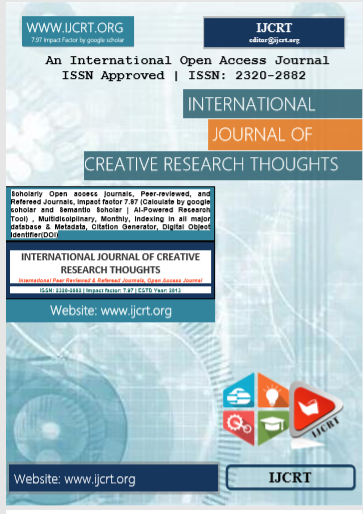 |
 |
|---|---|
| IJCRT Journal front page | IJCRT Journal Back Page |
Paper Title: GENETIC AND REPRODUCTIVE MANIFESTATIONS OF VISHA: CORRELATING AGADA TANTRA WITH MODERN TOXICOLOGY
Author Name(s): Dr. Nitika Kunwar Shaktawat, Prof. (Dr.) Pappu Lal Sharma, Dr. Mithilesh Shakywal
Published Paper ID: - IJCRT2606145
Register Paper ID - 310020
Publisher Journal Name: IJPUBLICATION, IJCRT
DOI Member ID: 10.6084/m9.doi.one.IJCRT2606145 and DOI :
Author Country : Indian Author, India, 313001 , Udaipur, 313001 , | Research Area: Humanities All Published Paper URL: http://ijcrt.org/viewfull.php?&p_id=IJCRT2606145 Published Paper PDF: download.php?file=IJCRT2606145 Published Paper PDF: http://www.ijcrt.org/papers/IJCRT2606145.pdf
Your Paper Publication Details:
Title: GENETIC AND REPRODUCTIVE MANIFESTATIONS OF VISHA: CORRELATING AGADA TANTRA WITH MODERN TOXICOLOGY
DOI (Digital Object Identifier) :
Pubished in Volume: 14 | Issue: 6 | Year: June 2026
Publisher Name : IJCRT | www.ijcrt.org | ISSN : 2320-2882
Subject Area: Humanities All
Author type: Indian Author
Pubished in Volume: 14
Issue: 6
Pages: b284-b300
Year: June 2026
Downloads: 95
E-ISSN Number: 2320-2882
Abstract
Ayurveda, the ancient science of life, describes Visha (toxic substances) as agents capable of disturbing the normal physiological and biochemical functions of the body, ultimately leading to disease and even death if not managed appropriately. Among the various branches of Ayurveda, Agada Tantra deals specifically with the identification, classification, pathogenesis, prevention, and treatment of toxic substances. Classical Ayurvedic texts not only discuss acute poisoning caused by natural toxins (Sthavara and Jangama Visha) but also provide a detailed description of chronic and cumulative toxic states under the concept of Dooshi Visha. Dooshi Visha refers to residual toxins that remain concealed within the body for prolonged periods, gradually affecting different tissues (Dhatus) and physiological systems. According to Ayurvedic principles, these toxins predominantly vitiate Rasa, Rakta, Mamsa, Artava, and Shukra Dhatu, thereby impairing reproductive health and adversely influencing the quality of offspring. The concepts of Beeja (sperm and ovum), Beejabhaga (chromosomal components), and Beejabhagavayava (genetic subunits) described in Ayurveda indicate an advanced understanding of heredity and congenital abnormalities. Classical texts mention that the vitiation of Shukra and Artava by toxic substances can result in infertility, recurrent abortions, fetal malformations, developmental abnormalities, defective progeny, and hereditary disorders. Furthermore, prolonged exposure to incompatible diet (Viruddha Ahara), environmental pollutants, contaminated food, artificial additives, chemicals, and chronic toxins has been conceptually linked with Dooshi Visha, producing systemic and reproductive dysfunctions that may persist across generations. From a modern scientific perspective, reproductive toxicity encompasses adverse effects on sexual function, fertility, hormonal regulation, conception, pregnancy maintenance, embryonic development, and postnatal growth. Similarly, genetic toxicity (genotoxicity) refers to damage inflicted on genetic material, including DNA mutations, chromosomal abnormalities, epigenetic alterations, and heritable genetic defects. Increasing industrialization, environmental contamination, excessive pesticide use, heavy metal exposure, food adulteration, pharmaceutical misuse, radiation exposure, and unhealthy lifestyle practices have significantly contributed to the rising prevalence of infertility, congenital anomalies, endocrine disorders, reproductive dysfunction, and genetic diseases worldwide. Modern toxicological research has demonstrated that chronic low-dose exposure to toxic substances can impair gametogenesis, disrupt endocrine pathways, induce oxidative stress, alter gene expression, damage reproductive organs, and adversely affect fetal development. These findings closely resemble the Ayurvedic description of Dooshi Visha and its long-term effects on reproductive tissues and progeny. The present review critically examines the Ayurvedic concepts of Visha and Dooshi Visha in relation to genetic and reproductive manifestations described in classical texts of Agada Tantra. It further explores the correlation between Ayurvedic principles and contemporary concepts of reproductive and genetic toxicology, including infertility, teratogenicity, mutagenicity, endocrine disruption, congenital malformations, and transgenerational inheritance. Particular emphasis is placed on understanding how chronic toxic exposure affects Shukra and Artava Dhatu, influences fetal development, and contributes to hereditary disorders. The review also highlights the relevance of Ayurvedic detoxification measures, preventive strategies, and lifestyle modifications in minimizing toxic burden and preserving reproductive health. By integrating the classical wisdom of Ayurveda with contemporary scientific evidence, this review attempts to establish a conceptual bridge between Agada Tantra and modern toxicology. Such an interdisciplinary approach may enhance the understanding of toxin-induced reproductive and genetic disorders, provide novel insights into preventive healthcare, and promote the development of integrative strategies for safeguarding reproductive health and ensuring healthy progeny in the modern era.
Licence: creative commons attribution 4.0
License
Creative Commons Attribution 4.0 and The Open Definition

Keywords
Agada Tantra, Visha, Dooshi Visha, Genotoxicity, Reproductive Toxicity, Beejabhaga, Reproductive Health, Ayurvedic Toxicology, Modern Toxicology.
License
Creative Commons Attribution 4.0 and The Open Definition
Paper Title: Neurostride-X: An Adaptive Human-Robot Platform For Dynamic Balance Recovery And Mobility Assistance
Author Name(s): Mahalaxmi Y Sanka, Anusha, Kavya, Eshwari M Patil, Dr.Jyoti R Maranur
Published Paper ID: - IJCRT2606144
Register Paper ID - 310041
Publisher Journal Name: IJPUBLICATION, IJCRT
DOI Member ID: 10.6084/m9.doi.one.IJCRT2606144 and DOI :
Author Country : Indian Author, India, 585102 , kalaburagi, 585102 , | Research Area: Science and Technology Published Paper URL: http://ijcrt.org/viewfull.php?&p_id=IJCRT2606144 Published Paper PDF: download.php?file=IJCRT2606144 Published Paper PDF: http://www.ijcrt.org/papers/IJCRT2606144.pdf
Your Paper Publication Details:
Title: NEUROSTRIDE-X: AN ADAPTIVE HUMAN-ROBOT PLATFORM FOR DYNAMIC BALANCE RECOVERY AND MOBILITY ASSISTANCE
DOI (Digital Object Identifier) :
Pubished in Volume: 14 | Issue: 6 | Year: June 2026
Publisher Name : IJCRT | www.ijcrt.org | ISSN : 2320-2882
Subject Area: Science and Technology
Author type: Indian Author
Pubished in Volume: 14
Issue: 6
Pages: b277-b283
Year: June 2026
Downloads: 88
E-ISSN Number: 2320-2882
Abstract
Robotic balance trainers have emerged as promising rehabilitation technologies for individuals affected by stroke, neurological disorders, age-related mobility decline, and other conditions that impair postural stability. This study presents NeuroStride-X, an adaptive human-robot platform designed to support dynamic balance recovery and mobility assistance through intelligent monitoring and controlled intervention. The proposed system integrates a mobile robotic base, a robotic support mechanism, ultrasonic sensing, Bluetooth communication, and a microcontroller-based control unit to assist users during standing and walking activities. The platform continuously observes body movement and stability conditions, providing support only when imbalance is detected, thereby encouraging natural motor responses and rehabilitation progress. The design emphasizes patient safety, fall prevention, reduced dependence on therapists, and suitability for home-based rehabilitation environments. Adaptive assistance enables improved confidence, mobility, and independence while supporting repetitive training essential for motor recovery. The system combines balance training and gait assistance within a single framework, addressing limitations of conventional rehabilitation methods. The proposed approach contributes toward accessible, cost-effective, and intelligent rehabilitation solutions for enhanced functional recovery outcomes.
Licence: creative commons attribution 4.0
License
Creative Commons Attribution 4.0 and The Open Definition
Keywords
NeuroStride-X, Robotic Balance Trainer, Human-Robot Interaction, Balance Rehabilitation, Mobility Assistance, Adaptive Control, Gait Training, Postural Stability, Rehabilitation Robotics, Assistive Technology.
License
Creative Commons Attribution 4.0 and The Open Definition
Paper Title: Impact of Mobile Marketing on Brand Awareness and Consumer Loyalty in Eastern Uttar Pradesh
Author Name(s): Namrata Kapoor, Dr. Pankaj Dhingra, Dr. Nancy Gupta
Published Paper ID: - IJCRT2606143
Register Paper ID - 310039
Publisher Journal Name: IJPUBLICATION, IJCRT
DOI Member ID: 10.6084/m9.doi.one.IJCRT2606143 and DOI :
Author Country : Indian Author, India, 211006 , Prayagraj, 211006 , | Research Area: Management All Published Paper URL: http://ijcrt.org/viewfull.php?&p_id=IJCRT2606143 Published Paper PDF: download.php?file=IJCRT2606143 Published Paper PDF: http://www.ijcrt.org/papers/IJCRT2606143.pdf
Your Paper Publication Details:
Title: IMPACT OF MOBILE MARKETING ON BRAND AWARENESS AND CONSUMER LOYALTY IN EASTERN UTTAR PRADESH
DOI (Digital Object Identifier) :
Pubished in Volume: 14 | Issue: 6 | Year: June 2026
Publisher Name : IJCRT | www.ijcrt.org | ISSN : 2320-2882
Subject Area: Management All
Author type: Indian Author
Pubished in Volume: 14
Issue: 6
Pages: b262-b276
Year: June 2026
Downloads: 109
E-ISSN Number: 2320-2882
Abstract
The rapid expansion of smartphone access, low-cost mobile data and social media usage has transformed the way consumers interact with brands in India, particularly in semi-urban and emerging regional markets. This study examines the impact of mobile marketing on brand awareness and consumer loyalty in Eastern Uttar Pradesh, focusing on three major districts: Prayagraj, Varanasi and Gorakhpur. A structured questionnaire was administered to 150 respondents, with 50 respondents selected from each district. The study investigates key mobile marketing dimensions such as SMS and WhatsApp promotions, social media advertising, mobile app notifications, personalized offers and influencer-based mobile content. The findings indicate that mobile marketing has a significant positive effect on brand awareness and consumer loyalty. Personalized offers, frequent brand visibility on mobile platforms and interactive communication were found to be especially influential in improving brand recall, trust and repeat purchase intention. The study concludes that mobile marketing is not merely a promotional tool but a relationship-building mechanism in Eastern Uttar Pradesh's digitally evolving consumer market.
Licence: creative commons attribution 4.0
License
Creative Commons Attribution 4.0 and The Open Definition
Keywords
Mobile marketing, brand awareness, consumer loyalty, Eastern Uttar Pradesh, Prayagraj, Varanasi, Gorakhpur, digital marketing, consumer behaviour.
License
Creative Commons Attribution 4.0 and The Open Definition
Paper Title: A CRITICAL ANALYSIS OF COMMUNITY SERVICE AS A FORM OF PUNISHMENT UNDER THE BNS ACT 2023
Author Name(s): S.VARSHINI, M.VIJILA JHONCY
Published Paper ID: - IJCRT2606142
Register Paper ID - 309961
Publisher Journal Name: IJPUBLICATION, IJCRT
DOI Member ID: 10.6084/m9.doi.one.IJCRT2606142 and DOI :
Author Country : Indian Author, India, 637205 , KUMARAMANGALAM, 637205 , | Research Area: Other area not in list Published Paper URL: http://ijcrt.org/viewfull.php?&p_id=IJCRT2606142 Published Paper PDF: download.php?file=IJCRT2606142 Published Paper PDF: http://www.ijcrt.org/papers/IJCRT2606142.pdf
Your Paper Publication Details:
Title: A CRITICAL ANALYSIS OF COMMUNITY SERVICE AS A FORM OF PUNISHMENT UNDER THE BNS ACT 2023
DOI (Digital Object Identifier) :
Pubished in Volume: 14 | Issue: 6 | Year: June 2026
Publisher Name : IJCRT | www.ijcrt.org | ISSN : 2320-2882
Subject Area: Other area not in list
Author type: Indian Author
Pubished in Volume: 14
Issue: 6
Pages: b237-b261
Year: June 2026
Downloads: 127
E-ISSN Number: 2320-2882
Abstract
This study critically analysis the concept of community service as a form of punishment introduced under Section 4(f) of the Bharatiya Nyaya Sanhita (BNS), 2023. It explores the shift from retributive to reformative justice in India, evaluating whether community service aligns with constitutional protections under Articles 21 (Right to Life and Personal Liberty) and 23 (Prohibition of Forced Labour). The research highlights the absence of a statutory definition and detailed procedural framework for implementing community service, raising concerns about potential judicial inconsistency and constitutional violations. Through doctrinal analysis and case law review, the study demonstrates how Indian courts have increasingly endorsed community service, especially for petty offences and first-time offenders, as a tool for rehabilitation and societal reintegration. Drawing from international legal instruments such as the Tokyo and Beijing Rules, the study affirms that while community service is a constitutionally viable and socially constructive penal measure, its success depends on legislative refinement, clear guidelines, and judicial training.
Licence: creative commons attribution 4.0
License
Creative Commons Attribution 4.0 and The Open Definition
Keywords
Community Service, Bharatiya Nyaya Sanhita 2023, Article 21, Article 23, Reformative Justice, Penal Reform, Alternative Sentencing.
License
Creative Commons Attribution 4.0 and The Open Definition
Paper Title: PM College Of Excellence Shaskiya Madhav Kala Evam Vanijya Mahavidyalaya Ujjain MP Muraina Jile Ke Rajvanshon Ka Itihasik Vivechan
Author Name(s): Kamlesh Bairwa, Ruplal Ahirwar
Published Paper ID: - IJCRT2606141
Register Paper ID - 309877
Publisher Journal Name: IJPUBLICATION, IJCRT
DOI Member ID: 10.6084/m9.doi.one.IJCRT2606141 and DOI :
Author Country : Indian Author, India, - , -, - , | Research Area: Arts All Published Paper URL: http://ijcrt.org/viewfull.php?&p_id=IJCRT2606141 Published Paper PDF: download.php?file=IJCRT2606141 Published Paper PDF: http://www.ijcrt.org/papers/IJCRT2606141.pdf
Your Paper Publication Details:
Title: PM COLLEGE OF EXCELLENCE SHASKIYA MADHAV KALA EVAM VANIJYA MAHAVIDYALAYA UJJAIN MP MURAINA JILE KE RAJVANSHON KA ITIHASIK VIVECHAN
DOI (Digital Object Identifier) :
Pubished in Volume: 14 | Issue: 6 | Year: June 2026
Publisher Name : IJCRT | www.ijcrt.org | ISSN : 2320-2882
Subject Area: Arts All
Author type: Indian Author
Pubished in Volume: 14
Issue: 6
Pages: b233-b236
Year: June 2026
Downloads: 80
E-ISSN Number: 2320-2882
Abstract
PM College Of Excellence Shaskiya Madhav Kala Evam Vanijya Mahavidyalaya Ujjain MP Muraina Jile Ke Rajvanshon Ka Itihasik Vivechan
Licence: creative commons attribution 4.0
License
Creative Commons Attribution 4.0 and The Open Definition
Keywords
PM College Of Excellence Shaskiya Madhav Kala Evam Vanijya Mahavidyalaya Ujjain MP Muraina Jile Ke Rajvanshon Ka Itihasik Vivechan
License
Creative Commons Attribution 4.0 and The Open Definition
Paper Title: Mlsd-Iot: A Multi-Layer Stateful Ddos Detection And Mitigation Architecture For Intelligent Iot Security
Author Name(s): Renuka, Navmita, Nityashree, Rekha, Siddaling
Published Paper ID: - IJCRT2606140
Register Paper ID - 309947
Publisher Journal Name: IJPUBLICATION, IJCRT
DOI Member ID: 10.6084/m9.doi.one.IJCRT2606140 and DOI :
Author Country : Indian Author, India, 585102 , kalaburagi, 585102 , | Research Area: Science and Technology Published Paper URL: http://ijcrt.org/viewfull.php?&p_id=IJCRT2606140 Published Paper PDF: download.php?file=IJCRT2606140 Published Paper PDF: http://www.ijcrt.org/papers/IJCRT2606140.pdf
Your Paper Publication Details:
Title: MLSD-IOT: A MULTI-LAYER STATEFUL DDOS DETECTION AND MITIGATION ARCHITECTURE FOR INTELLIGENT IOT SECURITY
DOI (Digital Object Identifier) :
Pubished in Volume: 14 | Issue: 6 | Year: June 2026
Publisher Name : IJCRT | www.ijcrt.org | ISSN : 2320-2882
Subject Area: Science and Technology
Author type: Indian Author
Pubished in Volume: 14
Issue: 6
Pages: b226-b232
Year: June 2026
Downloads: 92
E-ISSN Number: 2320-2882
Abstract
MLSD-IoT (Multi-Layer Stateful DDoS Detection and Mitigation for Intelligent IoT Security) is a security framework designed to identify and mitigate Distributed Denial of Service attacks targeting Internet of Things environments. The rapid growth of interconnected IoT devices has increased network vulnerability to high-volume and low-rate DDoS attacks that can disrupt services, degrade performance, and compromise system availability. This study presents a multi-layer architecture that combines feature selection, machine learning based classification, and stateful traffic analysis for efficient attack detection. Network traffic data are preprocessed, normalized, and analyzed using mutual information based feature selection to identify the most relevant attributes. Multiple machine learning models including Decision Tree, Random Forest, Logistic Regression, Naive Bayes, and Support Vector Machine are evaluated to determine the most effective classifier. The proposed framework performs attack classification, traffic monitoring, and mitigation through layered decision making, improving detection reliability and response efficiency. Experimental evaluation demonstrates high classification accuracy and effective identification of malicious traffic patterns, making the framework suitable for intelligent and scalable IoT network protection.
Licence: creative commons attribution 4.0
License
Creative Commons Attribution 4.0 and The Open Definition
Keywords
MLSD-IoT, Internet of Things, DDoS Detection, Network Security, Stateful Analysis, Machine Learning, Feature Selection, Random Forest, Decision Tree, Traffic Classification, Intrusion Detection, Cybersecurity.
License
Creative Commons Attribution 4.0 and The Open Definition
Paper Title: "Role Of Artificial Intelligence (AI) In Skilling, Upskilling and Reskilling for Life Long Learning."
Author Name(s): DR PRAMOD SINGH CHAUHAN
Published Paper ID: - IJCRT2606139
Register Paper ID - 309932
Publisher Journal Name: IJPUBLICATION, IJCRT
DOI Member ID: 10.6084/m9.doi.one.IJCRT2606139 and DOI :
Author Country : Indian Author, India, 203131 , KHURJA, 203131 , | Research Area: Arts1 All Published Paper URL: http://ijcrt.org/viewfull.php?&p_id=IJCRT2606139 Published Paper PDF: download.php?file=IJCRT2606139 Published Paper PDF: http://www.ijcrt.org/papers/IJCRT2606139.pdf
Your Paper Publication Details:
Title: "ROLE OF ARTIFICIAL INTELLIGENCE (AI) IN SKILLING, UPSKILLING AND RESKILLING FOR LIFE LONG LEARNING."
DOI (Digital Object Identifier) :
Pubished in Volume: 14 | Issue: 6 | Year: June 2026
Publisher Name : IJCRT | www.ijcrt.org | ISSN : 2320-2882
Subject Area: Arts1 All
Author type: Indian Author
Pubished in Volume: 14
Issue: 6
Pages: b216-b225
Year: June 2026
Downloads: 84
E-ISSN Number: 2320-2882
Abstract
Abstract: By providing individualized and flexible learning experiences, artificial intelligence (AI) has the potential to completely transform lifelong learning. AI enables educational systems to better identify the needs and preferences of each unique learner, customizing the delivery and material to maximize learning outcomes. There is room to explore the ethical implications of AI in education and to identify the opportunities and problems related to its deployment. This article looks at how AI may improve teaching and evaluation techniques as well as how it can help with ongoing skill improvement and career advancement. Understanding how AI will affect education in the future and the abilities required for lifelong learning in a world driven by AI is the goal here. Artificial intelligence technology has the potential to revolutionize education through flexible and personalized active learning. However, incorporating artificial intelligence into Internet technologies presents a number of challenges, such as managing the quick pace of technological advancement, inadequate infrastructure, dealing with the problems of diverse learning, protecting data privacy, and integrating AI with current educational frameworks. Artificial intelligence has become essential for lifelong learning in the current technological era, changing how adult access and interact with educational materials. Continuous reskilling and upskilling have become essential due to the IT environment's rapid evolution. AI is therefore positioned as both a facilitator and a disruptor of workforce transformation, requiring governance based on human-centered, ethical, and inclusive design. Automation and rapid technology breakthroughs are changing businesses, highlighting the need for people to learn new skills. Upskilling has become a crucial tactic in the AI era for navigating the changing labor market. Upskilling entails lifelong learning and gaining proficiency in fields that enhance or make use of AI technologies. Upskilling, which is the act of enhancing one's knowledge and abilities to stay relevant and productive in a world where automation and artificial intelligence (AI) are becoming more and more prevalent, has emerged as a critical necessity.
Licence: creative commons attribution 4.0
License
Creative Commons Attribution 4.0 and The Open Definition
Keywords
Artificial Intelligence, Lifelong Learning, Personalized Learning, Adaptive Learning, Skilling, and Reskilling.
License
Creative Commons Attribution 4.0 and The Open Definition
Paper Title: A CONCEPTUAL STUDY ON ECONOMIC TRANSFORMATION OF TRIBAL LIVELIHOODS THROUGH STRATEGIC SKILL DEVELOPMENT INITIATIVES
Author Name(s): Kamalakannan E, Dr.T.Sarathy
Published Paper ID: - IJCRT2606138
Register Paper ID - 309900
Publisher Journal Name: IJPUBLICATION, IJCRT
DOI Member ID: 10.6084/m9.doi.one.IJCRT2606138 and DOI : https://doi.org/10.56975/ijcrt.v14i6.309900
Author Country : Indian Author, India, 636011 , Salem, 636011 , | Research Area: Management All Published Paper URL: http://ijcrt.org/viewfull.php?&p_id=IJCRT2606138 Published Paper PDF: download.php?file=IJCRT2606138 Published Paper PDF: http://www.ijcrt.org/papers/IJCRT2606138.pdf
Your Paper Publication Details:
Title: A CONCEPTUAL STUDY ON ECONOMIC TRANSFORMATION OF TRIBAL LIVELIHOODS THROUGH STRATEGIC SKILL DEVELOPMENT INITIATIVES
DOI (Digital Object Identifier) : https://doi.org/10.56975/ijcrt.v14i6.309900
Pubished in Volume: 14 | Issue: 6 | Year: June 2026
Publisher Name : IJCRT | www.ijcrt.org | ISSN : 2320-2882
Subject Area: Management All
Author type: Indian Author
Pubished in Volume: 14
Issue: 6
Pages: b206-b215
Year: June 2026
Downloads: 105
E-ISSN Number: 2320-2882
Abstract
Tribal communities represent one of the most socio-economically vulnerable populations in developing nations, particularly in India. Despite the presence of numerous welfare programmes and constitutional safeguards, tribal populations continue to experience poverty, unemployment, low educational attainment, social exclusion, and inadequate access to sustainable livelihood opportunities. Traditional livelihood systems that once supported tribal communities are gradually declining due to modernization, environmental degradation, industrial expansion, displacement, and limited market accessibility. In this context, strategic skill development initiatives have emerged as an important mechanism for promoting economic empowerment, employability, entrepreneurship, and sustainable livelihood transformation among tribal populations. This conceptual paper examines the role of strategic skill development initiatives in transforming tribal livelihoods and enhancing economic sustainability. The paper discusses the changing nature of tribal livelihood patterns, the importance of skill-oriented interventions, government and non-government initiatives, digital and vocational training programmes, and the integration of entrepreneurship development for tribal economic empowerment. The study also highlights the major barriers affecting the implementation of skill development programmes in tribal regions, including geographical isolation, educational backwardness, language barriers, digital inequality, and lack of market linkage. The paper is based on conceptual analysis and secondary sources including books, research articles, policy reports, government publications, and development frameworks related to tribal development and skill enhancement. Further, the study proposes a conceptual framework connecting skill development, employability, income generation, economic empowerment, and sustainable tribal livelihood transformation. The findings indicate that strategic skill development initiatives can significantly contribute to improving tribal socio-economic conditions when implemented with localized, inclusive, culturally sensitive, and market-oriented approaches. The paper concludes with policy recommendations for strengthening tribal skill ecosystems and promoting long-term economic transformation among tribal communities.
Licence: creative commons attribution 4.0
License
Creative Commons Attribution 4.0 and The Open Definition
Keywords
Tribal Livelihoods, Economic Transformation, Skill Development, Employability, Tribal Empowerment, Sustainable Development, Vocational Training, Entrepreneurship
License
Creative Commons Attribution 4.0 and The Open Definition
Paper Title: Psychological Determinants of Oral Presentation Skills: The Role of Self-Confidence and Classroom Anxiety in Secondary Students
Author Name(s): Mehanaz Mahamoodha A, Dr.ShabiyaThaseen
Published Paper ID: - IJCRT2606137
Register Paper ID - 309126
Publisher Journal Name: IJPUBLICATION, IJCRT
DOI Member ID: 10.6084/m9.doi.one.IJCRT2606137 and DOI :
Author Country : Indian Author, India, 600018 , chennai, 600018 , | Research Area: Other area not in list Published Paper URL: http://ijcrt.org/viewfull.php?&p_id=IJCRT2606137 Published Paper PDF: download.php?file=IJCRT2606137 Published Paper PDF: http://www.ijcrt.org/papers/IJCRT2606137.pdf
Your Paper Publication Details:
Title: PSYCHOLOGICAL DETERMINANTS OF ORAL PRESENTATION SKILLS: THE ROLE OF SELF-CONFIDENCE AND CLASSROOM ANXIETY IN SECONDARY STUDENTS
DOI (Digital Object Identifier) :
Pubished in Volume: 14 | Issue: 6 | Year: June 2026
Publisher Name : IJCRT | www.ijcrt.org | ISSN : 2320-2882
Subject Area: Other area not in list
Author type: Indian Author
Pubished in Volume: 14
Issue: 6
Pages: b195-b205
Year: June 2026
Downloads: 67
E-ISSN Number: 2320-2882
Abstract
Licence: creative commons attribution 4.0
License
Creative Commons Attribution 4.0 and The Open Definition
Keywords
Classroom anxiety, self-confidence, oral presentation skills, secondary school students.
License
Creative Commons Attribution 4.0 and The Open Definition
Paper Title: Gridhrasi (Sciatica): A Comprehensive Review of Etiopathogenesis and Ayurvedic Management
Author Name(s): DR. GADVE B. N, DR . YOGESH G. KAPSE
Published Paper ID: - IJCRT2606136
Register Paper ID - 309863
Publisher Journal Name: IJPUBLICATION, IJCRT
DOI Member ID: 10.6084/m9.doi.one.IJCRT2606136 and DOI :
Author Country : Indian Author, India, 431001 , CHH SAMBHAJINAGAR, 431001 , | Research Area: Health Science All Published Paper URL: http://ijcrt.org/viewfull.php?&p_id=IJCRT2606136 Published Paper PDF: download.php?file=IJCRT2606136 Published Paper PDF: http://www.ijcrt.org/papers/IJCRT2606136.pdf
Your Paper Publication Details:
Title: GRIDHRASI (SCIATICA): A COMPREHENSIVE REVIEW OF ETIOPATHOGENESIS AND AYURVEDIC MANAGEMENT
DOI (Digital Object Identifier) :
Pubished in Volume: 14 | Issue: 6 | Year: June 2026
Publisher Name : IJCRT | www.ijcrt.org | ISSN : 2320-2882
Subject Area: Health Science All
Author type: Indian Author
Pubished in Volume: 14
Issue: 6
Pages: b187-b194
Year: June 2026
Downloads: 67
E-ISSN Number: 2320-2882
Abstract
Gridhrasi is one of the significant Nanatmaja Vata Vyadhi mentioned in Ayurvedic classics. Radiating pain that begins in the hip area and progressively spreads to the lower limb is its primary characteristic. The clinical presentation of Gridhrasi closely resembles the condition known as sciatica in modern medicine. Sciatica is frequently brought on by disorders such as degenerative spinal disorders, spinal stenosis, and intervertebral disc prolapse that compress or irritate the sciatic nerve. Low back pain and sciatica have become much more commonplace globally due to the rise in sedentary lifestyles, bad posture, and work-related stress. According to Ayurveda, Gridhrasi is a disorder predominantly brought on by Vata Dosha vitiation, which is occasionally linked to Kapha Dosha. The etiological factors, pathogenesis, characteristics, and management principles of this condition all of them are thoroughly described in classical Ayurvedic texts. Gridhrasi is treated with Nidana Parivarjana (avoidance causative factors), Shamana therapy using different herbal formulations, and Shodhana therapy using Basti and Virechana. For pain relief and increased mobility, panchakarma techniques such as Abhyanga, Swedana, Kati Basti, and Patra Pinda Sweda are also advised. The goal of this review is to critically examine Gridhrasi's traditional Ayurvedic concepts and compare them with contemporary knowledge of sciatica. The therapeutic potential of Ayurvedic interventions in the treatment of this condition is also highlighted in the article. Combining lifestyle changes with Ayurvedic treatment principles may offer a comprehensive and successful strategy for managing Gridhrasi and enhancing patients' quality of life.
Licence: creative commons attribution 4.0
License
Creative Commons Attribution 4.0 and The Open Definition
Keywords
Ayurveda, Gridhrasi, Sciatica, Vata Vyadhi, Panchakarma
License
Creative Commons Attribution 4.0 and The Open Definition
Call For Paper August 2026
Call For Papers
August 2026
Volume 14 | Issue 8
Last Date :
31-Aug-2026
Submit Manuscript Online Impact Factor: 7.97 Review Results : Within 02-03 Days Paper Publication : Within 02-03 Days
August 2026
Volume 14 | Issue 8
Last Date :
31-Aug-2026
Submit Manuscript Online Impact Factor: 7.97 Review Results : Within 02-03 Days Paper Publication : Within 02-03 Days
Published Issue Details
For Authors
Forms / Downloads
Other IMP Links
Indexing Partner
Research Area
LICENSE





ISSN and 7.97 Impact Factor Details

ISSN: 2320-2882 Impact Factor: 7.97 and ISSN APPROVED Journal Starting Year (ESTD) : 2013


ISSN and 7.97 Impact Factor Details
ISSN: 2320-2882 Impact Factor: 7.97 and ISSN APPROVED Journal Starting Year (ESTD) : 2013
DOI Details
CONFERENCE
CONFERENCE MANAGMENT & PUBLICATION CONFERENCE PROPOSAL
RECENT CONFERENCE

CONFERENCE PROPOSAL CONFERENCE PROCEEDINGS
CONFERENCE PROPOSAL CONFERENCE PROCEEDINGS
For Reviewer /Referral (RMS) Earn 500 per paper
Important Links
NEWS & Conference
Digital Library
IJCRT RMS | Earn 500 Per Paper.

Open Access


LICENSE
Indexing Partner
Scholarly open access journals, Peer-reviewed, and Refereed Journals, Impact factor 7.97 (Calculate by google scholar and Semantic Scholar | AI-Powered Research Tool) , Multidisciplinary, Monthly, Indexing in all major database & Metadata, Citation Generator, Digital Object Identifier(DOI)