Important Details
IJCRT - International Peer Reviewed, Open Access Journal, Multidisciplinary, Monthly, Nominal(Low) Fees for Professional Research Services International Journal of Creative Research Thoughts - IJCRT Peer Review Journal, Refereed Journal, Peer Reviewed Journal , Referred Journal and Indexed Journal, Open access, Online and Print Journal,international Journal Open Access, Accepted by Indian and foreign university ,IJCRT Followed Norms, guidelines, requirement, listing criteria and methodology of score/point also applied from: Scopus , Web of Science , UGC Approved , UGC CARE, UGC-CARE .
UGC Approved Journal No: 49023 (18)
UGC approval Link
https://ijcrt.org/ugc%20approval.jpg
All Policy and Approval
Please Like Our Facebook Page | CrossRef DOI and Hard copy of Certificate Provide if required. | www.IJCRT.org | editor@IJCRT.org | WhatsApp: 7990172303
Publication Details:
- Paper Submission : 31-Mar-2026. Call For Paper (Volume 14 | Issue 3 | Month- March 2026)
- Acceptance/Rejection Notification: Within 02-04 Days.
- Paper Publish: Within 02-04 Days after submitting all documents.
-
Submit Your Paper Any time There No deadline.
-
Publication fees : 1570 INR for Indian author & 59$ for foreign International author.
Please Like Our Facebook Page | CrossRef DOI and Hard copy of Certificate Provide if required.
Licence and Indexing
Indexing In Google Scholar, SSRN, ResearcherID-Publons, Semantic Scholar | AI-Powered Research Tool, Microsoft Academic, Academia.edu, arXiv.org, Research Gate, CiteSeerX, ResearcherID Thomson Reuters, Mendeley : reference manager, DocStoc, ISSUU, Scribd, and many more | High Impact Factor: 7.97 | Digital object identifier (DOI) and Hard Copy of certificate Provided.




























Licence
DOI
ISSN Approved impact factor: 7.97 
Creative Common 
Valid as per new UGC Gazette regulations 

INTERNATIONAL JOURNAL OF CREATIVE RESEARCH THOUGHTS - IJCRT (IJCRT.ORG)
International Peer Reviewed & Refereed Journals, Open Access Journal
IJCRT Peer-Reviewed (Refereed) Journal as Per New UGC Rules.
ISSN Approved Journal No: 2320-2882 | Impact factor: 7.97 | ESTD Year: 2013
Call For Paper - Volume 14 | Issue 3 | Month- March 2026
Scholarly open access journals, Peer-reviewed, and Refereed Journals, Impact factor 7.97 (Calculate by google scholar and Semantic Scholar | AI-Powered Research Tool) , Multidisciplinary, Monthly, Indexing in all major database & Metadata, Citation Generator, Digital Object Identifier(CrossRef DOI)
Contact Us Click Here
WhatsApp Contact Click Here
IJCRT Search Xplore - Search all paper by Paper Name , Author Name, and Title
Volume 14 | Issue 3 |
Volume 14 | Issue 3 | Month
Downlaod After Publication 1) Table of content index in PDF
2) Table of content index in HTML 2)Table of content index in HTML
3) Front Page 3) Front Page
4) Back Page 4) Back Page
5) Editor Board Member 5)Editor Board Member
6) OLD Style Issue 6)OLD Style Issue
 |
 |
|---|---|
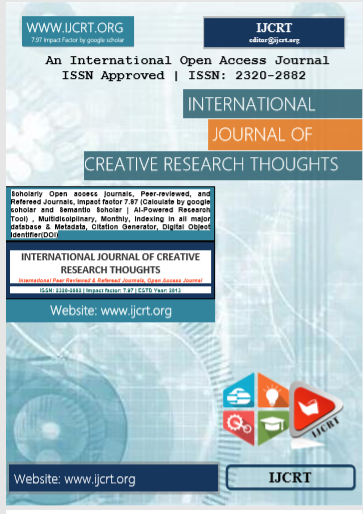
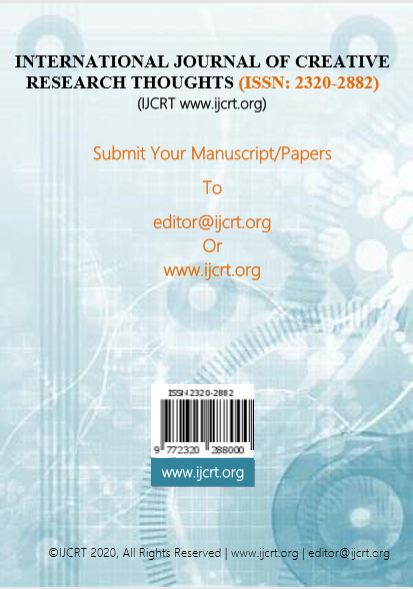
| IJCRT Journal front page | IJCRT Journal Back Page |
Paper Title: A Study On Neo Banking And Its Impact On The Overall Financial Landscape
Author Name(s): Akshay v Kumar
Published Paper ID: - IJCRT21X0387
Register Paper ID - 299845
Publisher Journal Name: IJPUBLICATION, IJCRT
DOI Member ID: 10.6084/m9.doi.one.IJCRT21X0387 and DOI :
Author Country : Indian Author, India, 689124 , Allapuzha, 689124 , | Research Area: Commerce and Management, MBA All Branch Published Paper URL: http://ijcrt.org/viewfull.php?&p_id=IJCRT21X0387 Published Paper PDF: download.php?file=IJCRT21X0387 Published Paper PDF: http://www.ijcrt.org/papers/IJCRT21X0387.pdf
Your Paper Publication Details:
Title: A STUDY ON NEO BANKING AND ITS IMPACT ON THE OVERALL FINANCIAL LANDSCAPE
DOI (Digital Object Identifier) :
Pubished in Volume: 14 | Issue: 3 | Year: March 2026
Publisher Name : IJCRT | www.ijcrt.org | ISSN : 2320-2882
Subject Area: Commerce and Management, MBA All Branch
Author type: Indian Author
Pubished in Volume: 14
Issue: 3
Pages: v377-v410
Year: March 2026
Downloads: 69
E-ISSN Number: 2320-2882
Abstract
The global financial industry is witnessing a paradigm shift with the emergence of neo-banks--digital-only financial institutions that operate without physical branches. These banks leverage cutting-edge technologies like AI, big data, and cloud computing to offer personalized, low-cost services with superior user experiences. This research provides a descriptive analysis of the neo-banking model, investigating its unique characteristics compared to conventional banking and evaluating its impact on market dynamics and financial inclusion. While neo-banks drive significant innovation and accessibility, particularly for underserved populations, they face critical challenges in long-term profitability, cybersecurity, and regulatory alignment. The findings suggest a future characterized by convergence, where "hybrid" models blending traditional trust with digital agility will define the financial landscape.
Licence: creative commons attribution 4.0
License
Creative Commons Attribution 4.0 and The Open Definition

Keywords
Neo-banking, Digital Banking, Financial Inclusion, Fintech Innovation, Banking Regulation, Cybersecurity, API-driven Architecture, Hybrid Banking Models
License
Creative Commons Attribution 4.0 and The Open Definition
Paper Title: Assessing Financial Literacy Among College Students
Author Name(s): S Samyuktha
Published Paper ID: - IJCRT21X0386
Register Paper ID - 299774
Publisher Journal Name: IJPUBLICATION, IJCRT
DOI Member ID: 10.6084/m9.doi.one.IJCRT21X0386 and DOI :
Author Country : Indian Author, India, 683501 , Ernakulam, 683501 , | Research Area: Other area not in list Published Paper URL: http://ijcrt.org/viewfull.php?&p_id=IJCRT21X0386 Published Paper PDF: download.php?file=IJCRT21X0386 Published Paper PDF: http://www.ijcrt.org/papers/IJCRT21X0386.pdf
Your Paper Publication Details:
Title: ASSESSING FINANCIAL LITERACY AMONG COLLEGE STUDENTS
DOI (Digital Object Identifier) :
Pubished in Volume: 14 | Issue: 3 | Year: March 2026
Publisher Name : IJCRT | www.ijcrt.org | ISSN : 2320-2882
Subject Area: Other area not in list
Author type: Indian Author
Pubished in Volume: 14
Issue: 3
Pages: v333-v376
Year: March 2026
Downloads: 76
E-ISSN Number: 2320-2882
Abstract
In the contemporary era, financial literacy has become an essential life skill. It influences an individual's capacity to make sound financial choices, handle finances efficiently, and establish plans for future financial stability. In a globalized economy where financial products and digital payment systems are rapidly evolving, understanding fundamental financial concepts is indispensable. Among youth, particularly college students, financial literacy forms the foundation for developing responsible financial behaviour and avoiding financial distress later in life. This study, titled "Assessing Financial Literacy among College Students: A Study on Basic Understanding of Financial Concepts," aims to evaluate the level of financial awareness among students in Kochi. It focuses on assessing their understanding of essential topics such as budgeting, interest, inflation, savings, credit management, taxation, and digital payments. The research also seeks to identify gaps in their knowledge and suggest educational strategies to enhance financial literacy among college students across different disciplines. Given the increasing exposure of young adults to digital finance platforms, online banking, and credit-based consumption, this study assumes greater importance. It intends to provide insights into how well-equipped students are to manage financial responsibilities and how educational institutions can incorporate structured financial education programs to prepare them for real-world financial decision-making.
Licence: creative commons attribution 4.0
License
Creative Commons Attribution 4.0 and The Open Definition
Keywords
Financial Literacy, financial awareness, credit management, digital financial literacy, financial behaviour, financial education
License
Creative Commons Attribution 4.0 and The Open Definition
Call For Paper March 2026
Call For Papers
March 2026
Volume 14 | Issue 3
Last Date :
31-Mar-2026
Submit Manuscript Online Impact Factor: 7.97 Review Results : Within 02-03 Days Paper Publication : Within 02-03 Days
March 2026
Volume 14 | Issue 3
Last Date :
31-Mar-2026
Submit Manuscript Online Impact Factor: 7.97 Review Results : Within 02-03 Days Paper Publication : Within 02-03 Days
Published Issue Details
For Authors
Forms / Downloads
Other IMP Links
Indexing Partner
Research Area
LICENSE





ISSN and 7.97 Impact Factor Details

ISSN: 2320-2882 Impact Factor: 7.97 and ISSN APPROVED Journal Starting Year (ESTD) : 2013


ISSN and 7.97 Impact Factor Details
ISSN: 2320-2882 Impact Factor: 7.97 and ISSN APPROVED Journal Starting Year (ESTD) : 2013
DOI Details
CONFERENCE
CONFERENCE MANAGMENT & PUBLICATION CONFERENCE PROPOSAL
RECENT CONFERENCE

CONFERENCE PROPOSAL CONFERENCE PROCEEDINGS
CONFERENCE PROPOSAL CONFERENCE PROCEEDINGS
For Reviewer /Referral (RMS) Earn 500 per paper
Important Links
NEWS & Conference
Digital Library
IJCRT RMS | Earn 500 Per Paper.

Open Access


LICENSE
Indexing Partner
Scholarly open access journals, Peer-reviewed, and Refereed Journals, Impact factor 7.97 (Calculate by google scholar and Semantic Scholar | AI-Powered Research Tool) , Multidisciplinary, Monthly, Indexing in all major database & Metadata, Citation Generator, Digital Object Identifier(DOI)