Important Details
IJCRT - International Peer Reviewed, Open Access Journal, Multidisciplinary, Monthly, Nominal(Low) Fees for Professional Research Services International Journal of Creative Research Thoughts - IJCRT Peer Review Journal, Refereed Journal, Peer Reviewed Journal , Referred Journal and Indexed Journal, Open access, Online and Print Journal,international Journal Open Access, Accepted by Indian and foreign university ,IJCRT Followed Norms, guidelines, requirement, listing criteria and methodology of score/point also applied from: Scopus , Web of Science , UGC Approved , UGC CARE, UGC-CARE .
UGC Approved Journal No: 49023 (18)
UGC approval Link
https://ijcrt.org/ugc%20approval.jpg
All Policy and Approval
Please Like Our Facebook Page | CrossRef DOI and Hard copy of Certificate Provide if required. | www.IJCRT.org | editor@IJCRT.org | WhatsApp: 7990172303
Publication Details:
- Paper Submission : 31-Mar-2026. Call For Paper (Volume 14 | Issue 3 | Month- March 2026)
- Acceptance/Rejection Notification: Within 02-04 Days.
- Paper Publish: Within 02-04 Days after submitting all documents.
-
Submit Your Paper Any time There No deadline.
-
Publication fees : 1570 INR for Indian author & 59$ for foreign International author.
Please Like Our Facebook Page | CrossRef DOI and Hard copy of Certificate Provide if required.
Licence and Indexing
Indexing In Google Scholar, SSRN, ResearcherID-Publons, Semantic Scholar | AI-Powered Research Tool, Microsoft Academic, Academia.edu, arXiv.org, Research Gate, CiteSeerX, ResearcherID Thomson Reuters, Mendeley : reference manager, DocStoc, ISSUU, Scribd, and many more | High Impact Factor: 7.97 | Digital object identifier (DOI) and Hard Copy of certificate Provided.




























Licence
DOI
ISSN Approved impact factor: 7.97 
Creative Common 
Valid as per new UGC Gazette regulations 

INTERNATIONAL JOURNAL OF CREATIVE RESEARCH THOUGHTS - IJCRT (IJCRT.ORG)
International Peer Reviewed & Refereed Journals, Open Access Journal
IJCRT Peer-Reviewed (Refereed) Journal as Per New UGC Rules.
ISSN Approved Journal No: 2320-2882 | Impact factor: 7.97 | ESTD Year: 2013
Call For Paper - Volume 14 | Issue 3 | Month- March 2026
Scholarly open access journals, Peer-reviewed, and Refereed Journals, Impact factor 7.97 (Calculate by google scholar and Semantic Scholar | AI-Powered Research Tool) , Multidisciplinary, Monthly, Indexing in all major database & Metadata, Citation Generator, Digital Object Identifier(CrossRef DOI)
Contact Us Click Here
WhatsApp Contact Click Here
IJCRT Search Xplore - Search all paper by Paper Name , Author Name, and Title
Volume 14 | Issue 3 |
Volume 14 | Issue 3 | Month
Downlaod After Publication 1) Table of content index in PDF
2) Table of content index in HTML 2)Table of content index in HTML
3) Front Page 3) Front Page
4) Back Page 4) Back Page
5) Editor Board Member 5)Editor Board Member
6) OLD Style Issue 6)OLD Style Issue
 |
 |
|---|---|
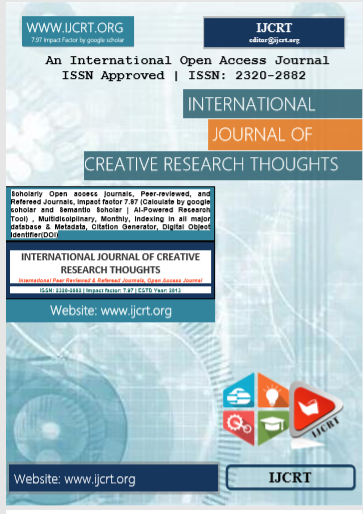
| IJCRT Journal front page | IJCRT Journal Back Page |
Paper Title: Repression and the Crisis of Identity in Late Nineteenth-Century Gothic Literature
Author Name(s): Shreya Anand, Prof. (Dr.) Jayatee Bhattacharya
Published Paper ID: - IJCRT2603110
Register Paper ID - 302562
Publisher Journal Name: IJPUBLICATION, IJCRT
DOI Member ID: 10.6084/m9.doi.one.IJCRT2603110 and DOI :
Author Country : Indian Author, India, 110034 , Delhi, 110034 , | Research Area: Medical Science All Published Paper URL: http://ijcrt.org/viewfull.php?&p_id=IJCRT2603110 Published Paper PDF: download.php?file=IJCRT2603110 Published Paper PDF: http://www.ijcrt.org/papers/IJCRT2603110.pdf
Your Paper Publication Details:
Title: REPRESSION AND THE CRISIS OF IDENTITY IN LATE NINETEENTH-CENTURY GOTHIC LITERATURE
DOI (Digital Object Identifier) :
Pubished in Volume: 14 | Issue: 3 | Year: March 2026
Publisher Name : IJCRT | www.ijcrt.org | ISSN : 2320-2882
Subject Area: Medical Science All
Author type: Indian Author
Pubished in Volume: 14
Issue: 3
Pages: a891-a898
Year: March 2026
Downloads: 22
E-ISSN Number: 2320-2882
Abstract
With an emphasis on The Strange Case of Dr. Jekyll and Mr. Hyde and The Picture of Dorian Gray, this essay explores the connection between repression and identity crises in late nineteenth-century Gothic fiction. These books, which emerged from the moral and cultural conflicts of the Victorian era, depict a society that encouraged the concealing of socially inappropriate urges while demanding external respectability. The idea of a cohesive self is eventually undermined by such repression, which causes a psychological struggle between private urge and public identity. This study examines how both Stevenson and Wilde depict identity as brittle and divided when moral and emotional urges are repressed rather than integrated through in-depth textual analysis guided by psychoanalytic viewpoints. In Stevenson's story, suppression takes the form of Jekyll and Hyde's bodily separation, signifying the effort to separate impulse from morality. In Wilde's book, Dorian Gray's image serves as a metaphor for the accumulation of covert corruption while the protagonist pretends to be innocent. Both pieces demonstrate how repression exacerbates internal conflict and results in an identity crisis, despite their disparate narrative techniques. The study makes the case that Gothic fiction reveals the psychological effects of a society that prioritizes moral image over emotional authenticity by looking at various depictions.
Licence: creative commons attribution 4.0
License
Creative Commons Attribution 4.0 and The Open Definition

Paper Title: Reconfiguring The Human-Nonhuman Boundary In Frankenstein And Frankissstein: A Posthumanist Perspective
Author Name(s): Ann Riya Saji, Dr Tanu Kashyap
Published Paper ID: - IJCRT2603109
Register Paper ID - 302570
Publisher Journal Name: IJPUBLICATION, IJCRT
DOI Member ID: 10.6084/m9.doi.one.IJCRT2603109 and DOI :
Author Country : Indian Author, India, 110096 , Delhi, 110096 , | Research Area: Medical Science All Published Paper URL: http://ijcrt.org/viewfull.php?&p_id=IJCRT2603109 Published Paper PDF: download.php?file=IJCRT2603109 Published Paper PDF: http://www.ijcrt.org/papers/IJCRT2603109.pdf
Your Paper Publication Details:
Title: RECONFIGURING THE HUMAN-NONHUMAN BOUNDARY IN FRANKENSTEIN AND FRANKISSSTEIN: A POSTHUMANIST PERSPECTIVE
DOI (Digital Object Identifier) :
Pubished in Volume: 14 | Issue: 3 | Year: March 2026
Publisher Name : IJCRT | www.ijcrt.org | ISSN : 2320-2882
Subject Area: Medical Science All
Author type: Indian Author
Pubished in Volume: 14
Issue: 3
Pages: a886-a890
Year: March 2026
Downloads: 24
E-ISSN Number: 2320-2882
Abstract
This study compares Mary Shelley's Frankenstein (1818) and Jeanette Winterson's Frankissstein (2019) through the posthuman theory of Rosi Braidotti. It questions the traditional humanist belief that humans are autonomous, superior, and separate from other forms of life. Using close textual analysis, the research examines Victor Frankenstein's experiment and the Creature's emotional and physical suffering, alongside Winterson's exploration of artificial intelligence, cryonics, and emerging technologies. Through Braidotti's concepts of post-anthropocentrism and relational subjectivity, the study argues that both novels destabilize the boundary between human and nonhuman, natural and artificial. While Shelley anticipates these concerns in a nineteenth-century scientific context, Winterson revisits them within contemporary technological culture.
Licence: creative commons attribution 4.0
License
Creative Commons Attribution 4.0 and The Open Definition
Keywords
Keywords: Posthumanism; Human-Nonhuman Boundary; Identity; Artificial Intelligence; Anthropocentrism; Ethics; Technology; Relational Subjectivity.
License
Creative Commons Attribution 4.0 and The Open Definition
Paper Title: PEER-TO-PEER LENDING AND TRADITIONAL BANK CREDIT IN INDIA: SUBSTITUTES OR COMPLEMENTS? AN EMPIRICAL INVESTIGATION USING REGULATORY SHOCKS
Author Name(s): Deepak Kumar Prasad
Published Paper ID: - IJCRT2603108
Register Paper ID - 302525
Publisher Journal Name: IJPUBLICATION, IJCRT
DOI Member ID: 10.6084/m9.doi.one.IJCRT2603108 and DOI : https://doi.org/10.56975/ijcrt.v14i3.302525
Author Country : Indian Author, India, 712222 , Baidyabati, 712222 , | Research Area: Commerce All Published Paper URL: http://ijcrt.org/viewfull.php?&p_id=IJCRT2603108 Published Paper PDF: download.php?file=IJCRT2603108 Published Paper PDF: http://www.ijcrt.org/papers/IJCRT2603108.pdf
Your Paper Publication Details:
Title: PEER-TO-PEER LENDING AND TRADITIONAL BANK CREDIT IN INDIA: SUBSTITUTES OR COMPLEMENTS? AN EMPIRICAL INVESTIGATION USING REGULATORY SHOCKS
DOI (Digital Object Identifier) : https://doi.org/10.56975/ijcrt.v14i3.302525
Pubished in Volume: 14 | Issue: 3 | Year: March 2026
Publisher Name : IJCRT | www.ijcrt.org | ISSN : 2320-2882
Subject Area: Commerce All
Author type: Indian Author
Pubished in Volume: 14
Issue: 3
Pages: a875-a885
Year: March 2026
Downloads: 58
E-ISSN Number: 2320-2882
Abstract
This study examined whether peer-to-peer (P2P) lending in India acts as a substitute for or a complement to conventional bank credit. P2P platforms in India operate under the Reserve Bank of India (RBI) framework as NBFC-P2P entities and are prohibited from accepting deposits, lending from their own balance sheets, or providing credit guarantees. Two significant regulatory events were used for empirical identification: the tightening of risk weights on unsecured consumer credit by the RBI in November 2023, and the revision of conduct and disclosure norms for NBFC-P2P platforms in August 2024. Using event-study and difference-in-differences (DiD) methods robust to staggered timing and heterogeneous treatment effects, the study tested whether P2P lending volumes increased when bank consumer credit supply was restricted and whether bank credit expanded in overlapping segments when P2P activity was curtailed. Data access constraints relating to RBI-hosted attachments and fragmented platform disclosures meant that all reported coefficients are simulated placeholders, clearly labelled as such throughout. The study offers substantive insights for India's financial stability agenda, consumer protection frameworks, and the evolving role of credit information reporting infrastructure.
Licence: creative commons attribution 4.0
License
Creative Commons Attribution 4.0 and The Open Definition
Keywords
Peer-to-peer lending, fintech credit, NBFC-P2P, bank credit supply, difference-in-differences, event study, consumer credit regulation, India, credit information reporting
License
Creative Commons Attribution 4.0 and The Open Definition
Paper Title: STRESS HORMONES AND DOSHA PRAKOPA: AN AYURVEDIC - NEUROENDOCRINE HYPOTHETICAL FRAMEWORK
Author Name(s): Dr. Pranjal Devendra Raorane, Dr. Suraj Ishwar Shirsath
Published Paper ID: - IJCRT2603107
Register Paper ID - 302515
Publisher Journal Name: IJPUBLICATION, IJCRT
DOI Member ID: 10.6084/m9.doi.one.IJCRT2603107 and DOI :
Author Country : Indian Author, India, 415722 , Lote, 415722 , | Research Area: Health Science All Published Paper URL: http://ijcrt.org/viewfull.php?&p_id=IJCRT2603107 Published Paper PDF: download.php?file=IJCRT2603107 Published Paper PDF: http://www.ijcrt.org/papers/IJCRT2603107.pdf
Your Paper Publication Details:
Title: STRESS HORMONES AND DOSHA PRAKOPA: AN AYURVEDIC - NEUROENDOCRINE HYPOTHETICAL FRAMEWORK
DOI (Digital Object Identifier) :
Pubished in Volume: 14 | Issue: 3 | Year: March 2026
Publisher Name : IJCRT | www.ijcrt.org | ISSN : 2320-2882
Subject Area: Health Science All
Author type: Indian Author
Pubished in Volume: 14
Issue: 3
Pages: a872-a874
Year: March 2026
Downloads: 27
E-ISSN Number: 2320-2882
Abstract
Psychological and physiological stress is a well-established contributor to the onset and progression of multiple chronic disorders, mediated primarily through neuroendocrine pathways involving stress hormones such as cortisol, adrenaline, and noradrenaline. Despite extensive biomedical research, individual variability in stress response and disease susceptibility remains inadequately explained. Ayurveda, through its holistic understanding of mind-body interaction, offers a constitution-based framework that may elucidate this variability. This paper proposes a hypothetical framework correlating stress hormone dysregulation with Dosha Prakopa, emphasizing the role of Manasika Nidana, Agni, Ojas, and Srotas. Classical Ayurvedic concepts such as Chinta, Bhaya, Krodha, Shoka, and Vishada are examined alongside modern stress physiology, particularly hypothalamic-pituitary-adrenal (HPA) axis activation. A Dosha-specific interpretation of stress hormone effects is proposed, suggesting that chronic stress leads to predictable Dosha imbalance patterns depending on individual Prakriti. By integrating Ayurvedic psychopathology with contemporary neuroendocrinology, this conceptual model provides a novel explanation for stress-related disorders and inter-individual variability in stress resilience. The framework highlights potential clinical and research implications, including personalized stress management, preventive strategies, and integrative therapeutic approaches. The hypothesis warrants further validation through observational, clinical, and experimental studies.
Licence: creative commons attribution 4.0
License
Creative Commons Attribution 4.0 and The Open Definition
Keywords
Stress Hormones; Dosha Prakopa; Cortisol; HPA Axis; Manas Roga; Prakriti; Ayurveda; Psychoneuroendocrinology
License
Creative Commons Attribution 4.0 and The Open Definition
Paper Title: ROLE OF PRAKRITI IN DRUG RESISTANCE: AN AYURVEDIC HYPOTHESIS
Author Name(s): Dr. Pranjal Devendra Raorane, Dr. Nayanesh D. Kambale
Published Paper ID: - IJCRT2603106
Register Paper ID - 302518
Publisher Journal Name: IJPUBLICATION, IJCRT
DOI Member ID: 10.6084/m9.doi.one.IJCRT2603106 and DOI :
Author Country : Indian Author, India, 415722 , Khed, 415722 , | Research Area: Health Science All Published Paper URL: http://ijcrt.org/viewfull.php?&p_id=IJCRT2603106 Published Paper PDF: download.php?file=IJCRT2603106 Published Paper PDF: http://www.ijcrt.org/papers/IJCRT2603106.pdf
Your Paper Publication Details:
Title: ROLE OF PRAKRITI IN DRUG RESISTANCE: AN AYURVEDIC HYPOTHESIS
DOI (Digital Object Identifier) :
Pubished in Volume: 14 | Issue: 3 | Year: March 2026
Publisher Name : IJCRT | www.ijcrt.org | ISSN : 2320-2882
Subject Area: Health Science All
Author type: Indian Author
Pubished in Volume: 14
Issue: 3
Pages: a868-a871
Year: March 2026
Downloads: 33
E-ISSN Number: 2320-2882
Abstract
Drug resistance has emerged as a major challenge in the management of chronic, infectious, metabolic, and inflammatory diseases in contemporary medicine. Despite appropriate diagnosis and standard therapeutic regimens, a subset of patients shows poor or diminishing response to pharmacological interventions. Ayurveda, with its individualized approach to diagnosis and treatment, offers a unique framework to understand inter-individual variability in drug response through the concept of Prakriti. Prakriti, the innate psychosomatic constitution of an individual determined at conception, governs physiological functions, metabolic capacity, disease susceptibility, and therapeutic responsiveness. This paper proposes an Ayurvedic hypothesis that drug resistance may be partially explained by Prakriti-specific variations in Agni, Dhatu Paka, Srotas, and Koshta, leading to altered drug assimilation, metabolism, distribution, and action. The article critically examines classical Ayurvedic principles, correlates them with contemporary concepts of pharmacogenomics and personalized medicine, and proposes a Prakriti-based model for understanding drug resistance. This conceptual framework opens new avenues for integrative research, individualized therapeutics, and optimized drug selection in both Ayurveda and modern medicine.
Licence: creative commons attribution 4.0
License
Creative Commons Attribution 4.0 and The Open Definition
Keywords
Prakriti; Drug Resistance; Personalized Medicine; Agni; Pharmacogenomics; Kayachikitsa; Ayurveda
License
Creative Commons Attribution 4.0 and The Open Definition
Paper Title: A SECURE INFRASTRUCTURE FOR REGULATING AND MONETIZING AI WEB CRAWLERS
Author Name(s): Adhithyan E, Ashwin k, Athil s, Larry lysander V G, Sri Roopini U
Published Paper ID: - IJCRT2603105
Register Paper ID - 302348
Publisher Journal Name: IJPUBLICATION, IJCRT
DOI Member ID: 10.6084/m9.doi.one.IJCRT2603105 and DOI :
Author Country : Indian Author, India, 641021 , coimbatore, 641021 , | Research Area: Science and Technology Published Paper URL: http://ijcrt.org/viewfull.php?&p_id=IJCRT2603105 Published Paper PDF: download.php?file=IJCRT2603105 Published Paper PDF: http://www.ijcrt.org/papers/IJCRT2603105.pdf
Your Paper Publication Details:
Title: A SECURE INFRASTRUCTURE FOR REGULATING AND MONETIZING AI WEB CRAWLERS
DOI (Digital Object Identifier) :
Pubished in Volume: 14 | Issue: 3 | Year: March 2026
Publisher Name : IJCRT | www.ijcrt.org | ISSN : 2320-2882
Subject Area: Science and Technology
Author type: Indian Author
Pubished in Volume: 14
Issue: 3
Pages: a862-a867
Year: March 2026
Downloads: 31
E-ISSN Number: 2320-2882
Abstract
The rapid growth of artificial intelligence (AI) systems and automated web crawlers has created significant challenges for website owners, including uncontrolled data scraping, server overload, and lack of fair compensation for content usage. Existing crawler control mechanisms such as robots.txt and IP blocking are limited and ineffective against advanced AI crawlers. This project addresses these challenges by proposing a secure infrastructure to regulate AI web crawlers while enabling monetization of web access, ensuring ethical and controlled data consumption. The proposed system introduces an authentication and access control layer that verifies crawler identity, enforces usage policies, and applies rate limiting based on predefined rules. Each crawl request is tracked and validated through a pay-per-crawl mechanism, allowing website owners to charge AI crawlers for accessing their content. Secure verification methods and transaction logging ensure transparency, prevent misuse, and protect both crawler operators and content providers. By combining regulation and monetization into a single framework, this project transforms traditional web crawling into a structured and accountable process, promoting a sustainable, secure, and mutually beneficial ecosystem for AI web crawling.
Licence: creative commons attribution 4.0
License
Creative Commons Attribution 4.0 and The Open Definition
Keywords
AI Web Crawlers, Web Crawling Regulation, Data Monetization, Secure Infrastructure, Crawler Authentication, Access Control, Pay-Per-Crawl Model, Rate Limiting, Policy Enforcement, Ethical Data Usage, Web Data Protection, Usage Monitoring, Micropayments, Website Security, API-Based Access, Transparency and Accountability, Crawler Behaviour Analysis, Data Licensing, Digital Resource Protection, Sustainable AI Ecosystem.
License
Creative Commons Attribution 4.0 and The Open Definition
Paper Title: Artificial Intelligence and Colour Psychology: A Systematic Review of Algorithmic Colour Selection and Emotional Outcomes
Author Name(s): Karpagam K, Ajisha Bhasi
Published Paper ID: - IJCRT2603104
Register Paper ID - 302579
Publisher Journal Name: IJPUBLICATION, IJCRT
DOI Member ID: 10.6084/m9.doi.one.IJCRT2603104 and DOI :
Author Country : Indian Author, India, 695581 , Trivandrum, 695581 , | Research Area: Health Science All Published Paper URL: http://ijcrt.org/viewfull.php?&p_id=IJCRT2603104 Published Paper PDF: download.php?file=IJCRT2603104 Published Paper PDF: http://www.ijcrt.org/papers/IJCRT2603104.pdf
Your Paper Publication Details:
Title: ARTIFICIAL INTELLIGENCE AND COLOUR PSYCHOLOGY: A SYSTEMATIC REVIEW OF ALGORITHMIC COLOUR SELECTION AND EMOTIONAL OUTCOMES
DOI (Digital Object Identifier) :
Pubished in Volume: 14 | Issue: 3 | Year: March 2026
Publisher Name : IJCRT | www.ijcrt.org | ISSN : 2320-2882
Subject Area: Health Science All
Author type: Indian Author
Pubished in Volume: 14
Issue: 3
Pages: a838-a861
Year: March 2026
Downloads: 32
E-ISSN Number: 2320-2882
Abstract
Despite the significant application of Artificial Intelligence (AI) in generating color palettes for digital communication, the emotional and psychological outcomes of these AI-selected colors remain largely unexplored (Guo et al., 2023; Rishu & Kukreja, 2025). This systematic review is a part of the effort to find out the influence of AI-driven color selection methods on the emotional responses of humans in digital climate environments. Peer-reviewed studies published between 2020 and 2025 were identified across major scientific databases, focusing on research that links AI-based colour recommendation to emotional responses such as mood, arousal, and valence, etc. The quality of the studies and the eligibility criteria were judged based on predefined systematic review guidelines. The findings clarify in what ways AI-selected colors differ from those chosen by humans in terms of creating emotional experiences, with an emphasis on methodological difficulties and locating gaps for the upcoming studies. Hence, this review is expected to facilitate the development of a more human- centered and ethically sound approach to AI use in visual ?????design.
Licence: creative commons attribution 4.0
License
Creative Commons Attribution 4.0 and The Open Definition
Keywords
Artificial Intelligence, colour psychology, emotional response, colour palette generation, systematic review.
License
Creative Commons Attribution 4.0 and The Open Definition
Paper Title: STUDIES OF SILVEROXIDE NANOPARTICLES FROM ORANGE PEEL
Author Name(s): Dr.K.Priya Rajini, Dr.M.Mary Sheeba
Published Paper ID: - IJCRT2603103
Register Paper ID - 302411
Publisher Journal Name: IJPUBLICATION, IJCRT
DOI Member ID: 10.6084/m9.doi.one.IJCRT2603103 and DOI :
Author Country : Indian Author, India, 629153 , Marthandam , 629153 , | Research Area: Chemistry All Published Paper URL: http://ijcrt.org/viewfull.php?&p_id=IJCRT2603103 Published Paper PDF: download.php?file=IJCRT2603103 Published Paper PDF: http://www.ijcrt.org/papers/IJCRT2603103.pdf
Your Paper Publication Details:
Title: STUDIES OF SILVEROXIDE NANOPARTICLES FROM ORANGE PEEL
DOI (Digital Object Identifier) :
Pubished in Volume: 14 | Issue: 3 | Year: March 2026
Publisher Name : IJCRT | www.ijcrt.org | ISSN : 2320-2882
Subject Area: Chemistry All
Author type: Indian Author
Pubished in Volume: 14
Issue: 3
Pages: a831-a837
Year: March 2026
Downloads: 27
E-ISSN Number: 2320-2882
Abstract
The current study was attempted to develop silver nanoparticles from orange peel extract designed for the management of lung cancer. Silver nanoparticles were prepared using orange peel extract and nanoparticles forming material in an organic solvent to form an effective solution. The nanoparticles were formed by the solvent evaporation method. Nanoparticles are extremely small units whose size is articulated in nano-meters 10-9. To transport medications to the target region, nanoparticles (NP) play a crucial function and can conjugate with different pharmaceuticals in a variety of ways. The prepared silver nanoparticle were characterized by UV spectroscopy, FTIR, XRD, SEM and anti-cancer activity. Orange peel silver nanoparticles exhibit satisfactory parameters results which shows this nanoparticle can be used for anticancer activity and both the compounds have good compatibility and effectiveness in the cancer cells and sustainability for the growth of the cancer. Silver nanoparticles are one of the most prominent compounds for cancer activity.
Licence: creative commons attribution 4.0
License
Creative Commons Attribution 4.0 and The Open Definition
Keywords
AgO nanoparticles, ,UV, FTIR, XRD, Antibactrial Studies
License
Creative Commons Attribution 4.0 and The Open Definition
Paper Title: Interest Rates and Stock Market Returns: A Cross-Country Literature Review
Author Name(s): Shreyashi Purkayastha, Prof. Joydeep Goswami
Published Paper ID: - IJCRT2603102
Register Paper ID - 302499
Publisher Journal Name: IJPUBLICATION, IJCRT
DOI Member ID: 10.6084/m9.doi.one.IJCRT2603102 and DOI :
Author Country : Indian Author, India, 781026 , Guwahati, 781026 , | Research Area: Management All Published Paper URL: http://ijcrt.org/viewfull.php?&p_id=IJCRT2603102 Published Paper PDF: download.php?file=IJCRT2603102 Published Paper PDF: http://www.ijcrt.org/papers/IJCRT2603102.pdf
Your Paper Publication Details:
Title: INTEREST RATES AND STOCK MARKET RETURNS: A CROSS-COUNTRY LITERATURE REVIEW
DOI (Digital Object Identifier) :
Pubished in Volume: 14 | Issue: 3 | Year: March 2026
Publisher Name : IJCRT | www.ijcrt.org | ISSN : 2320-2882
Subject Area: Management All
Author type: Indian Author
Pubished in Volume: 14
Issue: 3
Pages: a826-a830
Year: March 2026
Downloads: 29
E-ISSN Number: 2320-2882
Abstract
The relationship between interest rates and stock returns is a basic problem in financial economics, as it captures the interaction between monetary policy and stock market performance. This paper offers a cross-country analysis of the theoretical basis and empirical evidence for the relationship between interest rates and stock returns. Based on asset pricing theory and monetary transmission mechanisms, the analysis describes how interest rate changes affect stock prices via discount rate changes, corporate cash flows, portfolio rebalancing, and capital flow channels. The analysis contrasts the empirical evidence for developed and emerging markets, emphasizing the similarities in the negative relationship between interest rates and stock returns, while focusing on the differences in magnitude, volatility, and transmission mechanisms. The evidence indicates that developed markets display more stable and predictable responses to interest rate changes because of their more developed financial structures and sounder institutional frameworks, while emerging markets display greater responsiveness to both domestic and international interest rate shocks. The paper concludes that while the theoretical frameworks offer a consistent basis, cross-country differences are primarily explained by financial development, market integration, and macroeconomic stability.
Licence: creative commons attribution 4.0
License
Creative Commons Attribution 4.0 and The Open Definition
Keywords
Interest Rates; Stock Market Returns; Monetary Policy; Cross-Country Analysis; Asset Pricing; Financial Markets; Monetary Transmission Mechanism; Capital Flows
License
Creative Commons Attribution 4.0 and The Open Definition
Paper Title: UNDERSTANDING ENDOMETRIOSIS THROUGH THE LENSE OF TRIDOSHA
Author Name(s): DR VINAYA VIJAY POTDAR, DR J.J. PAWAR, DR S.K. INGLE
Published Paper ID: - IJCRT2603101
Register Paper ID - 302517
Publisher Journal Name: IJPUBLICATION, IJCRT
DOI Member ID: 10.6084/m9.doi.one.IJCRT2603101 and DOI :
Author Country : Indian Author, India, 431603 , NANDED, 431603 , | Research Area: Health Science All Published Paper URL: http://ijcrt.org/viewfull.php?&p_id=IJCRT2603101 Published Paper PDF: download.php?file=IJCRT2603101 Published Paper PDF: http://www.ijcrt.org/papers/IJCRT2603101.pdf
Your Paper Publication Details:
Title: UNDERSTANDING ENDOMETRIOSIS THROUGH THE LENSE OF TRIDOSHA
DOI (Digital Object Identifier) :
Pubished in Volume: 14 | Issue: 3 | Year: March 2026
Publisher Name : IJCRT | www.ijcrt.org | ISSN : 2320-2882
Subject Area: Health Science All
Author type: Indian Author
Pubished in Volume: 14
Issue: 3
Pages: a822-a825
Year: March 2026
Downloads: 30
E-ISSN Number: 2320-2882
Abstract
Endometriosis is a gynecological disorder, reduces quality of life. It is approached through the lens of Ayurvedic Tridosha principles, offering a comprehensive understanding of its pathogenesis, symptoms, and management. This article explores the detail interplay of Vata, Pitta, and Kapha in endometriosis, highlighting the significance of doshic imbalance in the development and progression of the condition. By understanding the underlying doshic dynamics, Ayurvedic interventions can be tailored to restore balance and reduces symptoms, promoting overall well-being.
Licence: creative commons attribution 4.0
License
Creative Commons Attribution 4.0 and The Open Definition
Keywords
Endometriosis, Tridosha, Vata, Pitta, Kapha, Ayurveda, Ashayapkarsh Gati, Retrograde flow.
License
Creative Commons Attribution 4.0 and The Open Definition
Call For Paper March 2026
Call For Papers
March 2026
Volume 14 | Issue 3
Last Date :
31-Mar-2026
Submit Manuscript Online Impact Factor: 7.97 Review Results : Within 02-03 Days Paper Publication : Within 02-03 Days
March 2026
Volume 14 | Issue 3
Last Date :
31-Mar-2026
Submit Manuscript Online Impact Factor: 7.97 Review Results : Within 02-03 Days Paper Publication : Within 02-03 Days
Published Issue Details
For Authors
Forms / Downloads
Other IMP Links
Indexing Partner
Research Area
LICENSE





ISSN and 7.97 Impact Factor Details

ISSN: 2320-2882 Impact Factor: 7.97 and ISSN APPROVED Journal Starting Year (ESTD) : 2013


ISSN and 7.97 Impact Factor Details
ISSN: 2320-2882 Impact Factor: 7.97 and ISSN APPROVED Journal Starting Year (ESTD) : 2013
DOI Details
CONFERENCE
CONFERENCE MANAGMENT & PUBLICATION CONFERENCE PROPOSAL
RECENT CONFERENCE

CONFERENCE PROPOSAL CONFERENCE PROCEEDINGS
CONFERENCE PROPOSAL CONFERENCE PROCEEDINGS
For Reviewer /Referral (RMS) Earn 500 per paper
Important Links
NEWS & Conference
Digital Library
IJCRT RMS | Earn 500 Per Paper.

Open Access


LICENSE
Indexing Partner
Scholarly open access journals, Peer-reviewed, and Refereed Journals, Impact factor 7.97 (Calculate by google scholar and Semantic Scholar | AI-Powered Research Tool) , Multidisciplinary, Monthly, Indexing in all major database & Metadata, Citation Generator, Digital Object Identifier(DOI)