Important Details
IJCRT - International Peer Reviewed, Open Access Journal, Multidisciplinary, Monthly, Nominal(Low) Fees for Professional Research Services International Journal of Creative Research Thoughts - IJCRT Peer Review Journal, Refereed Journal, Peer Reviewed Journal , Referred Journal and Indexed Journal, Open access, Online and Print Journal,international Journal Open Access, Accepted by Indian and foreign university ,IJCRT Followed Norms, guidelines, requirement, listing criteria and methodology of score/point also applied from: Scopus , Web of Science , UGC Approved , UGC CARE, UGC-CARE .
UGC Approved Journal No: 49023 (18)
UGC approval Link
https://ijcrt.org/ugc%20approval.jpg
All Policy and Approval
Please Like Our Facebook Page | CrossRef DOI and Hard copy of Certificate Provide if required. | www.IJCRT.org | editor@IJCRT.org | IJCRT WhatsApp +91 7990172303
Publication Details:
- Paper Submission : 30-Jun-2026. Call For Paper (Volume 14 | Issue 6 | Month- June 2026)
- Acceptance/Rejection Notification: Within 02-04 Days.
- Paper Publish: Within 02-04 Days after submitting all documents.
-
Submit Your Paper Any time There No deadline.
-
Publication fees : 1570 INR for Indian author & 59$ for foreign International author.
Please Like Our Facebook Page | CrossRef DOI and Hard copy of Certificate Provide if required.
Licence and Indexing
Indexing In Google Scholar, SSRN, ResearcherID-Publons, Semantic Scholar | AI-Powered Research Tool, Microsoft Academic, Academia.edu, arXiv.org, Research Gate, CiteSeerX, ResearcherID Thomson Reuters, Mendeley : reference manager, DocStoc, ISSUU, Scribd, and many more | High Impact Factor: 7.97 | Digital object identifier (DOI) and Hard Copy of certificate Provided.




























Licence
DOI
ISSN Approved impact factor: 7.97 
Creative Common 
Valid as per new UGC Gazette regulations 

INTERNATIONAL JOURNAL OF CREATIVE RESEARCH THOUGHTS - IJCRT (IJCRT.ORG)
International Peer Reviewed & Refereed Journals, Open Access Journal
IJCRT Peer-Reviewed (Refereed) Journal as Per New UGC Rules.
ISSN Approved Journal No: 2320-2882 | Impact factor: 7.97 | ESTD Year: 2013
Call For Paper - Volume 14 | Issue 6 | Month- June 2026
Scholarly open access journals, Peer-reviewed, and Refereed Journals, Impact factor 7.97 (Calculate by google scholar and Semantic Scholar | AI-Powered Research Tool) , Multidisciplinary, Monthly, Indexing in all major database & Metadata, Citation Generator, Digital Object Identifier(CrossRef DOI)
IJCRT WhatsApp Contact
IJCRT Search Xplore - Search all paper by Paper Name , Author Name, and Title
Volume 14 | Issue 2 | February-2026
Volume 14 | Issue 2 | Month February-2026
Downlaod After Publication 1) Table of content index in PDF
2) Table of content index in HTML 2)Table of content index in HTML
3) Front Page 3) Front Page
4) Back Page 4) Back Page
5) Editor Board Member 5)Editor Board Member
6) OLD Style Issue 6)OLD Style Issue
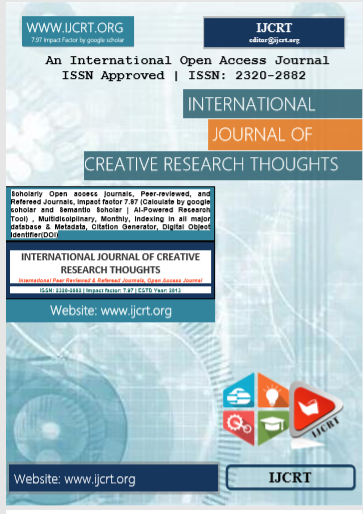 |
 |
|---|---|
| IJCRT Journal front page | IJCRT Journal Back Page |
Paper Title: Smart Agriculture with Integration of IoT, Renewable Energy and Big Data for Efficient Resource Utilization
Author Name(s): Kalaiselvi N, Vijayabaskaran PS, Mosikeeran T, Akash P, Harinath P, Rahul R
Published Paper ID: - IJCRTBM02030
Register Paper ID - 300512
Publisher Journal Name: IJPUBLICATION, IJCRT
DOI Member ID: 10.6084/m9.doi.one.IJCRTBM02030 and DOI :
Author Country : Indian Author, India, - , -, - , | Research Area: Science and Technology Published Paper URL: http://ijcrt.org/viewfull.php?&p_id=IJCRTBM02030 Published Paper PDF: download.php?file=IJCRTBM02030 Published Paper PDF: http://www.ijcrt.org/papers/IJCRTBM02030.pdf
Your Paper Publication Details:
Title: SMART AGRICULTURE WITH INTEGRATION OF IOT, RENEWABLE ENERGY AND BIG DATA FOR EFFICIENT RESOURCE UTILIZATION
DOI (Digital Object Identifier) :
Pubished in Volume: 14 | Issue: 2 | Year: February-2026
Publisher Name : IJCRT | www.ijcrt.org | ISSN : 2320-2882
Subject Area: Science and Technology
Author type: Indian Author
Pubished in Volume: 14
Issue: 2
Pages: 233-240
Year: February-2026
Downloads: 236
E-ISSN Number: 2320-2882
Abstract
Water is a critical resource, and its sustainable management is essential to meet the growing demands of agriculture while preserving the environment. This study explores the integration of smart water metering, autonomous irrigation, renewable energy, and big data analytics to enhance agricultural productivity and conserve resources. A cloud-based Internet of Things (IoT) framework enables real-time monitoring, recording, and analysis of water consumption, water table levels, temperature, humidity, soil moisture, and light sensor data. Big Data Analytics to harness real-time data from sensors monitoring temperature, humidity, soil moisture, and light intensity. By processing and analysing vast datasets, the system derives actionable insights to optimize irrigation schedules, energy consumption, and crop management strategies. The Big Data platform enables predictive modelling and trend analysis, improving longterm planning and resource allocation. Smart water metering ensures precise and efficient water distribution, delivering water only where and when needed. Renewable energy sources, such as solar and wind power, reduce dependence on fossil fuels, making agriculture more energy-efficient and eco-friendly. Autonomous irrigation systems, powered by real-time data, enhance crop quality, productivity, and soil health while mitigating issues such as waterlogging and over-irrigation. Additionally, RFID technology enables seamless replication of the system across lands with similar crop and soil conditions, ensuring scalability and operational consistency. This comprehensive solution safeguards aquifers, maintains the water table, and addresses critical environmental challenges. By integrating these advanced technologies, the study provides a sustainable, scalable framework to balance agricultural productivity with environmental conservation, paving the way for resilient farming systems.
Licence: creative commons attribution 4.0
License
Creative Commons Attribution 4.0 and The Open Definition

Keywords
Smart Water Metering; Renewable Energy Integration; Water-table Conservation; Energy efficient Agriculture; Soil Health;
License
Creative Commons Attribution 4.0 and The Open Definition
Paper Title: Vision-Driven Virtual Piano: Monocular Hand Tracking, Dynamic Calibration, and Velocity-Based Note Triggering
Author Name(s): Kunal Chaugule, Gauri Deshpande, Ragini Sharma, Onkar Gurav
Published Paper ID: - IJCRTBM02029
Register Paper ID - 300511
Publisher Journal Name: IJPUBLICATION, IJCRT
DOI Member ID: 10.6084/m9.doi.one.IJCRTBM02029 and DOI :
Author Country : Indian Author, India, - , -, - , | Research Area: Science and Technology Published Paper URL: http://ijcrt.org/viewfull.php?&p_id=IJCRTBM02029 Published Paper PDF: download.php?file=IJCRTBM02029 Published Paper PDF: http://www.ijcrt.org/papers/IJCRTBM02029.pdf
Your Paper Publication Details:
Title: VISION-DRIVEN VIRTUAL PIANO: MONOCULAR HAND TRACKING, DYNAMIC CALIBRATION, AND VELOCITY-BASED NOTE TRIGGERING
DOI (Digital Object Identifier) :
Pubished in Volume: 14 | Issue: 2 | Year: February-2026
Publisher Name : IJCRT | www.ijcrt.org | ISSN : 2320-2882
Subject Area: Science and Technology
Author type: Indian Author
Pubished in Volume: 14
Issue: 2
Pages: 224-232
Year: February-2026
Downloads: 190
E-ISSN Number: 2320-2882
Abstract
In this paper, a new virtual piano system is proposed, with an emphasis on the use of a monocular camera system for gesture-based musical input with no dependence on keys. The system utilizes state-of-art hand and fingertip tracking built upon the principles of computer vision. One enhancement, in particular, is the velocity-sensitive key press detection mechanism used to detect rapid downward finger movement as the musical note triggers, much like the action of a piano. The concepts of dynamic calibration applied to an idealized reference line representing the edge of the desk and the study of accidental key presses resulting from hand movements not involved in keying enhance accuracy by clearly defining an exclusion zone that must not be crossed and minimizing interference from false contact with the keyboard. The system incorporates dynamic calibration so as to account for differing heights of the desk together with camera direction to make certain that it performs optimally in several situations. Efficiencies in tracking algorithms and feedback systems reduce latency delivering a dynamic and engaging application. Additional features include real-time fingertip highlighting and note names to facilitate user participation and to give feedback support. The proposed system shows that monocular camera-based solutions have the ability to provide an efficient way of constructing portable and accessible virtual musical instruments. The mentioned concepts include its use in music learning and teaching, as gesture-controlled devices, and augmented- or virtual-reality-based music applications. This paper discusses features of gesture recognition, interactive music systems, and computer vision with a focus on building a new approach to virtual instrument control.
Licence: creative commons attribution 4.0
License
Creative Commons Attribution 4.0 and The Open Definition
Keywords
Monocular Camera, Hand Gesture Tracking, Computer Vision, Interactive Music Systems.
License
Creative Commons Attribution 4.0 and The Open Definition
Paper Title: OPTIMIZATION OF CROP YIELD BY LINEAR PROGRAMMING APPROACH
Author Name(s): Abhiruchi Abhinay Dakwale, Dr. Swati Desai
Published Paper ID: - IJCRTBM02028
Register Paper ID - 300510
Publisher Journal Name: IJPUBLICATION, IJCRT
DOI Member ID: 10.6084/m9.doi.one.IJCRTBM02028 and DOI :
Author Country : Indian Author, India, - , -, - , | Research Area: Science and Technology Published Paper URL: http://ijcrt.org/viewfull.php?&p_id=IJCRTBM02028 Published Paper PDF: download.php?file=IJCRTBM02028 Published Paper PDF: http://www.ijcrt.org/papers/IJCRTBM02028.pdf
Your Paper Publication Details:
Title: OPTIMIZATION OF CROP YIELD BY LINEAR PROGRAMMING APPROACH
DOI (Digital Object Identifier) :
Pubished in Volume: 14 | Issue: 2 | Year: February-2026
Publisher Name : IJCRT | www.ijcrt.org | ISSN : 2320-2882
Subject Area: Science and Technology
Author type: Indian Author
Pubished in Volume: 14
Issue: 2
Pages: 220-223
Year: February-2026
Downloads: 193
E-ISSN Number: 2320-2882
Abstract
Agriculture and mathematics are very much related to each other. A linear programming technique from Operations Research, which is a branch of mathematics, is used to optimize the crop yield or crop production.This research paper throws light on how to optimize crop yield by the simplex method by using Excel.
Licence: creative commons attribution 4.0
License
Creative Commons Attribution 4.0 and The Open Definition
Keywords
Agriculture, mathematics, crop yield
License
Creative Commons Attribution 4.0 and The Open Definition
Paper Title: Application of Mathematics in Machine Learning
Author Name(s): Manisha Anand Gund, Dr. Swati Desai
Published Paper ID: - IJCRTBM02027
Register Paper ID - 300509
Publisher Journal Name: IJPUBLICATION, IJCRT
DOI Member ID: 10.6084/m9.doi.one.IJCRTBM02027 and DOI :
Author Country : Indian Author, India, - , -, - , | Research Area: Science and Technology Published Paper URL: http://ijcrt.org/viewfull.php?&p_id=IJCRTBM02027 Published Paper PDF: download.php?file=IJCRTBM02027 Published Paper PDF: http://www.ijcrt.org/papers/IJCRTBM02027.pdf
Your Paper Publication Details:
Title: APPLICATION OF MATHEMATICS IN MACHINE LEARNING
DOI (Digital Object Identifier) :
Pubished in Volume: 14 | Issue: 2 | Year: February-2026
Publisher Name : IJCRT | www.ijcrt.org | ISSN : 2320-2882
Subject Area: Science and Technology
Author type: Indian Author
Pubished in Volume: 14
Issue: 2
Pages: 213-219
Year: February-2026
Downloads: 224
E-ISSN Number: 2320-2882
Abstract
In today's era of big data, machine learning is the modern technology. Machine learning is nothing but the application of algorithms to solve the real-life problems. Mathematics provides useful tools for data representation, matrix multiplication, optimization, and decision-making in machine learning algorithms. This paper highlights the importance of these mathematical tools, which include linear algebra, calculus, and Probability theory. The important pillar of a machine learning algorithm is data. Linear algebra is useful for representing data in matrix form systematically and for reducing the dimension of the given data, making it easier to handle large datasets. Since the data is in matrix form, various operations can be performed using matrix operations. (Linear Transformations). Moreover, in the optimization part of a machine learning algorithm, calculus plays a crucial role. Probability theory is very much useful in the decision-making step of machine learning algorithms. So, mathematics acts as a building block for modern technology, machine learning. With the help of Mathematics, we can better understand the working behavior of Machine Learning. Knowledge of Mathematics helps us choose the appropriate or correct algorithm for a given data set and also to improve the accuracy of the machine learning algorithms.
Licence: creative commons attribution 4.0
License
Creative Commons Attribution 4.0 and The Open Definition
Keywords
Machine learning; Linear Algebra; Calculus; Probability Theory
License
Creative Commons Attribution 4.0 and The Open Definition
Paper Title: Impact of Entertainment and Family Perception on Children's Cognitive Development
Author Name(s): Dr. Gauri Deshpande, Dr. Anjali Kulkarni
Published Paper ID: - IJCRTBM02026
Register Paper ID - 300508
Publisher Journal Name: IJPUBLICATION, IJCRT
DOI Member ID: 10.6084/m9.doi.one.IJCRTBM02026 and DOI :
Author Country : Indian Author, India, - , -, - , | Research Area: Science and Technology Published Paper URL: http://ijcrt.org/viewfull.php?&p_id=IJCRTBM02026 Published Paper PDF: download.php?file=IJCRTBM02026 Published Paper PDF: http://www.ijcrt.org/papers/IJCRTBM02026.pdf
Your Paper Publication Details:
Title: IMPACT OF ENTERTAINMENT AND FAMILY PERCEPTION ON CHILDREN'S COGNITIVE DEVELOPMENT
DOI (Digital Object Identifier) :
Pubished in Volume: 14 | Issue: 2 | Year: February-2026
Publisher Name : IJCRT | www.ijcrt.org | ISSN : 2320-2882
Subject Area: Science and Technology
Author type: Indian Author
Pubished in Volume: 14
Issue: 2
Pages: 206-212
Year: February-2026
Downloads: 190
E-ISSN Number: 2320-2882
Abstract
Children's cognitive development is essential in the future of a nation. Strong, solid, well-educated and well equipped children are crucial for a country. Memory, attention, perception and logical problem solving are parts of the development of the cognitive process. The objective of this research study is to explore the entertainment factors and family perception that influencing children's cognitive development. This research will provide parents with much needed and valuable insight into the ways to better protect future generations. The proposed study adopts a quantitative research strategy and obtains data through structured questionnaires. Children are assessed in terms of perception, attention, problems solving, and memory. Data analysis reveals variation in mental skills of children and possible gaps that demand more support and interventions. Results show that parental occupation, screen exposure or toy play justification may have a negative effect on a child's concentration ability and reasoning ability decline. This study also finds gender differences in cognitive skills evaluations.
Licence: creative commons attribution 4.0
License
Creative Commons Attribution 4.0 and The Open Definition
Keywords
Cognitive development, entertainment, family perception, children, and cognitive skills
License
Creative Commons Attribution 4.0 and The Open Definition
Paper Title: A Generative AI Framework for Marathi Grammar Learning
Author Name(s): Dr. Gauri Deshpande, Mrs. Aarti Pardeshi
Published Paper ID: - IJCRTBM02025
Register Paper ID - 300507
Publisher Journal Name: IJPUBLICATION, IJCRT
DOI Member ID: 10.6084/m9.doi.one.IJCRTBM02025 and DOI :
Author Country : Indian Author, India, - , -, - , | Research Area: Science and Technology Published Paper URL: http://ijcrt.org/viewfull.php?&p_id=IJCRTBM02025 Published Paper PDF: download.php?file=IJCRTBM02025 Published Paper PDF: http://www.ijcrt.org/papers/IJCRTBM02025.pdf
Your Paper Publication Details:
Title: A GENERATIVE AI FRAMEWORK FOR MARATHI GRAMMAR LEARNING
DOI (Digital Object Identifier) :
Pubished in Volume: 14 | Issue: 2 | Year: February-2026
Publisher Name : IJCRT | www.ijcrt.org | ISSN : 2320-2882
Subject Area: Science and Technology
Author type: Indian Author
Pubished in Volume: 14
Issue: 2
Pages: 199-205
Year: February-2026
Downloads: 160
E-ISSN Number: 2320-2882
Abstract
Marathi is one of the popular oldest languages of India and possesses the greater syntactic complexity. Nouns, verbs and compound words of this language have very clear and simple rules that make the learning of the language an easy task for anybody. However, a more effective tool is required to consolidate the particularity of the higher level grammar, especially the regional dialects. In the last few years there has been a lot of work done in the era of Artificial Intelligence (AI) and Natural Language Processing (NLP) where various languages related complicated tasks have been made easy. Pre-trained generative AI models like BERT (Bidirectional Encoder Representations from Transformers), GPT-3 (Generative Pre-trained Transformer), T5 (Text-to-Text Transfer Transformer) and many others hold much promise in different language uses like text generation, translation, and grammar checks. These models are capable of formulating, interpreting and modifying any linguistic behaviour that might be useful in handling other challenges of Marathi language such as noun declensions and verb conjugations. AI model built from the transformer architecture can be adapted to handle several of linguistic problems in Marathi language that involves syntax analysis and error detection. This paper presents a generative AI model for learning the Marathi grammar which is further categorized into two parts. The first part of the study is devoted to the elementary grammar training and the second part is dedicated to the intermediate and advanced levels. Through the use of generative AI, this current model gives higher accuracy than rule-based system and presents effective ideas towards modern grammar. Also this model became improving tools in computational linguistics for regional languages and for promoting language education.
Licence: creative commons attribution 4.0
License
Creative Commons Attribution 4.0 and The Open Definition
Keywords
Marathi language, generative AI, BERT, GPT-3, T5, computational linguisticsii
License
Creative Commons Attribution 4.0 and The Open Definition
Paper Title: Movie Recommendation System
Author Name(s): Ms. Tisha Sachin Shah, Dr. Swati Maurya
Published Paper ID: - IJCRTBM02024
Register Paper ID - 300505
Publisher Journal Name: IJPUBLICATION, IJCRT
DOI Member ID: 10.6084/m9.doi.one.IJCRTBM02024 and DOI :
Author Country : Indian Author, India, - , -, - , | Research Area: Science and Technology Published Paper URL: http://ijcrt.org/viewfull.php?&p_id=IJCRTBM02024 Published Paper PDF: download.php?file=IJCRTBM02024 Published Paper PDF: http://www.ijcrt.org/papers/IJCRTBM02024.pdf
Your Paper Publication Details:
Title: MOVIE RECOMMENDATION SYSTEM
DOI (Digital Object Identifier) :
Pubished in Volume: 14 | Issue: 2 | Year: February 2026
Publisher Name : IJCRT | www.ijcrt.org | ISSN : 2320-2882
Subject Area: Science and Technology
Author type: Indian Author
Pubished in Volume: 14
Issue: 2
Pages: 191-198
Year: February 2026
Downloads: 210
E-ISSN Number: 2320-2882
Abstract
This research paper demonstrates the implementation of advanced machine learning filters used for collaborative and content-based recommendations. The delivery of personalized recommendations depends on these approaches because they analyze patterns of user choices together with elements of movies. The exploration builds recommendation accuracy through a K-Nearest Neighbors (KNN) and Recurrent Neural Networks (RNN) amalgamation. The joint operation of KNN and RNN services achieves optimal performance through rapid item and user similarity evaluation from KNN and RNN's sequential data processing for tracking user taste changes. Various filtering approaches that merge collaborative and content-based methods receive evaluation in this research through accuracy assessments and recommendation expansion evaluations. The collaborative filtering framework helps content-based filtering systems accomplish their collection process by performing item-item comparison operations. Initial recommendations for matching movies originate from built-in content features which include genre classifications and directorial credits combined with casting information. Hybrid recommendation models combine different recommendation methods in order to address collaborative systems' cold-start problems and content-based approaches' targeted application conditions. For this research, the datasets used are the Netflix Prize dataset and MovieLens, which are famous for their huge and diverse movie data. The datasets offered in these provide a solid basis for training and testing the proposed model. The study also compares the coverage and data quality with the IMDb Top 1000 dataset. Therefore, the Netflix Prize dataset provides large user-movie interaction data; MovieLens provides detailed movie metadata and user ratings, thereby achieving a fair evaluation of the system. The proposed hybrid approach produces various advantages to enhance user-specific recommendations and dynamic response capabilities as well as better prediction accuracy. The research notes that RNN component training requires extensive datasets while also accepting the implementation challenges of this hybrid system. Although challenging to implement the hybrid system demonstrates promising capabilities to deliver relevant movie suggestions at the appropriate times. The recommendation system which combines KNN and RNN enables development in research for movie recommendation platforms. The suggestion generation process in the system uses algorithm-matched technology to link content-based approaches with collaborative filtering for individualized recommendations. The core principles described in this work can help industrial fields strengthen their hybrid recommendation system creation process.
Licence: creative commons attribution 4.0
License
Creative Commons Attribution 4.0 and The Open Definition
Keywords
Movie recommendation, collaborative filtering, content-based filtering, RNN, KNN, Netflix Prize, MovieLens, IMDb.
License
Creative Commons Attribution 4.0 and The Open Definition
Paper Title: A REVIEW ON THE LINEAR/NONLINEAR OPTRICAL PROPERTIES OF PROTON IRRADIATED CHALCOGENIDE THINFILMS AND THEIR APPLICATIONS
Author Name(s): Thabang Kealeboga Matabana, Cosmas M. Muiva, Conrad B. Tabi
Published Paper ID: - IJCRTBM02023
Register Paper ID - 300504
Publisher Journal Name: IJPUBLICATION, IJCRT
DOI Member ID: 10.6084/m9.doi.one.IJCRTBM02023 and DOI :
Author Country : Indian Author, India, - , -, - , | Research Area: Science and Technology Published Paper URL: http://ijcrt.org/viewfull.php?&p_id=IJCRTBM02023 Published Paper PDF: download.php?file=IJCRTBM02023 Published Paper PDF: http://www.ijcrt.org/papers/IJCRTBM02023.pdf
Your Paper Publication Details:
Title: A REVIEW ON THE LINEAR/NONLINEAR OPTRICAL PROPERTIES OF PROTON IRRADIATED CHALCOGENIDE THINFILMS AND THEIR APPLICATIONS
DOI (Digital Object Identifier) :
Pubished in Volume: 14 | Issue: 2 | Year: February 2026
Publisher Name : IJCRT | www.ijcrt.org | ISSN : 2320-2882
Subject Area: Science and Technology
Author type: Indian Author
Pubished in Volume: 14
Issue: 2
Pages: 182-190
Year: February 2026
Downloads: 205
E-ISSN Number: 2320-2882
Abstract
The distinctive linear and nonlinear optical characteristics of chalcogenide thin films, particularly containing selenium (Se), have aroused considerable attention in photonics research. We examine how proton irradiation changes the optical characteristics of thin films made of chalcogenides. from a theoretical and experimental perspective in this work. Researchers have found that proton irradiation can change the physical and optical properties of these films, which in turn changes how well they work in a number of photonic uses. We look at how proton treatment changes the nonlinear optical behavior by looking at changes in transmission, absorption, and the refractive index. The potential applications in fields like optoelectronics and photonics are examined.
Licence: creative commons attribution 4.0
License
Creative Commons Attribution 4.0 and The Open Definition
Keywords
Chalcogenide Thin Films, Proton Irradiation, Linear optical Properties, Nonlinear Optical Properties, Photonic Applications
License
Creative Commons Attribution 4.0 and The Open Definition
Paper Title: Tech Meets Health: Predicting Anemia and HB Through Image Processing
Author Name(s): Snehal Kathale, Madhuri Patil, Prerana Wadavane, Sakshi Bakale, Sakshi Jadhav, Vrushali Limaye
Published Paper ID: - IJCRTBM02022
Register Paper ID - 300503
Publisher Journal Name: IJPUBLICATION, IJCRT
DOI Member ID: 10.6084/m9.doi.one.IJCRTBM02022 and DOI :
Author Country : Indian Author, India, - , -, - , | Research Area: Science and Technology Published Paper URL: http://ijcrt.org/viewfull.php?&p_id=IJCRTBM02022 Published Paper PDF: download.php?file=IJCRTBM02022 Published Paper PDF: http://www.ijcrt.org/papers/IJCRTBM02022.pdf
Your Paper Publication Details:
Title: TECH MEETS HEALTH: PREDICTING ANEMIA AND HB THROUGH IMAGE PROCESSING
DOI (Digital Object Identifier) :
Pubished in Volume: 14 | Issue: 2 | Year: February 2026
Publisher Name : IJCRT | www.ijcrt.org | ISSN : 2320-2882
Subject Area: Science and Technology
Author type: Indian Author
Pubished in Volume: 14
Issue: 2
Pages: 167-181
Year: February 2026
Downloads: 171
E-ISSN Number: 2320-2882
Abstract
Anemia is a very common medical condition in which the count or size of red blood cells is reduced, and it limits oxygen transport to the body. In most cases, it requires invasive and costly blood tests for diagnosis. India is Struggling to keep up the World Health Assembly targets for anemia reduction by 2025 .Anemia Mukt Bharat strategy Introduced in 2018. It is Aiming at iron and folic acid Nutritional support to adolescent girls as they provide the Renewed opportunity to eliminate or reduce the burden and break the intergenerational cycle of anemia before entering into the pregnancy [16]. Strengthening adolescents' nutrition is beneficial to adult health. It produce triple dividends- better health for adolescents now, Enhanced health and performance in their future adult life and lowered health risks for their offspring. (World Health Organization, 2018) At this stage, there is still the chances of correcting nutritional deficiencies and possibly even bridging the gap on growth. Nutrition Interference in adolescent may help break the cycle of malnutrition, chronic disease and poverty. Adolescent girls' health and their status in general, and the frequency of anaemia in particular, are affected by factors such as deworming, underweight, vegetarianism, obesity and the presence of pallor. Some other factor have been found to be associated with anemia such as socioeconomic status, education, worm infestation, menstruation, and pregnancy in adolescent females [1] This research addresses the gap between traditional diagnostics in health and modern non-invasive approaches by using image analysis and mathematical modelling [11] through matlab, which would provide a scalable solution for screening Anemia in resource-constrained areas.
Licence: creative commons attribution 4.0
License
Creative Commons Attribution 4.0 and The Open Definition
Keywords
Anemia Detection; Non-invasive Diagnosis; Image Processing; Curve Fitting; Hemoglobin Prediction
License
Creative Commons Attribution 4.0 and The Open Definition
Paper Title: Solving Time-Space Fractional Biological Population Model by Homotopy Perturbation Method
Author Name(s): Krishna Ghode, Kalyanrao Takale
Published Paper ID: - IJCRTBM02021
Register Paper ID - 300502
Publisher Journal Name: IJPUBLICATION, IJCRT
DOI Member ID: 10.6084/m9.doi.one.IJCRTBM02021 and DOI :
Author Country : Indian Author, India, - , -, - , | Research Area: Science and Technology Published Paper URL: http://ijcrt.org/viewfull.php?&p_id=IJCRTBM02021 Published Paper PDF: download.php?file=IJCRTBM02021 Published Paper PDF: http://www.ijcrt.org/papers/IJCRTBM02021.pdf
Your Paper Publication Details:
Title: SOLVING TIME-SPACE FRACTIONAL BIOLOGICAL POPULATION MODEL BY HOMOTOPY PERTURBATION METHOD
DOI (Digital Object Identifier) :
Pubished in Volume: 14 | Issue: 2 | Year: February 2026
Publisher Name : IJCRT | www.ijcrt.org | ISSN : 2320-2882
Subject Area: Science and Technology
Author type: Indian Author
Pubished in Volume: 14
Issue: 2
Pages: 154-166
Year: February 2026
Downloads: 168
E-ISSN Number: 2320-2882
Abstract
This article aims to study the time-space fractional biological population model which describe population densities in the various biological movements. To find an approximate solution for the time-space fractional population model, we employ the Homotopy Perturbation Method (homotopy perturbation method), a powerful analytical technique for solving nonlinear fractional differential equations. Also, we prove the convergence of the developed method. Fractional-order one-dimensional biological model for the spread of genes in a population and a twodimensional biological population model with Verhulst law are studied. Traveling wave solutions are observed for both one and two-dimensional models. The obtained results confirms that the proposed time-space fractional model provides valuable dynamic behavior of biological populations in fractional environments. Analytical and numerical solutions of models are presented in the form of tables and graphs with the help of SageMath programming..
Licence: creative commons attribution 4.0
License
Creative Commons Attribution 4.0 and The Open Definition
Keywords
Fractional order biological population model, Homotopy perturbation method, Convergence, Fractional Calculus, SageMath, etc.
License
Creative Commons Attribution 4.0 and The Open Definition
Call For Paper June 2026
Call For Papers
June 2026
Volume 14 | Issue 6
Last Date :
30-Jun-2026
Submit Manuscript Online Impact Factor: 7.97 Review Results : Within 02-03 Days Paper Publication : Within 02-03 Days
June 2026
Volume 14 | Issue 6
Last Date :
30-Jun-2026
Submit Manuscript Online Impact Factor: 7.97 Review Results : Within 02-03 Days Paper Publication : Within 02-03 Days
Published Issue Details
For Authors
Forms / Downloads
Other IMP Links
Indexing Partner
Research Area
LICENSE





ISSN and 7.97 Impact Factor Details

ISSN: 2320-2882 Impact Factor: 7.97 and ISSN APPROVED Journal Starting Year (ESTD) : 2013


ISSN and 7.97 Impact Factor Details
ISSN: 2320-2882 Impact Factor: 7.97 and ISSN APPROVED Journal Starting Year (ESTD) : 2013
DOI Details
CONFERENCE
CONFERENCE MANAGMENT & PUBLICATION CONFERENCE PROPOSAL
RECENT CONFERENCE

CONFERENCE PROPOSAL CONFERENCE PROCEEDINGS
CONFERENCE PROPOSAL CONFERENCE PROCEEDINGS
For Reviewer /Referral (RMS) Earn 500 per paper
Important Links
NEWS & Conference
Digital Library
IJCRT RMS | Earn 500 Per Paper.

Open Access


LICENSE
Indexing Partner
Scholarly open access journals, Peer-reviewed, and Refereed Journals, Impact factor 7.97 (Calculate by google scholar and Semantic Scholar | AI-Powered Research Tool) , Multidisciplinary, Monthly, Indexing in all major database & Metadata, Citation Generator, Digital Object Identifier(DOI)