Important Details
IJCRT - International Peer Reviewed, Open Access Journal, Multidisciplinary, Monthly, Nominal(Low) Fees for Professional Research Services International Journal of Creative Research Thoughts - IJCRT Peer Review Journal, Refereed Journal, Peer Reviewed Journal , Referred Journal and Indexed Journal, Open access, Online and Print Journal,international Journal Open Access, Accepted by Indian and foreign university ,IJCRT Followed Norms, guidelines, requirement, listing criteria and methodology of score/point also applied from: Scopus , Web of Science , UGC Approved , UGC CARE, UGC-CARE .
UGC Approved Journal No: 49023 (18)
UGC approval Link
https://ijcrt.org/ugc%20approval.jpg
All Policy and Approval
Please Like Our Facebook Page | CrossRef DOI and Hard copy of Certificate Provide if required. | www.IJCRT.org | editor@IJCRT.org | WhatsApp: 7990172303
Publication Details:
- Paper Submission : 31-May-2026. Call For Paper (Volume 14 | Issue 5 | Month- May 2026)
- Acceptance/Rejection Notification: Within 02-04 Days.
- Paper Publish: Within 02-04 Days after submitting all documents.
-
Submit Your Paper Any time There No deadline.
-
Publication fees : 1570 INR for Indian author & 59$ for foreign International author.
Please Like Our Facebook Page | CrossRef DOI and Hard copy of Certificate Provide if required.
Licence and Indexing
Indexing In Google Scholar, SSRN, ResearcherID-Publons, Semantic Scholar | AI-Powered Research Tool, Microsoft Academic, Academia.edu, arXiv.org, Research Gate, CiteSeerX, ResearcherID Thomson Reuters, Mendeley : reference manager, DocStoc, ISSUU, Scribd, and many more | High Impact Factor: 7.97 | Digital object identifier (DOI) and Hard Copy of certificate Provided.




























Licence
DOI
ISSN Approved impact factor: 7.97 
Creative Common 
Valid as per new UGC Gazette regulations 

INTERNATIONAL JOURNAL OF CREATIVE RESEARCH THOUGHTS - IJCRT (IJCRT.ORG)
International Peer Reviewed & Refereed Journals, Open Access Journal
IJCRT Peer-Reviewed (Refereed) Journal as Per New UGC Rules.
ISSN Approved Journal No: 2320-2882 | Impact factor: 7.97 | ESTD Year: 2013
Call For Paper - Volume 14 | Issue 5 | Month- May 2026
Scholarly open access journals, Peer-reviewed, and Refereed Journals, Impact factor 7.97 (Calculate by google scholar and Semantic Scholar | AI-Powered Research Tool) , Multidisciplinary, Monthly, Indexing in all major database & Metadata, Citation Generator, Digital Object Identifier(CrossRef DOI)
Contact Us Click Here
WhatsApp Contact Click Here
IJCRT Search Xplore - Search all paper by Paper Name , Author Name, and Title
Volume 7 | Issue 2 |
Volume 7 | Issue 2 | Month
Downlaod After Publication 1) Table of content index in PDF
2) Table of content index in HTML 2)Table of content index in HTML
3) Front Page 3) Front Page
4) Back Page 4) Back Page
5) Editor Board Member 5)Editor Board Member
6) OLD Style Issue 6)OLD Style Issue
 |
 |
|---|---|
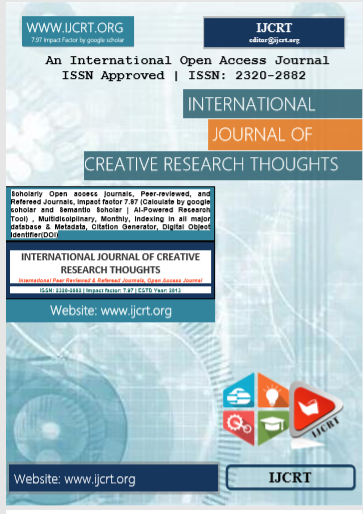
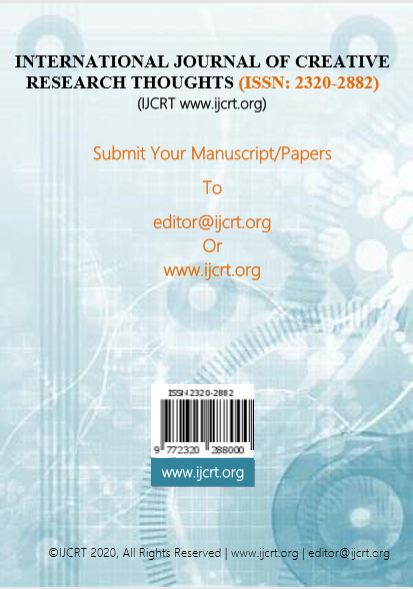
| IJCRT Journal front page | IJCRT Journal Back Page |
Paper Title: ELEMENTAL ANALYSIS OF THIOPICOLINANILIDE (TPA) AND ITS LEAD (II) COMPLEX.
Author Name(s): Dr Rudra Narayan sharma
Published Paper ID: - IJCRT1133594
Register Paper ID - 199634
Publisher Journal Name: IJPUBLICATION, IJCRT
DOI Member ID: 10.6084/m9.doi.one.IJCRT1133594 and DOI :
Author Country : Indian Author, 841301, India , SARAN, India , | Research Area: Chemistry Published Paper URL: http://ijcrt.org/viewfull.php?&p_id=IJCRT1133594 Published Paper PDF: download.php?file=IJCRT1133594 Published Paper PDF: http://www.ijcrt.org/papers/IJCRT1133594.pdf
Your Paper Publication Details:
Title: ELEMENTAL ANALYSIS OF THIOPICOLINANILIDE (TPA) AND ITS LEAD (II) COMPLEX.
DOI (Digital Object Identifier) :
Pubished in Volume: 7 | Issue: 2 | Year: April-2019
Publisher Name : IJCRT | www.ijcrt.org | ISSN : 2320-2882
Subject Area: Chemistry
Author type: Indian Author
Pubished in Volume: 7
Issue: 2
Pages: 981-983
Year: April-2019
Downloads: 1632
E-ISSN Number: 2320-2882
Abstract
The term elemental analysis is typically defined as the determination of the amount of an element in given sample. Elemental analysis determining what element are present and determining how much each are present. The elemental analysis of Thiopicolinanilide (TPA) and its lead (II) complex carried out by an electrobalance Stanton Red Craft (TG) Balance Model with a reader, operating 1.0mv full scale for obtaining thermograms i.e. temperature vs. loss in weight curves.
Licence: creative commons attribution 4.0
License
Creative Commons Attribution 4.0 and The Open Definition

Keywords
Elemental Analysis, Thermograms, Lead (II) Complex, Thiopicolinanilide (TPA)
License
Creative Commons Attribution 4.0 and The Open Definition
Paper Title: `` Emergence of positivism as a social science research method: analysis and its implications``
Author Name(s): Raghuwar Lal, Keshav Chandra
Published Paper ID: - IJCRT1133542
Register Paper ID - 199158
Publisher Journal Name: IJPUBLICATION, IJCRT
DOI Member ID: 10.6084/m9.doi.one.IJCRT1133542 and DOI :
Author Country : N, -, -- , -, -- , | Research Area: Science & Technology Published Paper URL: http://ijcrt.org/viewfull.php?&p_id=IJCRT1133542 Published Paper PDF: download.php?file=IJCRT1133542 Published Paper PDF: http://www.ijcrt.org/papers/IJCRT1133542.pdf
Your Paper Publication Details:
Title: `` EMERGENCE OF POSITIVISM AS A SOCIAL SCIENCE RESEARCH METHOD: ANALYSIS AND ITS IMPLICATIONS``
DOI (Digital Object Identifier) :
Pubished in Volume: 7 | Issue: 2 | Year: April-2019
Publisher Name : IJCRT | www.ijcrt.org | ISSN : 2320-2882
Subject Area: Science & Technology
Author type: N
Pubished in Volume: 7
Issue: 2
Pages: 640-646
Year: April-2019
Downloads: 1928
E-ISSN Number: 2320-2882
Abstract
??????? ??????? ???????? ?????? ?? ??? ??? ???????????? ?? ?????: ???????? ??? ???? ??????????
Licence: creative commons attribution 4.0
License
Creative Commons Attribution 4.0 and The Open Definition
Keywords
??????? ??????? ???????? ?????? ?? ??? ??? ???????????? ?? ?????: ???????? ??? ???? ??????????
License
Creative Commons Attribution 4.0 and The Open Definition
Paper Title: An Analysis of the Key Concept of Karl Marx and based on the special reference to Frederick Engels book ``The Origin of the Family, Private Property and the State``
Author Name(s): Raghuwar Lal, Keshav Chandra
Published Paper ID: - IJCRT1133536
Register Paper ID - 199159
Publisher Journal Name: IJPUBLICATION, IJCRT
DOI Member ID: 10.6084/m9.doi.one.IJCRT1133536 and DOI :
Author Country : N, -, -- , -, -- , | Research Area: Science & Technology Published Paper URL: http://ijcrt.org/viewfull.php?&p_id=IJCRT1133536 Published Paper PDF: download.php?file=IJCRT1133536 Published Paper PDF: http://www.ijcrt.org/papers/IJCRT1133536.pdf
Your Paper Publication Details:
Title: AN ANALYSIS OF THE KEY CONCEPT OF KARL MARX AND BASED ON THE SPECIAL REFERENCE TO FREDERICK ENGELS BOOK ``THE ORIGIN OF THE FAMILY, PRIVATE PROPERTY AND THE STATE``
DOI (Digital Object Identifier) :
Pubished in Volume: 7 | Issue: 2 | Year: April-2019
Publisher Name : IJCRT | www.ijcrt.org | ISSN : 2320-2882
Subject Area: Science & Technology
Author type: N
Pubished in Volume: 7
Issue: 2
Pages: 599-608
Year: April-2019
Downloads: 1806
E-ISSN Number: 2320-2882
Abstract
????? ??????? ?? ?????? ??????? ?? ???????? ??????? ?? ?????? �?????? ??????? ?? ????? ?? ????????� ?? ????? ?????? ?? ???? ?? ?????????
Licence: creative commons attribution 4.0
License
Creative Commons Attribution 4.0 and The Open Definition
Keywords
????? ??????? ?? ?????? ??????? ?? ???????? ??????? ?? ?????? �?????? ??????? ?? ????? ?? ????????� ?? ????? ?????? ?? ???? ?? ?????????
License
Creative Commons Attribution 4.0 and The Open Definition
Paper Title: DISINVESTMENT PROGRAM AND STRATEGIC DISINVESTMENT OF PUBLIC SECTOR IN INDIA: A STUDY ON CURRENT PERSPECTIVE
Author Name(s): Dr. Md. Imran Alam
Published Paper ID: - IJCRT1133533
Register Paper ID - 199045
Publisher Journal Name: IJPUBLICATION, IJCRT
DOI Member ID: 10.6084/m9.doi.one.IJCRT1133533 and DOI : http://doi.one/10.1729/Journal.26557
Author Country : Indian Author, India, 813222 , Bhagalpur, 813222 , | Research Area: Medical Science Published Paper URL: http://ijcrt.org/viewfull.php?&p_id=IJCRT1133533 Published Paper PDF: download.php?file=IJCRT1133533 Published Paper PDF: http://www.ijcrt.org/papers/IJCRT1133533.pdf
Your Paper Publication Details:
Title: DISINVESTMENT PROGRAM AND STRATEGIC DISINVESTMENT OF PUBLIC SECTOR IN INDIA: A STUDY ON CURRENT PERSPECTIVE
DOI (Digital Object Identifier) : http://doi.one/10.1729/Journal.26557
Pubished in Volume: 7 | Issue: 2 | Year: May 2019
Publisher Name : IJCRT | www.ijcrt.org | ISSN : 2320-2882
Subject Area: Medical Science
Author type: Indian Author
Pubished in Volume: 7
Issue: 2
Pages: 586-590
Year: May 2019
Downloads: 1685
E-ISSN Number: 2320-2882
Abstract
At present, to deal with the economic slowdown in the country the Central Government has decided to strategically disinvest in public sector undertakings (PSUs) It is worth mentioning that in the first phase of strategic disinvestment five public sector undertakings Bharat Petroleum Corporation Limited (BPCL) Shipping Corporation of India (SCI) Container Corporation of India Limited (CONCOR) Tehri Hydro Development Corporation India Limited (THDCIL) and North Eastern Electric Power Corporation Limited by the government in the first phase of strategic disinvestment Parts of (NEEPCO) will be sold. Giving information about the governments decision Finance Minister Smt Nirmala Sitharaman said that the government has decided that it will reduce its stake in many PSUs to below 51 percent.Analysts are assuming that this decision of the government will significantly increase the treasury which will be used by the government as public expenditure. The article presented discusses the governments recent decisions related to disinvestment in PSUs its necessity its consequences, challenges arising and measures to make the performances effective
Licence: creative commons attribution 4.0
License
Creative Commons Attribution 4.0 and The Open Definition
Keywords
public sector undertakings disinvestment Indian economy
License
Creative Commons Attribution 4.0 and The Open Definition
Paper Title: STUDENT MOVEMENT IN JAPAN
Author Name(s): Keshav Chandra, Gajendra
Published Paper ID: - IJCRT1133529
Register Paper ID - 199094
Publisher Journal Name: IJPUBLICATION, IJCRT
DOI Member ID: 10.6084/m9.doi.one.IJCRT1133529 and DOI :
Author Country : N, --, - , -, - , | Research Area: Science & Technology Published Paper URL: http://ijcrt.org/viewfull.php?&p_id=IJCRT1133529 Published Paper PDF: download.php?file=IJCRT1133529 Published Paper PDF: http://www.ijcrt.org/papers/IJCRT1133529.pdf
Your Paper Publication Details:
Title: STUDENT MOVEMENT IN JAPAN
DOI (Digital Object Identifier) :
Pubished in Volume: 7 | Issue: 2 | Year: April-2019
Publisher Name : IJCRT | www.ijcrt.org | ISSN : 2320-2882
Subject Area: Science & Technology
Author type: N
Pubished in Volume: 7
Issue: 2
Pages: 556-564
Year: April-2019
Downloads: 1752
E-ISSN Number: 2320-2882
Abstract
The student movement in Japan started as zengukaren which are raise against the undemocratic environment in campus the increase in fees and Japans government policy (US Japan security treaty in 1960) and national and international issues Later this movement turned in to SEALDs in 2013 which played a major role in the politics of Japan This student movement prominently raised various issues of Japan such as anti-nuclear movement nuclear energy US presence in Okinawa gender equality environment etc
Licence: creative commons attribution 4.0
License
Creative Commons Attribution 4.0 and The Open Definition
Keywords
Student movement student politics student activism Japan Zengakuren ANPO SEALDS
License
Creative Commons Attribution 4.0 and The Open Definition
Paper Title: AN ANALYSIS OF SELF HELP GROUPS COLLECTIVE EFFORT FOR WOMEN EMPOWERMENT
Author Name(s): Dr. Radhamma. D. K.
Published Paper ID: - IJCRT1133447
Register Paper ID - 197037
Publisher Journal Name: IJPUBLICATION, IJCRT
DOI Member ID: 10.6084/m9.doi.one.IJCRT1133447 and DOI :
Author Country : Indian Author, 560109, India , banglaore, India , | Research Area: Medical Science Published Paper URL: http://ijcrt.org/viewfull.php?&p_id=IJCRT1133447 Published Paper PDF: download.php?file=IJCRT1133447 Published Paper PDF: http://www.ijcrt.org/papers/IJCRT1133447.pdf
Your Paper Publication Details:
Title: AN ANALYSIS OF SELF HELP GROUPS COLLECTIVE EFFORT FOR WOMEN EMPOWERMENT
DOI (Digital Object Identifier) :
Pubished in Volume: 7 | Issue: 2 | Year: May 2019
Publisher Name : IJCRT | www.ijcrt.org | ISSN : 2320-2882
Subject Area: Medical Science
Author type: Indian Author
Pubished in Volume: 7
Issue: 2
Pages: 981-987
Year: May 2019
Downloads: 1739
E-ISSN Number: 2320-2882
Abstract
Existence of Chronic poverty is the major concern for the country and mitigating it has been the core of all developmental efforts. Post independence, several poverty alleviation programmes initiated by the government have resulted in the overall development of the poor but these programmes were not able to achieve the targeted success. Lack of capital and inaccessibility to credit is the serious constraint to the development and inhibits poor from responding to the opportunities created by the process of development. Empowerment of women is the most important means of poverty eradication. Despite considerable improvement in the status of women post independence, they still constitute the largest section of deprived population. Certain problems such as poverty, illiteracy, lack of skills, availability of proper health care facilities, ignorance etc., which are persistent in rural economy, cannot be tackled individually but could be effectively solved through group efforts. It reminds of a childhood story, where few birds are caught in a net and could not escape one by one. They thought of an idea and decided to fly together in a group and similarly one stick is easily breakable but bundle of sticks is difficult to break. These stories narrate the same moral � �Unity is strength�, �Self help is the best help� and �United we stand and divided we fall�. Hence attacking the problem through collective efforts yields better results. Today such collective group efforts are called as �Self Help Groups�, which has become a powerful tool in initiating the change and transforming the lives of crores of poor and marginalized women across the country.
Licence: creative commons attribution 4.0
License
Creative Commons Attribution 4.0 and The Open Definition
Keywords
Poverty, Collective effort, Group, Women empowerment, Self Help, Unity.
License
Creative Commons Attribution 4.0 and The Open Definition
Paper Title: GLORY OF REGIONAL POLITICAL PARTIES: WITH SPECIAL REFERENCE TO KARNATAKA
Author Name(s): Hanumantharaju
Published Paper ID: - IJCRT1133446
Register Paper ID - 197036
Publisher Journal Name: IJPUBLICATION, IJCRT
DOI Member ID: 10.6084/m9.doi.one.IJCRT1133446 and DOI :
Author Country : Indian Author, 560109, India , banglaore, India , | Research Area: Medical Science Published Paper URL: http://ijcrt.org/viewfull.php?&p_id=IJCRT1133446 Published Paper PDF: download.php?file=IJCRT1133446 Published Paper PDF: http://www.ijcrt.org/papers/IJCRT1133446.pdf
Your Paper Publication Details:
Title: GLORY OF REGIONAL POLITICAL PARTIES: WITH SPECIAL REFERENCE TO KARNATAKA
DOI (Digital Object Identifier) :
Pubished in Volume: 7 | Issue: 2 | Year: April-2019
Publisher Name : IJCRT | www.ijcrt.org | ISSN : 2320-2882
Subject Area: Medical Science
Author type: Indian Author
Pubished in Volume: 7
Issue: 2
Pages: 975-980
Year: April-2019
Downloads: 1805
E-ISSN Number: 2320-2882
Abstract
India boasts of being largest democracy in the world. In such political system and democracy, political parties, both national and regional play an important role. India has a multi-party system with recognition accorded to national and state and district level parties. The status is reviewed periodically by the Election Commission of India (ECI). Other political parties that wish to contest local, state or national elections are required to be registered by the Election Commission of India. Registered parties are considered as recognized national or state level parties based upon their party�s objective criteria. A recognized party enjoys privileges like a reserved party symbol, free broadcast time on state run television and radio, a consultation in setting of election dates and giving input in setting electoral rules and regulations. As per recent publication from Election Commission of India (2018), the total number of parties registered in India is 2,598, out of which, 8 are National parties, 52 are recognized as State parties and 2,538 are unrecognized parties. One of the important feature of the Indian Party System is the presence of a large number of regional parties. Regional party means �a party which generally operates within a limited geographical area and its activities are restricted only to a single or few states�. Added to this, compared with more comprehensive objectives of national political parties, these regional parties represent the interest, needs and requirements of a particular area. Regional parties necessarily concentrate on specific issues concerning, such as, usage of river water, creating local job opportunities, meeting a local needs of the people etc., In simple words, regional parties differ from National parties both in terms of their objectives, outlook, operations as well as the interests they pursue.
Licence: creative commons attribution 4.0
License
Creative Commons Attribution 4.0 and The Open Definition
Keywords
Democracy, Regional requirements, Local needs, Regional demands, Political party.
License
Creative Commons Attribution 4.0 and The Open Definition
Paper Title: GLIMPSE OF CO-OPERATIVE MOVEMENT IN INDIA: A RETROSPECTIVE STUDY
Author Name(s): Dr. Shekar Naik
Published Paper ID: - IJCRT1133445
Register Paper ID - 196961
Publisher Journal Name: IJPUBLICATION, IJCRT
DOI Member ID: 10.6084/m9.doi.one.IJCRT1133445 and DOI :
Author Country : Indian Author, 560109, India , banglaore, India , | Research Area: Medical Science Published Paper URL: http://ijcrt.org/viewfull.php?&p_id=IJCRT1133445 Published Paper PDF: download.php?file=IJCRT1133445 Published Paper PDF: http://www.ijcrt.org/papers/IJCRT1133445.pdf
Your Paper Publication Details:
Title: GLIMPSE OF CO-OPERATIVE MOVEMENT IN INDIA: A RETROSPECTIVE STUDY
DOI (Digital Object Identifier) :
Pubished in Volume: 7 | Issue: 2 | Year: April 2019
Publisher Name : IJCRT | www.ijcrt.org | ISSN : 2320-2882
Subject Area: Medical Science
Author type: Indian Author
Pubished in Volume: 7
Issue: 2
Pages: 968-974
Year: April 2019
Downloads: 1800
E-ISSN Number: 2320-2882
Abstract
Co-operative Societies is an autonomous association of people united voluntarily to meet their common economic, social and cultural needs and aspirations through a jointly-owned and democratically-controlled enterprise. These co-operative societies are voluntary association that replaces capitalism with co-operation, listen to their members� needs, are non-discriminatory in nature, arrive at decisions through discussions and follow the ideals of self-help and mutual help. Co-operatives exist in sectors such as retail, banking, housing, marketing, agriculture, manufacturing, purchasing, employment and in other sectors. Some of the most renowned co-operatives in India are Amul, Shree Mahila Gruha Udyog (Lijjat Papad), KRIBHCO, and Indian Farmers Fertiliser Cooperative (IFFCO � which is also one of the largest co-operatives in the world). India being an agrarian economy laid the foundation of world�s biggest cooperative movement in the world. According to Professor C. R. Fay, Co-operative is �an association for the purpose of joint trading, originating among the weak and conducted always in an unselfish spirit on such terms that all who are prepared to assume the duties of membership may share it�s rewards in proportion to the degree in which they make use of the associations�. Co-operation is based on self help as well as mutual help. It is a joint enterprise of those, who are not financially strong and cannot stand on their own legs and therefore come together not with a view to getting profits but to overcome disability arising out of want of adequate financial resources and thus better their economic conditions. According to the Co-operative Societies Act of each state, a co-operative society registered within a State under the law of that state, is not allowed to operate in other states without the permission of the Government or Registrar Co-operative Societies is an autonomous association of people united voluntarily to meet their common economic, social and cultural needs and aspirations through a jointly-owned and democratically-controlled enterprise. These co-operative societies are voluntary association that replaces capitalism with co-operation, listen to their members� needs, are non-discriminatory in nature, arrive at decisions through discussions and follow the ideals of self-help and mutual help. Co-operatives exist in sectors such as retail, banking, housing, marketing, agriculture, manufacturing, purchasing, employment and in other sectors. Some of the most renowned co-operatives in India are Amul, Shree Mahila Gruha Udyog (Lijjat Papad), KRIBHCO, and Indian Farmers Fertiliser Cooperative (IFFCO � which is also one of the largest co-operatives in the world). India being an agrarian economy laid the foundation of world�s biggest cooperative movement in the world. According to Professor C. R. Fay, Co-operative is �an association for the purpose of joint trading, originating among the weak and conducted always in an unselfish spirit on such terms that all who are prepared to assume the duties of membership may share it�s rewards in proportion to the degree in which they make use of the associations�. Co-operation is based on self help as well as mutual help. It is a joint enterprise of those, who are not financially strong and cannot stand on their own legs and therefore come together not with a view to getting profits but to overcome disability arising out of want of adequate financial resources and thus better their economic conditions. According to the Co-operative Societies Act of each state, a co-operative society registered within a State under the law of that state, is not allowed to operate in other states without the permission of the Government or Registrar of Co-operative Societies of that State. In case of multi-State co-operative society, it can operate in more than one State as a matter of right.of Co-operative Societies of that State. In case of multi-State co-operative society, it can operate in more than one State as a matter of right.
Licence: creative commons attribution 4.0
License
Creative Commons Attribution 4.0 and The Open Definition
Keywords
autonomous, association, open membership, self help, mutual help, common goal.
License
Creative Commons Attribution 4.0 and The Open Definition
Paper Title: A RETROSPECTIVE STUDY OF JSY MATERNAL HEALTH SERVICE OF INDIA WITH SPECIAL REFERENCE TO KARNATAKA
Author Name(s): ANANDA. S
Published Paper ID: - IJCRT1133444
Register Paper ID - 196910
Publisher Journal Name: IJPUBLICATION, IJCRT
DOI Member ID: 10.6084/m9.doi.one.IJCRT1133444 and DOI :
Author Country : Indian Author, 560109, India , banglaore, India , | Research Area: Medical Science Published Paper URL: http://ijcrt.org/viewfull.php?&p_id=IJCRT1133444 Published Paper PDF: download.php?file=IJCRT1133444 Published Paper PDF: http://www.ijcrt.org/papers/IJCRT1133444.pdf
Your Paper Publication Details:
Title: A RETROSPECTIVE STUDY OF JSY MATERNAL HEALTH SERVICE OF INDIA WITH SPECIAL REFERENCE TO KARNATAKA
DOI (Digital Object Identifier) :
Pubished in Volume: 7 | Issue: 2 | Year: May-2019
Publisher Name : IJCRT | www.ijcrt.org | ISSN : 2320-2882
Subject Area: Medical Science
Author type: Indian Author
Pubished in Volume: 7
Issue: 2
Pages: 960-967
Year: May-2019
Downloads: 1777
E-ISSN Number: 2320-2882
Abstract
Women�s contribution to economic development is great both in visible and invisible form. From primarily being a vehicle of human reproduction, to a vehicle of social, cultural and economic good, she can create wonders. Women constitute almost 50% of the world�s population, their number was 586.5 million as per 2011census report of Government of India. They represent 48.5 % of India�s population. Maternal Health is an important aspect for the development of any country, as survival and well-being of mothers is not only important in their own right but are also central to solving large economic, social and developmental challenges of a country. Government of India has launched various reproductive, Maternal and Child health services, which aims at addressing the major social and health related issues of women and children, which causes mortality and morbidity. Still availability and access to quality health care services in India is not upto the mark. Therefore, to achieve maternal health, in particular, several strategies and programmes have been implemented by the government, which are guided by the central tenets of equity, universal care, entitlement and accountability to provide �continuum of care� ensuring equal focus at various life stages. The Maternal Health Care facilities are not uniformly developed in the state of Karnataka. The northern parts of Karnataka state lag behind the southern parts of Karnataka State. Koppal District is considered as one of the 5 backward districts of North Karnataka region. The perinatal mortality rate of this district has been either equal to or higher than that of Karnataka State. The perinatal mortality rate, during year 2012 � 2013 was 30.3. Dakshina Kannada District is considered as one of the developed district of South Karnataka Region. The PMR of this district was 12.64 during year 2012-2013, which is far below the perinatal mortality rate of Karnataka State.
Licence: creative commons attribution 4.0
License
Creative Commons Attribution 4.0 and The Open Definition
Keywords
Maternal Health, Mortality, Morbidity, Women care, Government initiative.
License
Creative Commons Attribution 4.0 and The Open Definition
Paper Title: TRACING THE SEEDS OF GREEN REVOLUTION WITH SPECIAL REFERENCE TO INDIA � A HISTORICAL APPROACH
Author Name(s): Dr. H Thopesha
Published Paper ID: - IJCRT1133437
Register Paper ID - 196851
Publisher Journal Name: IJPUBLICATION, IJCRT
DOI Member ID: 10.6084/m9.doi.one.IJCRT1133437 and DOI :
Author Country : Indian Author, 560109, India , banglaore, India , | Research Area: Medical Science Published Paper URL: http://ijcrt.org/viewfull.php?&p_id=IJCRT1133437 Published Paper PDF: download.php?file=IJCRT1133437 Published Paper PDF: http://www.ijcrt.org/papers/IJCRT1133437.pdf
Your Paper Publication Details:
Title: TRACING THE SEEDS OF GREEN REVOLUTION WITH SPECIAL REFERENCE TO INDIA � A HISTORICAL APPROACH
DOI (Digital Object Identifier) :
Pubished in Volume: 7 | Issue: 2 | Year: April 2019
Publisher Name : IJCRT | www.ijcrt.org | ISSN : 2320-2882
Subject Area: Medical Science
Author type: Indian Author
Pubished in Volume: 7
Issue: 2
Pages: 917-922
Year: April 2019
Downloads: 1743
E-ISSN Number: 2320-2882
Abstract
�Food is the moral right of all, who are born into this world. Without food, man at most can live but a few weeks; without it all other components of social justice are meaningless� these lines were uttered by the Nobel laureate Norman Borlaug, who is considered as the �Father of Green Revolution�. He received the Nobel Peace prize in 1970, for having saved over a billion people from starvation. The term �Green Revolution� was first used by William S. Gaud, the administrator of the U.S. Agency for International Development (USAID), in a speech on 8 March 1968. Land area is perfectly inelastic, it cannot be artificially created, instead, it is a free gift of nature. On the other hand, population of a county and the world consistently increases. Therefore, every new born baby comes with a mouth, which needs to be feed. As a result, the pressure on the existing land, mounts up every year, forcing it to produce more food grains for the growing population. Today, if population of the world is getting enough food grains and not suffering from malnutrition, entire credit must go to one scientific research outcome, namely, �Green Revolution�. It is a set of research technology transfer initiatives, occurring between 1950 and the late 1960s, that increased agricultural production worldwide, beginning most markedly in the late 1960s. The initiatives resulted in the adoption of new technologies, including high-yielding varieties (HYVs) of seeds for different crops, especially dwarf wheat and rice. It was associated with chemical fertilizers, agrochemicals, controlled water-supply and newer methods of cultivation, including mechanization. All of these together were seen as a �package of practices� to supersede �traditional� technology of farming and to be adopted as a whole. This paper attempts to find out the genesis of green revolution across globe.
Licence: creative commons attribution 4.0
License
Creative Commons Attribution 4.0 and The Open Definition
Keywords
Food scarcity, population growth, HYV seeds, food security, mechanization
License
Creative Commons Attribution 4.0 and The Open Definition
Call For Paper May 2026
Call For Papers
May 2026
Volume 14 | Issue 5
Last Date :
31-May-2026
Submit Manuscript Online Impact Factor: 7.97 Review Results : Within 02-03 Days Paper Publication : Within 02-03 Days
May 2026
Volume 14 | Issue 5
Last Date :
31-May-2026
Submit Manuscript Online Impact Factor: 7.97 Review Results : Within 02-03 Days Paper Publication : Within 02-03 Days
Published Issue Details
For Authors
Forms / Downloads
Other IMP Links
Indexing Partner
Research Area
LICENSE





ISSN and 7.97 Impact Factor Details

ISSN: 2320-2882 Impact Factor: 7.97 and ISSN APPROVED Journal Starting Year (ESTD) : 2013


ISSN and 7.97 Impact Factor Details
ISSN: 2320-2882 Impact Factor: 7.97 and ISSN APPROVED Journal Starting Year (ESTD) : 2013
DOI Details
CONFERENCE
CONFERENCE MANAGMENT & PUBLICATION CONFERENCE PROPOSAL
RECENT CONFERENCE

CONFERENCE PROPOSAL CONFERENCE PROCEEDINGS
CONFERENCE PROPOSAL CONFERENCE PROCEEDINGS
For Reviewer /Referral (RMS) Earn 500 per paper
Important Links
NEWS & Conference
Digital Library
IJCRT RMS | Earn 500 Per Paper.

Open Access


LICENSE
Indexing Partner
Scholarly open access journals, Peer-reviewed, and Refereed Journals, Impact factor 7.97 (Calculate by google scholar and Semantic Scholar | AI-Powered Research Tool) , Multidisciplinary, Monthly, Indexing in all major database & Metadata, Citation Generator, Digital Object Identifier(DOI)