Important Details
IJCRT - International Peer Reviewed, Open Access Journal, Multidisciplinary, Monthly, Nominal(Low) Fees for Professional Research Services International Journal of Creative Research Thoughts - IJCRT Peer Review Journal, Refereed Journal, Peer Reviewed Journal , Referred Journal and Indexed Journal, Open access, Online and Print Journal,international Journal Open Access, Accepted by Indian and foreign university ,IJCRT Followed Norms, guidelines, requirement, listing criteria and methodology of score/point also applied from: Scopus , Web of Science , UGC Approved , UGC CARE, UGC-CARE .
UGC Approved Journal No: 49023 (18)
UGC approval Link
https://ijcrt.org/ugc%20approval.jpg
All Policy and Approval
Please Like Our Facebook Page | CrossRef DOI and Hard copy of Certificate Provide if required. | www.IJCRT.org | editor@IJCRT.org | WhatsApp: 7990172303
Publication Details:
- Paper Submission : 31-Dec-2025. Call For Paper (Volume 13 | Issue 12 | Month- December 2025)
- Acceptance/Rejection Notification: Within 02-04 Days.
- Paper Publish: Within 02-04 Days after submitting all documents.
-
Submit Your Paper Any time There No deadline.
-
Publication fees : 1570 INR for Indian author & 59$ for foreign International author.
Please Like Our Facebook Page | CrossRef DOI and Hard copy of Certificate Provide if required.
Licence and Indexing
Indexing In Google Scholar, SSRN, ResearcherID-Publons, Semantic Scholar | AI-Powered Research Tool, Microsoft Academic, Academia.edu, arXiv.org, Research Gate, CiteSeerX, ResearcherID Thomson Reuters, Mendeley : reference manager, DocStoc, ISSUU, Scribd, and many more | High Impact Factor: 7.97 | Digital object identifier (DOI) and Hard Copy of certificate Provided.




























Licence
DOI
ISSN Approved impact factor: 7.97 
Creative Common 
Valid as per new UGC Gazette regulations 

INTERNATIONAL JOURNAL OF CREATIVE RESEARCH THOUGHTS - IJCRT (IJCRT.ORG)
International Peer Reviewed & Refereed Journals, Open Access Journal
IJCRT Peer-Reviewed (Refereed) Journal as Per New UGC Rules.
ISSN Approved Journal No: 2320-2882 | Impact factor: 7.97 | ESTD Year: 2013
Call For Paper - Volume 13 | Issue 12 | Month- December 2025
Scholarly open access journals, Peer-reviewed, and Refereed Journals, Impact factor 7.97 (Calculate by google scholar and Semantic Scholar | AI-Powered Research Tool) , Multidisciplinary, Monthly, Indexing in all major database & Metadata, Citation Generator, Digital Object Identifier(CrossRef DOI)
Contact Us Click Here
WhatsApp Contact Click Here
IJCRT Search Xplore - Search all paper by Paper Name , Author Name, and Title
Volume 13 | Issue 12 |
Volume 13 | Issue 12 | Month
Downlaod After Publication 1) Table of content index in PDF
2) Table of content index in HTML 2)Table of content index in HTML
3) Front Page 3) Front Page
4) Back Page 4) Back Page
5) Editor Board Member 5)Editor Board Member
6) OLD Style Issue 6)OLD Style Issue
 |
 |
|---|---|
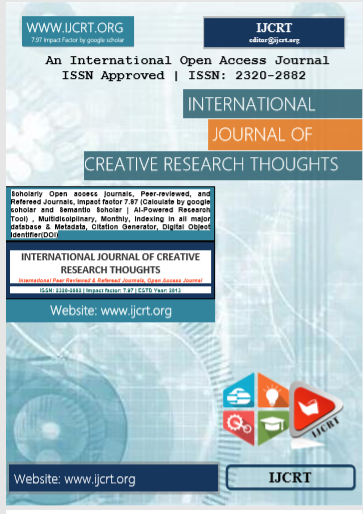
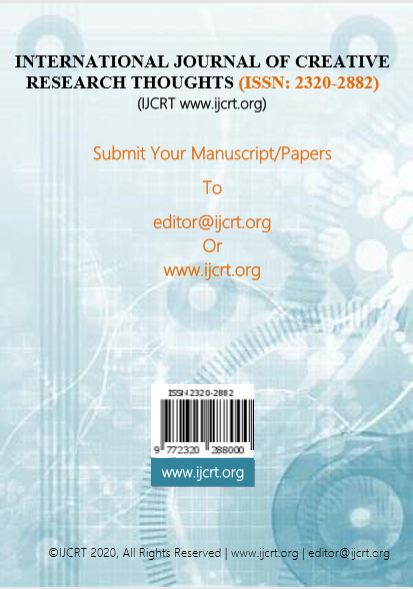
| IJCRT Journal front page | IJCRT Journal Back Page |
Paper Title: TRACING ANITA DESAI'S TRAUMATIC CHILDHOOD IN HER WORKS
Author Name(s): Hitkaran Ranawat, Neha
Published Paper ID: - IJCRT2512633
Register Paper ID - 299052
Publisher Journal Name: IJPUBLICATION, IJCRT
DOI Member ID: 10.6084/m9.doi.one.IJCRT2512633 and DOI :
Author Country : Indian Author, India, 311001 , bhilwara, 311001 , | Research Area: Arts All Published Paper URL: http://ijcrt.org/viewfull.php?&p_id=IJCRT2512633 Published Paper PDF: download.php?file=IJCRT2512633 Published Paper PDF: http://www.ijcrt.org/papers/IJCRT2512633.pdf
Your Paper Publication Details:
Title: TRACING ANITA DESAI'S TRAUMATIC CHILDHOOD IN HER WORKS
DOI (Digital Object Identifier) :
Pubished in Volume: 13 | Issue: 12 | Year: December 2025
Publisher Name : IJCRT | www.ijcrt.org | ISSN : 2320-2882
Subject Area: Arts All
Author type: Indian Author
Pubished in Volume: 13
Issue: 12
Pages: f609-f615
Year: December 2025
Downloads: 7
E-ISSN Number: 2320-2882
Abstract
Anita Desai's short story A Devoted Son offers a poignant exploration of the intricate dynamics between familial duty and personal autonomy within the Indian cultural context. This paper delves into the nuanced portrayal of the parent-child relationship. It focuses on the evolving bond between Rakesh, a dutiful son and accomplished doctor, and his ageing father, Varma. Through a critical analysis, the study examines how Desai articulates the tensions arising from generational expectations, the shifting roles within the family structure, and the psychological complexities that accompany ageing and caregiving. By integrating textual evidence and scholarly interpretations, the paper elucidates the delicate balance between respect, control, and compassion, ultimately questioning the true essence of devotion in familial relationships. In doing so, the paper not only underscores the emotional burden that filial piety can impose but also highlights the unspoken emotional rift that can develop within families when love becomes obligation and care transforms into control. , he story begins with Rakesh achieving academic excellence and his family celebrating his success. As Rakesh's career progresses, he becomes a renowned doctor, but his father's health deteriorates, leading to a shift in their dynamics. Rakesh, once an obedient and loving son, transforms into a controlling figure, imposing strict dietary restrictions and medication on his father. Despite the elderly Varma's pleas for a more relaxed approach to his health, Rakesh remains adamant. The story concludes with a poignant scene where Varma rejects Rakesh's medication, symbolizing his desire for a peaceful departure.
Licence: creative commons attribution 4.0
License
Creative Commons Attribution 4.0 and The Open Definition

Keywords
: Familial duty, parent-child relationship, ageing, filial piety, Indian culture
License
Creative Commons Attribution 4.0 and The Open Definition
Paper Title: Force Degradation And Stability Indicating Method For Impurity Profiling
Author Name(s): Todkar Dhanashree Gopinath, Prajakta Mhaske
Published Paper ID: - IJCRT2512632
Register Paper ID - 299022
Publisher Journal Name: IJPUBLICATION, IJCRT
DOI Member ID: 10.6084/m9.doi.one.IJCRT2512632 and DOI :
Author Country : Indian Author, India, 412208 , Pune, 412208 , | Research Area: Pharmacy All Published Paper URL: http://ijcrt.org/viewfull.php?&p_id=IJCRT2512632 Published Paper PDF: download.php?file=IJCRT2512632 Published Paper PDF: http://www.ijcrt.org/papers/IJCRT2512632.pdf
Your Paper Publication Details:
Title: FORCE DEGRADATION AND STABILITY INDICATING METHOD FOR IMPURITY PROFILING
DOI (Digital Object Identifier) :
Pubished in Volume: 13 | Issue: 12 | Year: December 2025
Publisher Name : IJCRT | www.ijcrt.org | ISSN : 2320-2882
Subject Area: Pharmacy All
Author type: Indian Author
Pubished in Volume: 13
Issue: 12
Pages: f598-f608
Year: December 2025
Downloads: 7
E-ISSN Number: 2320-2882
Abstract
Pharmaceutical products are vulnerable to degradation during manufacturing, storage, and distribution, which can adversely affect their safety, efficacy, and quality. Forced degradation (stress testing) is a systematic approach used during drug development to deliberately degrade active pharmaceutical ingredients (APIs) and drug products under exaggerated conditions such as hydrolytic, oxidative, photolytic, thermal, and humidity stress. Data generated from these studies support the development of stability-indicating analytical methods (SIAMs) that can selectively quantify the intact drug in the presence of its degradation products and impurities. Impurity profiling, which involves the detection, identification, characterization, and quantification of process- and degradation-related impurities, is essential to comply with International Council for Harmonisation (ICH) impurity guidelines and to ensure patient safety. This review summarizes the scientific principles of forced degradation, typical stress conditions, degradation mechanisms, and their relevance in understanding the intrinsic stability of drug substances. It further discusses the development and validation of stability-indicating methods, with emphasis on high-performance liquid chromatography (HPLC), liquid chromatography-mass spectrometry (LC-MS), nuclear magnetic resonance (NMR), Fourier transform infrared (FTIR) spectroscopy, and other hyphenated techniquesforimpurity profiling.Regulatory expectations from ICH Q1A(R2), Q1B, Q2(R1), Q3A(R2), and Q3B(R2), as well as USFDA and pharmacopeial recommendations, are highlighted. Concepts of mass balance and case studies on stability- indicating method development are also presented. Emerging trends such as high-resolution mass spectrometry, two-dimensional chromatography, chemometrics, and risk-based impurity assessment are briefly reviewed. Forced degradation and robust stability-indicating methods together form the backbone of impurity profiling strategies that ensure safe, effective, and stable pharmaceutical products throughout their shelf life.
Licence: creative commons attribution 4.0
License
Creative Commons Attribution 4.0 and The Open Definition
Keywords
Forced degradation; stress testing; stability-indicating method; impurity profiling; degradation products; HPLC; LC-MS; ICH guidelines; mass balance; drug stability
License
Creative Commons Attribution 4.0 and The Open Definition
Paper Title: ???? ?????? ???? ?? ????-??? ??? ??????? ????? & ?????? ?? ????????? (1990-2005)-?? ??????
Author Name(s): Prem Prabhat
Published Paper ID: - IJCRT2512631
Register Paper ID - 298971
Publisher Journal Name: IJPUBLICATION, IJCRT
DOI Member ID: 10.6084/m9.doi.one.IJCRT2512631 and DOI :
Author Country : Indian Author, India, 821115 , SASARAM, 821115 , | Research Area: Social Science All Published Paper URL: http://ijcrt.org/viewfull.php?&p_id=IJCRT2512631 Published Paper PDF: download.php?file=IJCRT2512631 Published Paper PDF: http://www.ijcrt.org/papers/IJCRT2512631.pdf
Your Paper Publication Details:
Title: ???? ?????? ???? ?? ????-??? ??? ??????? ????? & ?????? ?? ????????? (1990-2005)-?? ??????
DOI (Digital Object Identifier) :
Pubished in Volume: 13 | Issue: 12 | Year: December 2025
Publisher Name : IJCRT | www.ijcrt.org | ISSN : 2320-2882
Subject Area: Social Science All
Author type: Indian Author
Pubished in Volume: 13
Issue: 12
Pages: f591-f597
Year: December 2025
Downloads: 7
E-ISSN Number: 2320-2882
Abstract
???-??????: ??????? ??? ?? ?? ????? ????????? ?? ???? ??? ??? ????? ????????? ???? ?? ???????? ?? ?????? ?? ?????? ???????? ??????? ??, ????? ???????? ?? ?????? ?? ???? ????? ??? ?????? ????????? ??? ??? ?????? ?? ???? ??????? ??? ?? ??????? ????? ?? ?? ???????? ???? ????? ?????? ?? ?? ???? ??? ??? ?????? ?? ????? ?? ????? ???????? ?? ?? ?????? ??????? ?? ???? ??????? ????? ?? ??? ?? ???? ????? ?? ???????? ???? ????? ?? ???????? ?? ??? ??? ???????? ??? ??? ?? ?? ??? ?? ???? ?? ??? ?? ?????, ?????? ?? ???????? ?? ?????? ???????? ???? ????, ????? ??? ???? ?? ???? ?????? ?? 40 ???? ??? ???? ?? ??? ????: 1990 ??? ???? ?????? ???? ?? ??????? ??? ?? ??? ????? ??? ????? ??????? ??? ?? ?????? ?? ????? ?????? ?? ???????? ????????? ???? ?? ???? ????? ????????? ?? ??? ?????? ????? ?????? ?? ??? ??? ??????????????? ?? ?? ??? ???????? ??? ?? ?????? ?? ??? ?? ????? ?????? ?? ????? ??????????? ??? ??? ?????-?????? ?? ?????? ?? ??? ??????? ????? ??? ?? ????? ? ???? ??? ???? ??? ????? ??????? ?? ?? ??? ???? ??? ?? ??????? ???? ??? ?? ?????? ?? ??? ?? ?? ???? ??????????? ??? ????? ?? ??????? ?? ?????? ?????? ?????? ???? ???? ??? ??? ??? ??? ?? ????? ?? ????? ?? ??????? ?? ??? ??? ?? ????? ???????? ?????? ??? ?????? ?? ??????? ?? ?????????? ???????? ???? ??? ???
Licence: creative commons attribution 4.0
License
Creative Commons Attribution 4.0 and The Open Definition
Keywords
????? ????:??????? ?????, ????????, ?????, ???? ?????? ????, ?????, ???????, ??? ????????, ????? ??????
License
Creative Commons Attribution 4.0 and The Open Definition
Paper Title: Ultraviolet Spectroscopic Techniques For Quality Control And Impurity Detection In Pharmaceuticals
Author Name(s): Shelke Rutuja balaso, Vaishnavi Jadhav
Published Paper ID: - IJCRT2512630
Register Paper ID - 299059
Publisher Journal Name: IJPUBLICATION, IJCRT
DOI Member ID: 10.6084/m9.doi.one.IJCRT2512630 and DOI :
Author Country : Indian Author, India, 412403 , Pune, 412403 , | Research Area: Pharmacy All Published Paper URL: http://ijcrt.org/viewfull.php?&p_id=IJCRT2512630 Published Paper PDF: download.php?file=IJCRT2512630 Published Paper PDF: http://www.ijcrt.org/papers/IJCRT2512630.pdf
Your Paper Publication Details:
Title: ULTRAVIOLET SPECTROSCOPIC TECHNIQUES FOR QUALITY CONTROL AND IMPURITY DETECTION IN PHARMACEUTICALS
DOI (Digital Object Identifier) :
Pubished in Volume: 13 | Issue: 12 | Year: December 2025
Publisher Name : IJCRT | www.ijcrt.org | ISSN : 2320-2882
Subject Area: Pharmacy All
Author type: Indian Author
Pubished in Volume: 13
Issue: 12
Pages: f582-f590
Year: December 2025
Downloads: 7
E-ISSN Number: 2320-2882
Abstract
Ensuring pharmaceutical product quality and safety requires robust analytical methodologies throughout the drug development and manufacturing processes. Ultraviolet-visible (UV-Vis) spectroscopy has emerged as a fundamental analytical technique in pharmaceutical laboratories due to its operational simplicity, high sensitivity, cost-effectiveness, and regulatory acceptance. This review provides a comprehensive examination of UV spectroscopic applications specifically focused on pharmaceutical quality control and impurity detection. The fundamental principles of light absorption, the Beer-Lambert law, and electronic transitions in molecules are discussed in detail. Various pharmaceutical applications including compound identification, quantitative assay of active pharmaceutical ingredients, detection and quantification of impurities, analysis of degradation products, and dissolution testing are extensively reviewed. Method validation approaches aligned with International Conference on Harmonization (ICH) guidelines are elaborated, incorporating specificity, linearity, accuracy, precision, range, and robustness parameters. Regulatory compliance requirements established by major pharmacopeial standards including United States Pharmacopeia (USP), European Pharmacopoeia (EP), and related standards are discussed. The advantages and limitations of UV spectroscopy are critically analyzed, and emerging applications including diode array detection, chemometric integration, and process analytical technology are highlighted. This review demonstrates the continued significance of UV spectroscopy in pharmaceutical quality assurance and its substantial role in contemporary pharmaceutical analysis.
Licence: creative commons attribution 4.0
License
Creative Commons Attribution 4.0 and The Open Definition
Keywords
Uv- spectroscopy, pharmaceutical analysis, quality control, impurity detection, method validation, drug assay.
License
Creative Commons Attribution 4.0 and The Open Definition
Paper Title: Quantum Computing: Principles, Progress and Future Prospects
Author Name(s): Ayush
Published Paper ID: - IJCRT2512629
Register Paper ID - 299123
Publisher Journal Name: IJPUBLICATION, IJCRT
DOI Member ID: 10.6084/m9.doi.one.IJCRT2512629 and DOI :
Author Country : Indian Author, India, 176215 , Dharamshala , 176215 , | Research Area: Physics All Published Paper URL: http://ijcrt.org/viewfull.php?&p_id=IJCRT2512629 Published Paper PDF: download.php?file=IJCRT2512629 Published Paper PDF: http://www.ijcrt.org/papers/IJCRT2512629.pdf
Your Paper Publication Details:
Title: QUANTUM COMPUTING: PRINCIPLES, PROGRESS AND FUTURE PROSPECTS
DOI (Digital Object Identifier) :
Pubished in Volume: 13 | Issue: 12 | Year: December 2025
Publisher Name : IJCRT | www.ijcrt.org | ISSN : 2320-2882
Subject Area: Physics All
Author type: Indian Author
Pubished in Volume: 13
Issue: 12
Pages: f576-f581
Year: December 2025
Downloads: 6
E-ISSN Number: 2320-2882
Abstract
Abstract In recent studies, quantum computing has turned out as a new paradigm of computation and has been able to solve the problems with many classes of problems that are still unsolvable by ordinary classical machines. In contrast to the commutative architecture of binary computing, which needs bits being limited to either zero or one, quantum computing utilizes superposition, entanglement and unitary evolution, which permit computations on exponentially large spaces. This article provides a systematic coverage of the literal principles, quantum mathematical procedures, computer tumult, and the recent applications of the quantum technologies. It further examines the constraints of Noisy Intermediate-Scale Quantum (NISQ) devices and explains the possible ways that could be taken to achieve scalable, fault-tolerant architecture. The review highlights the importance of continuous interdisciplinary cooperation between physics, engineering, and computer science solutions that make quantum computing a feasible idea.
Licence: creative commons attribution 4.0
License
Creative Commons Attribution 4.0 and The Open Definition
Keywords
Keywords: Quantum Computing, Qubits, Superposition, Quantum Algorithms, NISQ
License
Creative Commons Attribution 4.0 and The Open Definition
Paper Title: A Review On Nanoparticle In Herbal Medicine
Author Name(s): Ms. Gauri Saybanna Bhange, Dr. Vijaykumar Kale, Dr. Mahesh Thakare, Mr. Vaibhav Narwade, Ms. Snehal Kadbhane
Published Paper ID: - IJCRT2512628
Register Paper ID - 298952
Publisher Journal Name: IJPUBLICATION, IJCRT
DOI Member ID: 10.6084/m9.doi.one.IJCRT2512628 and DOI :
Author Country : Indian Author, India, 411014 , Pune, 411014 , | Research Area: Pharmacy All Published Paper URL: http://ijcrt.org/viewfull.php?&p_id=IJCRT2512628 Published Paper PDF: download.php?file=IJCRT2512628 Published Paper PDF: http://www.ijcrt.org/papers/IJCRT2512628.pdf
Your Paper Publication Details:
Title: A REVIEW ON NANOPARTICLE IN HERBAL MEDICINE
DOI (Digital Object Identifier) :
Pubished in Volume: 13 | Issue: 12 | Year: December 2025
Publisher Name : IJCRT | www.ijcrt.org | ISSN : 2320-2882
Subject Area: Pharmacy All
Author type: Indian Author
Pubished in Volume: 13
Issue: 12
Pages: f568-f575
Year: December 2025
Downloads: 9
E-ISSN Number: 2320-2882
Abstract
One of the most revolutionary areas of contemporary pharmaceutical science is nanotechnology, which provides creative ways to get around the drawbacks of traditional drug delivery methods. Poor water solubility, instability, low bioavailability, quick metabolism, and limited absorption of numerous phytoconstituents are some of the difficulties faced by herbal medicine, despite its reputation for therapeutic efficacy, safety, and cultural acceptance. One potential solution to these issues is the use of nanotechnology in herbal preparations. The therapeutic efficacy of herbal medications can be greatly increased by encasing or delivering herbal actives through nanoparticles like polymeric nanoparticles, solid lipid nanoparticles (SLNs), nanostructured lipid carriers (NLCs), nanoemulsions, liposomes, metallic nanoparticles, and phytosomes. These nanosystems increase solubility, preserve bioactives from degradation, allow deep penetration into tissues, prolong systemic circulation, and provide controlled. Additionally, the "green synthesis" of nanoparticles can be made eco-friendly and biocompatible by using plant extracts as natural reducing and stabilising agents. The foundations, varieties, preparation processes, characterisation methods, benefits, difficulties, and wide range of therapeutic uses of nanoparticles in herbal medicine are the main topics of this review. By combining nanotechnology with traditional herbal knowledge, new treatment approaches that are safer, more effective, more scientifically advanced can be developed.
Licence: creative commons attribution 4.0
License
Creative Commons Attribution 4.0 and The Open Definition
Keywords
Herbal Nanomedicine, Nanoparticles, Herbal Nanoparticles, Nano-Drug Delivery Systems, Phytochemicals, Bioavailability Enhancement, Polymeric Nanoparticles, Lipid-Based Nanocarriers, Green Synthesis, Phytosomes
License
Creative Commons Attribution 4.0 and The Open Definition
Paper Title: Recent Advances In Nanoparticles In Drug Delivery System
Author Name(s): Prachi Rajendra Pisal, Mrs. Chaitali Ingawale, Dr. Vijaykumar Kale, Dr. Mahesh M. Thakare, Mr. Vaibhav Narwade
Published Paper ID: - IJCRT2512627
Register Paper ID - 299080
Publisher Journal Name: IJPUBLICATION, IJCRT
DOI Member ID: 10.6084/m9.doi.one.IJCRT2512627 and DOI :
Author Country : Indian Author, India, 415511 , Satara, 415511 , | Research Area: Pharmacy All Published Paper URL: http://ijcrt.org/viewfull.php?&p_id=IJCRT2512627 Published Paper PDF: download.php?file=IJCRT2512627 Published Paper PDF: http://www.ijcrt.org/papers/IJCRT2512627.pdf
Your Paper Publication Details:
Title: RECENT ADVANCES IN NANOPARTICLES IN DRUG DELIVERY SYSTEM
DOI (Digital Object Identifier) :
Pubished in Volume: 13 | Issue: 12 | Year: December 2025
Publisher Name : IJCRT | www.ijcrt.org | ISSN : 2320-2882
Subject Area: Pharmacy All
Author type: Indian Author
Pubished in Volume: 13
Issue: 12
Pages: f557-f567
Year: December 2025
Downloads: 7
E-ISSN Number: 2320-2882
Abstract
Nanotechnology has accelerated over the past forty years and shows no signs of slowing down. Nanotechnology-related innovations and products have transformed every facet of daily life, from the food sector to medical uses. Nanoparticles have improved the intracellular delivery of hydrophobic medications, greatly increased the shelf life of food products, and increased the effectiveness of some treatments like anticancer medicines. As a result, nanotechnology has affected both the global economy and the standard of living. This review discusses the properties of nanoparticles that give them appropriate and potentially harmful biological effects, as well as their uses in various biological domains and nanoparticle-based medications and delivery systems in biomedicine, including nano-based medications that are currently FDA-approved in the United States. The potential effects of ongoing nanoparticle exposure brought on by the growing usage of nanotechnology are also emphasized, along with potential remedies.
Licence: creative commons attribution 4.0
License
Creative Commons Attribution 4.0 and The Open Definition
Keywords
nanotechnology, nanoparticles, drug delivery systems, nanomedicine
License
Creative Commons Attribution 4.0 and The Open Definition
Paper Title: Sun Protection Factor
Author Name(s): Sakshi Bapu Mane, Dr.Vijaykumar Kale, Dr.Mahesh M. Thakare, Mr.Vaibhav Narwade, Miss.Mamata pawale
Published Paper ID: - IJCRT2512626
Register Paper ID - 299048
Publisher Journal Name: IJPUBLICATION, IJCRT
DOI Member ID: 10.6084/m9.doi.one.IJCRT2512626 and DOI :
Author Country : Indian Author, India, 415521 , Lonand , 415521 , | Research Area: Pharmacy All Published Paper URL: http://ijcrt.org/viewfull.php?&p_id=IJCRT2512626 Published Paper PDF: download.php?file=IJCRT2512626 Published Paper PDF: http://www.ijcrt.org/papers/IJCRT2512626.pdf
Your Paper Publication Details:
Title: SUN PROTECTION FACTOR
DOI (Digital Object Identifier) :
Pubished in Volume: 13 | Issue: 12 | Year: December 2025
Publisher Name : IJCRT | www.ijcrt.org | ISSN : 2320-2882
Subject Area: Pharmacy All
Author type: Indian Author
Pubished in Volume: 13
Issue: 12
Pages: f546-f556
Year: December 2025
Downloads: 6
E-ISSN Number: 2320-2882
Abstract
The Sun Protection Factor (SPF) is a crucial measure of a sunscreen's capacity to shield the skin against UV radiation-induced damage, especially UVB-induced erythema. Global awareness of the need for efficient photo protection techniques has risen due to growing environmental risks, ozone layer depletion, and greater outdoor exposure. This paper offers a thorough analysis of SPF, its scientific foundation, testing procedures, influencing variables, formulation improvements, and new technologies in sunscreen production. The kinds of UV radiation, their biological consequences, and the ways in which various sunscreens chemical, physical, and hybrid offer protection are all covered in this article. In-vitro and in-vivo SPF determination techniques, such as spectrophotometric tests, Minimal Erythema Dose (MED) evaluation, and worldwide regulatory standards, are also covered in detail. The disparity between labelled SPF and actual protection is emphasized by highlighting important aspects that impact SPF effectiveness, including film formation, photo stability, skin type, product vehicle, ambient circumstances, and customer behaviour. To illustrate the future course of photo protection science, cutting-edge discoveries including Nano encapsulation, antioxidant-enriched formulations, DNA repair enzymes, probiotic-supported sunscreens, hybrid UV filters, and smart UV-responsive technologies are examined. The article also covers environmental effects, safety concerns, and the growing popularity of biodegradable and reef-safe sunscreens. In order to enable researchers, formulators, doctors, and consumers better understand SPF, maximise sunscreen use, and investigate next-generation photo protective treatments, the study summarizes existing information and developing trends.
Licence: creative commons attribution 4.0
License
Creative Commons Attribution 4.0 and The Open Definition
Keywords
SPF, Sun Protection Factor, Sunscreen, Ultraviolet Radiation, UVB Protection, UVA Protection, Photo protection, Nano encapsulation, UV Filters, Photo stability, Broad-Spectrum Sunscreen, Antioxidants, Film-Forming Agents, Herbal Sunscreens, Smart Sunscreens, Reef-Safe Sunscreens.
License
Creative Commons Attribution 4.0 and The Open Definition
Paper Title: An Experimental Study of Second Language Acquisition through English Literature among Indian Engineering Undergraduate ESL Learners
Author Name(s): Dr. Nakeeb Ahmad Khanday, Mridula Khaskalam, Avnish Pandey
Published Paper ID: - IJCRT2512625
Register Paper ID - 299054
Publisher Journal Name: IJPUBLICATION, IJCRT
DOI Member ID: 10.6084/m9.doi.one.IJCRT2512625 and DOI :
Author Country : Indian Author, India, 192221 , ANANTNAG, 192221 , | Research Area: Languages Published Paper URL: http://ijcrt.org/viewfull.php?&p_id=IJCRT2512625 Published Paper PDF: download.php?file=IJCRT2512625 Published Paper PDF: http://www.ijcrt.org/papers/IJCRT2512625.pdf
Your Paper Publication Details:
Title: AN EXPERIMENTAL STUDY OF SECOND LANGUAGE ACQUISITION THROUGH ENGLISH LITERATURE AMONG INDIAN ENGINEERING UNDERGRADUATE ESL LEARNERS
DOI (Digital Object Identifier) :
Pubished in Volume: 13 | Issue: 12 | Year: December 2025
Publisher Name : IJCRT | www.ijcrt.org | ISSN : 2320-2882
Subject Area: Languages
Author type: Indian Author
Pubished in Volume: 13
Issue: 12
Pages: f540-f545
Year: December 2025
Downloads: 8
E-ISSN Number: 2320-2882
Abstract
The present study examines the efficacy of English literature as a pedagogical tool for developing second language acquisition (SLA) among Indian engineering undergraduate English as second language (ESL) learners. In Indian higher education, engineering students are required to possess strong English communication skills for academic success, professional growth, and global employability. However, despite prolonged exposure to English, many learners continue to demonstrate inadequate communicative competence. This research adopts an experimental design involving a control group and an experimental group to examine whether literature-based instruction is more effective than traditional ESL teaching methods. A sample of 80 first-year engineering students was equally divided into the two groups. The control group was taught using conventional language teaching methods, whereas the experimental group was exposed to selected English literary texts, including short stories, novels, and plays. Pre-test and post-test scores measuring reading, writing, vocabulary, grammar, and speaking skills were statistically analyzed. The findings reveal a significant development in overall language proficiency among students who received literature-based teaching. The study concludes that English literature plays a vital role in developing linguistic competence, communicative skills, and cultural awareness among Indian engineering undergraduate ESL learners.
Licence: creative commons attribution 4.0
License
Creative Commons Attribution 4.0 and The Open Definition
Keywords
Experimental Study, Second Language Acquisition, English Literature, ESL Learners, Engineering Undergraduates, Indian Context
License
Creative Commons Attribution 4.0 and The Open Definition
Paper Title: The Role of Law Enforcement in Preventing Online Crimes against Children in India
Author Name(s): CHENNAMPALLI NARESHBABU
Published Paper ID: - IJCRT2512623
Register Paper ID - 299099
Publisher Journal Name: IJPUBLICATION, IJCRT
DOI Member ID: 10.6084/m9.doi.one.IJCRT2512623 and DOI :
Author Country : Indian Author, India, 515001 , Ananthapuramu, 515001 , | Research Area: Others area Published Paper URL: http://ijcrt.org/viewfull.php?&p_id=IJCRT2512623 Published Paper PDF: download.php?file=IJCRT2512623 Published Paper PDF: http://www.ijcrt.org/papers/IJCRT2512623.pdf
Your Paper Publication Details:
Title: THE ROLE OF LAW ENFORCEMENT IN PREVENTING ONLINE CRIMES AGAINST CHILDREN IN INDIA
DOI (Digital Object Identifier) :
Pubished in Volume: 13 | Issue: 12 | Year: December 2025
Publisher Name : IJCRT | www.ijcrt.org | ISSN : 2320-2882
Subject Area: Others area
Author type: Indian Author
Pubished in Volume: 13
Issue: 12
Pages: f523-f530
Year: December 2025
Downloads: 6
E-ISSN Number: 2320-2882
Abstract
Children's online safety has become a critical national concern as the digital environment exposes them to cyberbullying, online grooming, sexual exploitation, trafficking, financial fraud, and harmful content. This paper examines the pivotal role of police in safeguarding children from online crime at the national level. It analyses the preventive, investigative, and response-oriented functions of law enforcement agencies in addressing cyber offences against children. The study explores the national legal and policy frameworks--such as the Information Technology Act, BNS, 2023, POCSO Act, and the Cybercrime Prevention against Women and Children (CCPWC) Scheme--that guide police actions in digital child protection. The abstract further highlights the essential coordination between national police bodies, cyber forensic units, social media platforms, child welfare organizations, and educational institutions in effectively combating online threats. It also discusses the emerging challenges faced by law enforcement, including rapid technological changes, resource limitations, capacity-building needs, encrypted platforms, and darknet-based exploitation. Finally, the paper outlines effective national-level strategies and best practices adopted by the police to strengthen online child safety, enhance digital resilience, and improve protection outcomes across the country.
Licence: creative commons attribution 4.0
License
Creative Commons Attribution 4.0 and The Open Definition
Keywords
Online cyber Crime, Police, Role of Law Enforcement, Best Strategies Children's online safety, Police role, Child protection, National-level policing, POCSO Act, BNS-2023, IT Act, CCPWC Scheme, Cyber forensic units.
License
Creative Commons Attribution 4.0 and The Open Definition
Call For Paper December 2025
Call For Papers
December 2025
Volume 13 | Issue 12
Last Date :
31-Dec-2025
Submit Manuscript Online Impact Factor: 7.97 Review Results : Within 02-03 Days Paper Publication : Within 02-03 Days
December 2025
Volume 13 | Issue 12
Last Date :
31-Dec-2025
Submit Manuscript Online Impact Factor: 7.97 Review Results : Within 02-03 Days Paper Publication : Within 02-03 Days
Published Issue Details
For Authors
Forms / Downloads
Other IMP Links
Indexing Partner
Research Area
LICENSE





ISSN and 7.97 Impact Factor Details

ISSN: 2320-2882 Impact Factor: 7.97 and ISSN APPROVED Journal Starting Year (ESTD) : 2013


ISSN and 7.97 Impact Factor Details
ISSN: 2320-2882 Impact Factor: 7.97 and ISSN APPROVED Journal Starting Year (ESTD) : 2013
DOI Details
CONFERENCE
CONFERENCE MANAGMENT & PUBLICATION CONFERENCE PROPOSAL
RECENT CONFERENCE

CONFERENCE PROPOSAL CONFERENCE PROCEEDINGS
CONFERENCE PROPOSAL CONFERENCE PROCEEDINGS
For Reviewer /Referral (RMS) Earn 500 per paper
Important Links
NEWS & Conference
Digital Library
IJCRT RMS | Earn 500 Per Paper.

Open Access


LICENSE
Indexing Partner
Scholarly open access journals, Peer-reviewed, and Refereed Journals, Impact factor 7.97 (Calculate by google scholar and Semantic Scholar | AI-Powered Research Tool) , Multidisciplinary, Monthly, Indexing in all major database & Metadata, Citation Generator, Digital Object Identifier(DOI)